What you get from a literature review writing project
Each engagement is delivered as a complete bundle so you can drop the review straight into your thesis, manuscript, or grant document, and you are matched with a PhD methodologist published in your field. We write for researchers across health sciences, nursing, psychology, education, social sciences, and beyond, and we scope each project depending on whether your question calls for a narrative or systematic approach. Every review is built on thematic organization rather than a source-by-source summary, with theoretical and conceptual framing, a transparent search, disciplined citation management, and a gap identification that positions your own contribution. Published examples of our work are available on the ask to see our sample deliverables page.
- Documented search strategy for PubMed, Scopus, Web of Science, Google Scholar, or the domain-specific databases your topic calls for, with the search strings, dates, and filters used. When the search itself is the deliverable, our search strategy service service builds and documents the strings as a standalone piece.
- Screening log showing the records found, the records read, and the final included set, with a short justification per excluded source.
- Thematic synthesis structured around the research question, with sub-headings that mirror your dissertation outline or your manuscript's argument.
- Theoretical framework section when the review supports a thesis chapter, identifying the underlying theory or model that organises the evidence.
- Critical gap analysis that explains what the field is missing and why your study addresses that gap.
- Inline citations in your required style: APA 7, AMA, Vancouver, Harvard, or Chicago.
- Reference manager file in EndNote (.enl), Zotero (.bib or .ris), or Mendeley format. You can re-import the file and edit citations yourself later.
- Plagiarism report confirming originality of the writing.
- Written structure walkthrough from the lead writer confirming the outline and theme order before final delivery.
Narrative literature review vs systematic review vs scoping review
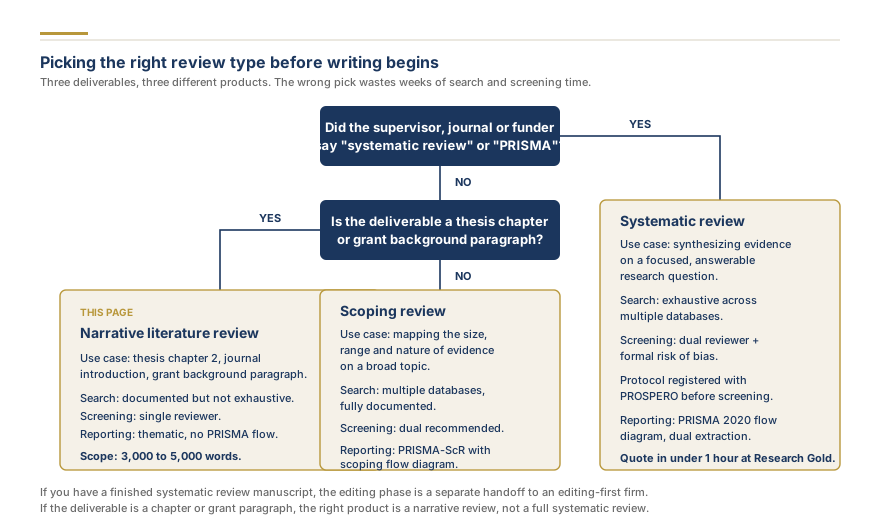
These three deliverables are different products. Picking the wrong one wastes time and money. Use the table to choose.
| Deliverable | When to use | Search | Screening | Reporting standard |
|---|---|---|---|---|
| Narrative literature review (this page) | Thesis chapter 2, journal introduction, grant background | Documented but not exhaustive | Single reviewer | Thematic, no PRISMA flow |
| Scoping review | Mapping the size, range, and nature of evidence on a broad topic | Multiple databases, fully documented | Dual screening recommended | PRISMA-ScR, scoping flow diagram |
| Systematic review | Synthesizing evidence on a focused, answerable research question | Exhaustive multi-database search, registered protocol | Dual screening, formal risk-of-bias | PRISMA 2020, registered with PROSPERO |
If your supervisor, journal, or funder used the words "systematic review" or "PRISMA flow diagram", you need the professional systematic review support, not this service. If the language was "scoping review" or "evidence map", use the scoping review service. If the deliverable is a thesis chapter or a grant background paragraph, this is the right service.
Where this service is the right fit
Thesis chapter 2 (the literature review chapter)
Most masters and doctoral programs require a literature review chapter that establishes the theoretical framework and the empirical state of the field. We write this chapter to your university's specifications: word count, citation style, and chapter structure. The deliverable includes the theoretical framework sub-section, the thematic synthesis sub-sections (typically three to five themes), the critical gap analysis, and the positioning paragraph that links the gap to your research question.
Journal article introduction (background section)
When a journal manuscript needs a stronger background section than a single page can hold, we write a 1,500 to 3,000 word literature review that lives in the introduction or a separate background section. This is common in narrative reviews submitted to journals such as the International Journal of Educational Research, Journal of Business Research, or Public Health Reviews, and in clinical narrative reviews where the journal does not require PRISMA.
Grant proposal background
R01, R03, R21, NIHR, ESRC, MRC, and Wellcome proposals all require a background section that establishes the evidence base for your aims. We write this section to fit the page limits of the funder template, with citations in the funder's preferred style. The grant background is bundled with our grant methodology writing service when the proposal also needs the methods section drafted.
Theoretical framework write-up
For doctoral candidates working in fields where the framework section is its own task (education, sociology, management, nursing theory), we write a standalone framework chapter that engages with the primary theorists and translates the framework into testable propositions for your study.
Standalone narrative review for journal submission
Some journals publish narrative reviews as their own article type. We write 6,000 to 10,000 word standalone narrative reviews to AMA or APA style, with a structured abstract, a documented search, a thematic synthesis, an implications section, and a reference list of 80 to 200 citations. Where a journal expects a defensible quality standard, we structure these reviews against SANRA, a scale for the quality assessment of narrative review articles (Baethge et al., 2019), so the search, synthesis, and referencing withstand editorial scrutiny.