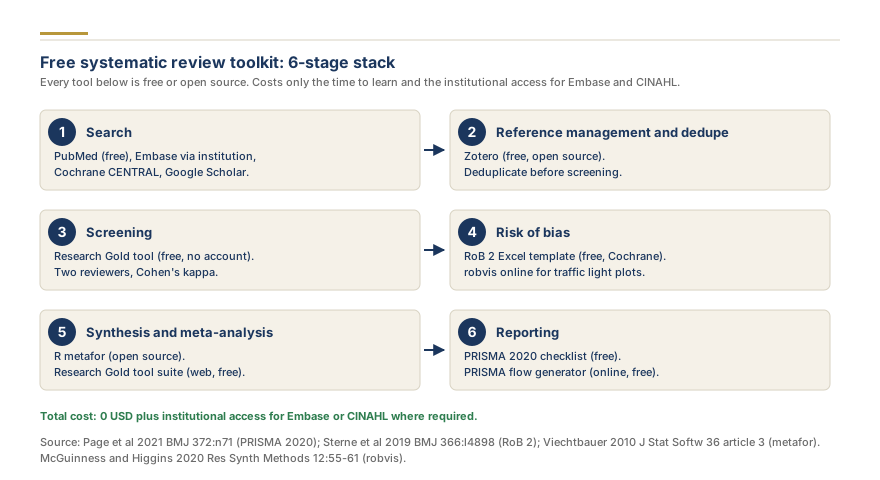
Covidence alternatives include Research Gold's screening tool (free tier: 3 projects with 20,000 records each, PRISMA diagram included), Rayyan (free tier), ASReview (free, open-source), SysRev (free), RevMan (free from Cochrane), EPPI-Reviewer (free for UK institutions), DistillerSR (paid enterprise), and Nested Knowledge (paid with automation). The strongest free option for the screening step itself is the free screening tool from Research Gold, which delivers two-reviewer title and abstract screening with Cohen's kappa agreement scoring in your browser at no cost. Covidence remains the most widely used screening and data extraction platform for systematic reviews, but its pricing model, which charges $339 USD per year for a single review as of mid 2026 with no monthly option and no student discount, creates a significant barrier for unfunded researchers, graduate students, and teams in low-resource settings. This comparison evaluates each alternative on pricing, screening capabilities, collaboration features, data extraction support, and overall fit for different research contexts.
The 8 Alternatives at a Glance
| # | Tool | Cost | Pick it when |
|---|---|---|---|
| 1 | Research Gold screening tool | Free tier (3 projects, 20,000 records each); Pro $12 per month | You want free two-reviewer screening with the PRISMA diagram, Cohen's kappa, and self-serve AI screening |
| 2 | Rayyan | Free tier; Essential from $8.33 per month billed quarterly | You screen on mobile and can live without a PRISMA diagram on the free tier |
| 3 | DistillerSR | Enterprise, roughly $4,000 to $8,000 per year | Your organization runs reviews as a core business with compliance needs |
| 4 | EPPI-Reviewer | Free for UK institutions; roughly $500 per year otherwise | You are UK-based or need built-in meta-analysis with text mining |
| 5 | ASReview | Free, open source | You screen solo, want active-learning AI, and are comfortable with setup |
| 6 | SysRev | Free for public projects | You run open-science projects and will share the data |
| 7 | Nested Knowledge | Free tier; paid from roughly $500 per year per user | You need living reviews and interactive evidence maps |
| 8 | RevMan | Free | You are writing a Cochrane review or need free built-in meta-analysis |
Each tool gets a full breakdown below, followed by a feature-by-feature comparison table and a worked zero-budget workflow for a 4,000-record review.
Why Researchers Look Beyond Covidence
The most common reason researchers seek Covidence alternatives is cost. Covidence offers a free trial, but it restricts you to a single review capped at 500 records. Once your search returns more than that, or you want a second project, you must upgrade to a paid subscription.
As of mid 2026, the Single plan costs $339 USD per year for exactly one review, and the Package plan costs $907 USD per year for up to three reviews. Both are valid for 12 months, which means an active review is effectively rented each year rather than owned. There is no monthly billing option, self-serve purchases require a credit card, and Covidence's own pricing FAQ states plainly that they do not offer a student discount. Institutional pricing is not published at all; libraries must contact sales.
Beyond pricing, researchers cite several other reasons for exploring alternatives. Limited customization of data extraction forms frustrates teams conducting reviews with complex or non-standard outcomes. The platform's lack of built-in meta-analysis means you need separate software (such as R with the metafor package or RevMan) to analyze your extracted data. Some researchers also find that Covidence's rigid workflow, while excellent for Cochrane-style reviews, does not adapt well to scoping reviews, rapid reviews, or integrative reviews that follow different methodological frameworks.
The JBI Manual for Evidence Synthesis and the Cochrane Handbook both acknowledge that multiple software platforms can support rigorous systematic review conduct. No single tool holds a monopoly on methodological quality.
Covidence Pricing Explained
Covidence pricing as of mid 2026 has four levels, and the structure matters as much as the sticker price because plans are sold per review, not per user.
| Plan | Price (as of mid 2026) | What you get |
|---|---|---|
| Free trial | $0 | 1 review, capped at 500 records |
| Single | $339 USD per year | 1 review, unlimited collaborators, valid 12 months |
| Package | $907 USD per year | Up to 3 reviews, unlimited collaborators, valid 12 months |
| Organizations | Contact sales (no price published) | Unlimited reviews, users, and collaborators |
Five details of the Covidence cost model catch buyers off guard:
- Plans are valid for 12 months. A review that stays active for three years costs $339 per year every year, so long-running or living reviews accumulate cost.
- There is no monthly option. The smallest self-serve purchase is a full year, paid by credit card only.
- There is no student discount. Covidence's own pricing FAQ states they do not offer an additional student discount. Concessions exist only for researchers in low- and middle-income countries.
- The gap between 3 reviews and unlimited is awkward. Teams needing 4 to 9 concurrent reviews are told to stack multiple $907 Packages or ask their library to buy an institutional license.
- Institutional pricing is unpublished. Organizational access is sales-led and typically brokered through a university librarian.
The one genuinely generous element is unlimited collaborators on every paid plan, including Single. If your whole team works on one review, $339 covers everyone.
Is Covidence Free?
Not in any practical sense. The Covidence free trial gives you one review capped at 500 records. A typical systematic review search across MEDLINE, Embase, and CENTRAL returns several thousand records before deduplication, so most real projects exhaust the trial before finishing title and abstract screening. The trial works as an interface test drive, not as a free tier you can complete a review on.
If you need a genuinely free starting point, the comparison below includes options with materially higher free limits: Research Gold's free tier covers three projects of up to 20,000 records each with the PRISMA diagram and deduplication included, ASReview is fully open source, and RevMan is free from Cochrane.
How Covidence Works
For readers evaluating the platform itself, here is the documented Covidence workflow from import to export:
- Create a review and set criteria. Choose the review type, invite co-reviewers by email (any affiliation), define PICOS-structured eligibility criteria, and pick single or dual reviewer mode.
- Import references. Covidence accepts EndNote XML, PubMed format, and RIS files in batches of up to 15,000 records (50 MB maximum, one file at a time), and assigns each import a source for PRISMA tracking.
- Deduplicate. Deduplication runs automatically on every import. It is deliberately strict, so some duplicates slip through; reviewers mark leftovers manually during screening.
- Screen titles and abstracts. Default two votes per study with Yes, No, or Maybe, keyword highlighting, and an AI "most relevant" sort that activates after 25 manual votes. Conflicts route to a resolution queue.
- Review full texts. Covidence auto-retrieves open access PDFs via Unpaywall (this cannot be turned off), you bulk-upload the rest, and reviewers vote with customizable exclusion reasons.
- Extract data and assess quality. Choose between two extraction modules: Extraction 1 feeds RevMan for Cochrane-style intervention reviews, while the customizable Extraction 2 cannot export to RevMan. The default quality template is based on the original Cochrane risk of bias tool; RoB 2 is not supported in-app.
- Export. Download the auto-built PRISMA 2020 diagram as an editable DOCX, export references as RIS or CSV, and send extraction data to Excel or RevMan Web. Meta-analysis happens outside Covidence in RevMan, R, or Stata.
The workflow is polished for Cochrane-style intervention reviews. The friction appears at the edges: the two extraction modules are incompatible, consensus submission is irreversible, and analysis always requires a second tool.
Covidence vs Rayyan: Quick Comparison
The most common head-to-head decision is Covidence against Rayyan, so here is the factual picture as of mid 2026, with Research Gold's screening tool included as the reference point on each row:
| Covidence | Rayyan | Research Gold | |
|---|---|---|---|
| Entry price | $339 per year for 1 review, no monthly plan | $8.33 per month billed quarterly (Essential), no monthly billing | Free tier, then $12 per month or $99 per year |
| Free tier | Trial capped at 500 records | 3 reviews, but no PRISMA diagram and no automatic duplicate resolution | 3 projects, 20,000 records each, PRISMA diagram and deduplication included |
| AI screening for individuals | Declined to release LLM screening | ResearchPilot AI restricted to institutional plans per their help center | Self-serve from $12 per month |
| Mobile | No app; browser screening for titles and abstracts only | Native iOS and Android app | Responsive web |
| Published accuracy numbers | RCT classifier only (over 99.5 percent recall at RCT tagging) | None published | 99.1 percent recall (229 of 231 relevant records) measured across five published benchmark datasets, with every decision human-confirmed |
Covidence wins on end-to-end structure and Cochrane pedigree. Rayyan wins on mobile screening and free-tier project count. If your deciding factor is verifiable AI screening accuracy at an individual price, neither delivers it. For a switcher-focused breakdown of Rayyan's own ecosystem, see our guide to the strongest alternatives to Rayyan.
Tool-by-Tool Comparison
1. Research Gold Screening Tool (Free Tier, Pro from $12 per Month)
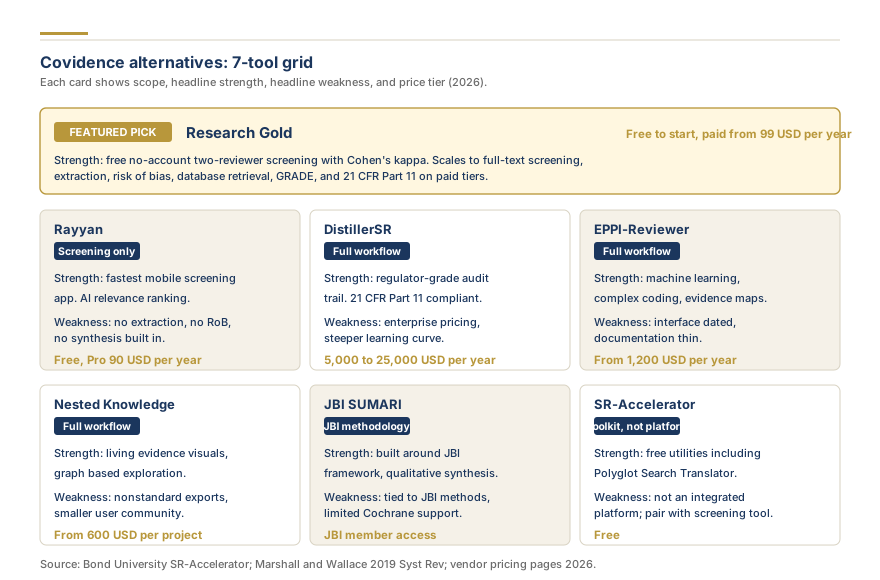
Research Gold is the most complete Covidence alternative on this list. The title and abstract screening tool saves privately to your account, ranks records by relevance, lets two independent reviewers reconcile their decisions with Cohen's kappa agreement scoring, and, unlike either Covidence or Rayyan, publishes a measured accuracy benchmark: the AI screening kept 99.1 percent of relevant records (229 of 231) across five published benchmark datasets, relevance ranking achieved a work saved over sampling at 95 percent recall (WSS@95) of 69 to 93 percent across those datasets, and deduplication caught 97.4 percent of duplicates with zero wrong merges.
Pricing: The free tier covers 3 projects of up to 20,000 records each, with the PRISMA flow diagram and deduplication included, ten times the Covidence trial cap per project. Pro costs $12 per month or $99 per year with unlimited projects and self-serve AI screening. Team/Lab starts at $390 per year for five seats, Institution at $3,000 per year (pricing published, unlike Covidence), and Enterprise is quoted.
Key features by tier:
- Free: 3 projects with 20,000 records each, a relevance-ranked screening queue, blind two-reviewer mode with Cohen's kappa computed in-app, automatic deduplication, a live PRISMA 2020 flow diagram, 7 free database connectors (PubMed, Europe PMC, OpenAlex, Semantic Scholar, Crossref, DOAJ, and ClinicalTrials.gov), citation chasing (snowballing), and reviews that save privately to your account automatically. Plus a full suite of free companion utilities: a PRISMA flow diagram generator, a data extraction template builder, a reference deduplication tool, an inclusion and exclusion criteria builder in PICOS format, a Cohen's d and Hedges' g calculator, forest plot generation, and risk of bias visualization.
- Pro ($12/month or $99/year): Unlimited projects, self-serve AI screening against your own eligibility criteria with the published benchmark above, full-text PDF screening, structured data extraction, a complete audit trail, an interactive PRISMA checklist, a methods-section generator, custom RevMan and Cochrane exports, and automated retraction checks.
- Team / Lab (from $390/year, five seats): Blinded dual screening, a conflict dashboard with tiebreak adjudication, roles and permissions, inter-rater reliability analytics, risk of bias modules (RoB 2, ROBINS-I, NOS), and living-review updating.
- Institution (from $3,000/year): GRADE certainty assessment, single sign-on (SSO/SAML/SCIM), an admin console, and usage analytics.
- Enterprise / Pharma (custom): 21 CFR Part 11 compliance with electronic signatures and validation documentation, data residency with BAA and SOC 2, a REST API with REDCap integration, and immutable audit logs.
Pros: The free tier already includes the two features Rayyan withholds from its free plan (PRISMA diagram and automatic deduplication) at ten times Covidence's trial record cap. It is the only tool of the three that publishes measured accuracy numbers on a named public dataset, and the only one where an individual can buy AI-assisted screening without an institutional sales cycle. Database connectors and citation chasing mean you can search, import, and screen in one place.
Cons: No native mobile app (the web interface is responsive). The platform is younger than Covidence and Rayyan, so it has a smaller citation footprint in published methods sections. GRADE is reserved for the Institution tier.
Best for: Everyone from graduate students and unfunded researchers who need a genuinely free screening platform with PRISMA output, up to labs and institutions that want one tool covering retrieval, screening, extraction, risk of bias, and compliance without switching software mid-review.
2. Rayyan (Free Tier with Paid Plans)
Rayyan is the most popular free-tier alternative to Covidence, originally developed at the Qatar Computing Research Institute and now operated by Rayyan Systems in Cambridge, Massachusetts. It centers on title and abstract screening and has been cited in thousands of published systematic reviews through the widely referenced Ouzzani et al. 2016 paper.
Pricing (as of mid 2026): Free forever for 3 active reviews with 2 free reviewer invitations. Essential costs $8.33 per month billed quarterly, or $4.99 per seat per month billed annually. Advanced costs $13.33 per month billed quarterly, or $8.33 per seat per month billed annually. There is no monthly billing option; the smallest commitment is a quarter. Business/Academic and Enterprise plans are custom quoted with a 5-license minimum.
Key features: Blind screening mode for independent reviewer decisions, strong duplicate detection with confidence scores, keyword highlighting, labeling and categorization, a 5-star relevance ranking classifier, a native mobile app with offline screening, and a risk of bias workspace supporting RoB 2, ROBINS-I, QUADAS-2, Newcastle-Ottawa, JBI, and AMSTAR 2 frameworks. Imports cover RIS, BibTeX, CSV, and most database export formats.
Pros: The free tier costs nothing forever and handles three concurrent reviews. The machine learning predictions help prioritize likely-relevant records during screening. The mobile app is the best in the category. The risk of bias framework breadth exceeds Covidence.
Cons: The free tier excludes the PRISMA flow diagram and automatic duplicate resolution, the two outputs beginners need most, and caps mobile use at 100 decisions. The flagship ResearchPilot AI (AI Reviewer, auto extraction) is available only on institutional plans according to Rayyan's own help center, even though the Advanced plan card advertises AI agents, so individuals cannot buy it at any price. No accuracy numbers are published for any AI feature.
Best for: Graduate students and teams that primarily need free multi-project screening with a mobile app and plan to use separate tools for data extraction methodology and PRISMA reporting.
For a detailed head-to-head comparison, see our guide on Covidence vs Rayyan.
3. DistillerSR (Paid Enterprise)
DistillerSR by Evidence Partners targets organizations conducting multiple systematic reviews simultaneously. It is the most feature-rich alternative to Covidence and competes directly at the enterprise level.
Pricing: Custom enterprise pricing, typically starting around $4,000 to $8,000 per year for institutional licenses. Individual pricing is not publicly listed. Free trials are available.
Key features: AI-powered reference prioritization that learns from reviewer decisions in real time, fully customizable data extraction forms, built-in quality assessment templates (including Cochrane Risk of Bias 2.0, Newcastle-Ottawa Scale, and AMSTAR 2), automated PRISMA flow diagrams, and comprehensive audit trails for regulatory compliance.
Pros: The most complete systematic review management platform available. AI prioritization can reduce screening time by 30 to 50 percent according to Evidence Partners. Extremely customizable forms adapt to any review type. Enterprise-grade security and compliance features suit hospital systems and government agencies.
Cons: The highest price point of any tool on this list. The learning curve is steeper than Covidence. Smaller teams may find the feature set overwhelming. Setup and configuration require more upfront investment than simpler tools.
Best for: Health technology assessment agencies, Cochrane review groups, hospital evidence synthesis units, and organizations that produce systematic reviews as a core business function.
4. EPPI-Reviewer (Free for UK Institutions)
EPPI-Reviewer is developed by the Evidence for Policy and Practice Information and Co-ordinating Centre at University College London. It has supported evidence synthesis in education, health, and social policy for over two decades.
Pricing: Free for UK higher education and public sector institutions through JISC licensing. International users can access it through institutional agreements or paid subscriptions starting at approximately $500 per year.
Key features: Full workflow coverage from protocol to synthesis, text mining and machine learning for screening prioritization, customizable coding frameworks, built-in meta-analysis capabilities (one of the few tools that includes this), support for qualitative and mixed-methods synthesis, and integration with reference databases.
Pros: The built-in meta-analysis module eliminates the need for separate statistical software for basic analyses. Text mining tools genuinely accelerate screening. Supports review types beyond traditional systematic reviews, including qualitative evidence syntheses and mixed-methods reviews. Long track record in published research.
Cons: The interface feels dated compared to Covidence and Rayyan. The learning curve is significant, particularly for the text mining features. Performance can lag with very large datasets. Documentation could be more comprehensive for new users.
Best for: UK-based researchers (where it is free), teams conducting policy-relevant reviews, and researchers who need built-in statistical analysis without purchasing additional software.
5. ASReview (Free, Open-Source, AI-Powered)
ASReview (Active learning for Systematic Reviews) is an open-source tool developed at Utrecht University that uses active learning to dramatically reduce screening workload.
Pricing: Completely free and open-source. No premium tier, no usage limits, no institutional requirements.
Key features: Active learning algorithms that continuously reorder records based on your screening decisions, placing the most likely relevant studies at the top of your queue. Supports multiple classifier models. Simulation mode lets you benchmark performance against fully screened datasets. Runs locally on your machine or through a hosted version.
Pros: The AI screening assistance is genuinely transformative. Published validation studies show that ASReview can identify 95 percent of relevant records after screening only 10 to 30 percent of the total library. Completely free with no restrictions. Active open-source community with regular updates. Privacy-friendly because data can stay on your local machine.
Cons: Focuses exclusively on screening. No data extraction, no quality assessment, no collaboration features built in. Requires some technical comfort to install locally (though the web version reduces this barrier). The tool assumes you will use other software for subsequent review steps.
Best for: Solo researchers or small teams who want to reduce screening time dramatically and are comfortable using separate tools for data extraction, quality assessment, and analysis.
6. SysRev (Free)
SysRev is a free, web-based platform that supports collaborative screening and data extraction for systematic reviews, with a unique emphasis on transparency and open data.
Pricing: Free for public (open-access) projects. Private projects require a paid subscription.
Key features: Collaborative screening with conflict resolution, customizable data extraction labels, machine learning-assisted screening, project analytics and reviewer agreement metrics, and the ability to share completed reviews as open datasets.
Pros: Genuinely free for open projects. The data extraction system is more flexible than Rayyan's. Reviewer agreement metrics help identify screening inconsistencies early. The open-data philosophy aligns well with transparent research practices.
Cons: The interface is less polished than Covidence or Rayyan. The user community is smaller, which means fewer tutorials and less peer support. Private projects require payment. Limited integration with reference management software compared to competitors.
Best for: Researchers committed to open science who want free screening and data extraction in a single platform, and who do not require their project data to remain private.
7. Nested Knowledge (Paid with Automation)
Nested Knowledge differentiates itself by combining systematic review management with automated evidence mapping and interactive visualizations.
Pricing: Free tier available with limited features. Paid plans start at approximately $500 per year per user, with institutional pricing available.
Key features: Automated search updates that monitor databases for new publications matching your search strategy. Interactive evidence maps that visualize relationships between studies, interventions, and outcomes. Integrated screening, data extraction, and meta-analysis in a single platform. Living systematic review support with continuous updating.
Pros: The evidence mapping and visualization features are unique among systematic review tools. Living review support keeps your review current without starting over. The integrated meta-analysis module means fewer tools in your workflow. Modern interface with a thoughtful user experience.
Cons: Relatively new compared to established platforms, so fewer published validation studies exist. The pricing sits between free tools and enterprise solutions, which may not satisfy either budget-constrained or feature-demanding teams. Smaller user base means fewer community resources.
Best for: Researchers conducting living systematic reviews or those who need interactive evidence maps for stakeholder communication. Also suits teams wanting screening, extraction, and analysis in one platform.
8. RevMan (Free from Cochrane)
RevMan (Review Manager) is Cochrane's official software for preparing and maintaining systematic reviews. RevMan Web is the current cloud-based version.
Pricing: Free for all users. No premium tier. Cochrane provides RevMan at no cost to support evidence synthesis globally.
Key features: Full systematic review workflow from protocol registration through publication. Built-in meta-analysis engine with forest plots, funnel plots, and subgroup analysis. Risk of bias assessment tools aligned with the Cochrane Risk of Bias 2.0 framework. Direct publishing to the Cochrane Library for Cochrane review authors. GRADE evidence certainty assessment.
Pros: Completely free with full functionality. The gold standard for Cochrane reviews with direct integration into Cochrane editorial processes. Built-in statistical analysis eliminates the need for R or Stata for standard meta-analyses. Extensive documentation and training resources through the Cochrane Handbook.
Cons: Designed primarily for Cochrane reviews, so the workflow may feel rigid for non-Cochrane projects. The screening module is less sophisticated than Covidence or Rayyan. Import options are more limited than dedicated screening tools. The interface, while improved in RevMan Web, still prioritizes function over aesthetics.
Best for: Cochrane review authors (mandatory), researchers who want a free all-in-one platform with built-in meta-analysis, and teams that prioritize methodological rigor aligned with Cochrane standards.