Hire a Freelance Statistician: Marketplaces, Vetting, Contracts
Freelance statistician hiring guide: marketplaces, engagement structures, six-item vetting checklist, contract essentials, deliverables, and when to use a dedicated service.
Dr. Sarah Mitchell
May 14, 2026
Key Takeaways
Freelance statisticians work through Upwork, Kolabtree, Stat Pals, university bulletin boards, and direct LinkedIn outreach, each with a different signal-to-noise ratio.
Vetting credentials, publication track record, software fluency, domain expertise, reporting guideline literacy, and reproducibility practice predicts engagement quality more reliably than price alone.
Engagement structures are hourly for uncertain scope, fixed-fee for well-defined scope, and milestone-based for larger projects with intermediate review points.
A dedicated biostatistics service typically fits better than a freelance contractor when the work supports a grant submission, thesis chapter, manuscript revision, or regulatory submission.
Contract essentials include scope of work, intellectual property assignment, data sharing terms, non-disclosure, revision rounds, and authorship expectations.
Hiring a freelance statistician means engaging a contractor for one-off statistical analysis, with options ranging from independent consultants on marketplaces to dedicated biostatistics service teams that include reproducible code and audit-ready output. The decision is not just about who runs the regression. It is about who is accountable when a reviewer asks for a sensitivity analysis at midnight, who holds the version history of the analysis script, and who carries professional indemnity if a published finding turns out to be wrong. This guide walks through where freelance statisticians actually work, how to vet them, what to put in the contract, what to expect for deliverables, and when a dedicated biostatistics service is the better fit than a single contractor. If you would rather skip the vetting work entirely, you can hire a vetted statistician through our team.
Freelance Marketplaces Versus Dedicated Biostatistics Services
A freelance statistician is typically a single individual selling full statistical analysis service time through an online marketplace, a university bulletin board, or a personal referral. A dedicated biostatistics service is a team that delivers a defined output, often combining a senior biostatistician, a data analyst, and a project manager, with internal peer review and standardized deliverables. The difference matters most when the analysis must support a high-stakes decision such as a grant submission, a thesis defense, or a journal manuscript revision.
A marketplace freelancer is paid by the hour or by the deliverable, and quality varies enormously between contractors. A dedicated service typically charges a fixed fee for a defined scope, includes a named senior reviewer, and delivers a reproducible analysis script alongside any tables or figures. For a small one-off task the freelance route is cheaper and faster. For anything with a deadline, a regulator, or a reviewer attached, the dedicated route reduces the chance of late-stage rework.
Where Freelance Statisticians Actually Work
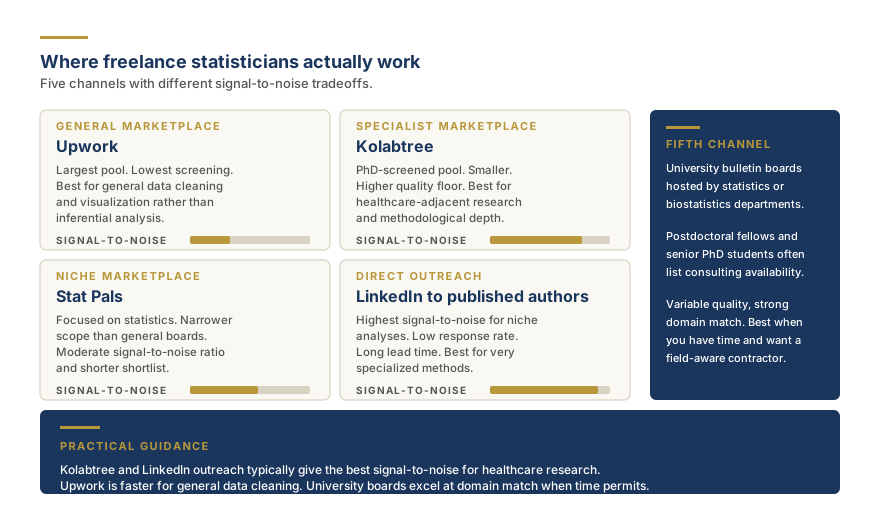
The four places researchers typically find freelance statisticians are general marketplaces, specialist research marketplaces, university bulletin boards, and direct LinkedIn outreach. Each has a different signal-to-noise ratio and a different price ceiling.
Upwork is the largest general marketplace and has the deepest pool of statisticians, but the average contractor is a generalist data analyst rather than a trained biostatistician. Kolabtree is a specialist research marketplace where contractors are screened for PhD-level qualifications, which raises the floor on quality but reduces the pool size; see our roundup of Kolabtree alternatives for adjacent specialist marketplaces. Stat Pals is a smaller niche marketplace focused on statistics specifically. University bulletin boards, often hosted by statistics or biostatistics departments, sometimes list postdoctoral fellows or senior PhD students available for consulting; the quality is variable but the domain match is usually strong. LinkedIn outreach to authors of methodologically similar published papers is the highest-yield path for niche analyses, but the response rate is low and the lead time is long.
For most healthcare-adjacent research, Kolabtree and direct LinkedIn outreach give the best signal-to-noise ratio. Upwork is better for general data cleaning, basic descriptive analysis, and visualization rather than for the inferential analysis that supports a peer-reviewed manuscript.
Engagement Structures You Will Encounter
Freelance statisticians work under three common engagement structures, and the choice has more practical consequences than most researchers realize.
Hourly contracts are the marketplace default and are appropriate when the scope is genuinely uncertain, for example an exploratory analysis where the modeling approach is not yet decided. Hourly contracts reward open-ended discovery but punish the researcher when the contractor is slow or when the scope expands. Always agree a maximum-hour ceiling before work starts.
Fixed-fee contracts are appropriate when the scope is well defined, for example a propensity-score analysis on a defined cohort with a pre-specified outcome and a pre-specified set of covariates. Fixed fees reward speed and penalize scope creep, which means the contractor will resist mid-project additions and the researcher must front-load every requirement during the briefing.
Milestone contracts split a larger engagement into pre-agreed deliverables such as data cleaning, primary analysis, sensitivity analyses, and manuscript-ready figures. Each milestone has its own deliverable and its own payment. Milestone contracts are the right structure for grant-funded projects and thesis chapters because they create natural review points and protect both parties when scope shifts.
A Practical Vetting Checklist
The single best predictor of a successful freelance statistician engagement is whether the contractor can produce a sample report from a previous project that resembles your output. The second best predictor is whether they understand the relevant reporting guideline for your study type. The third is software fluency in the language your collaborators can actually read.
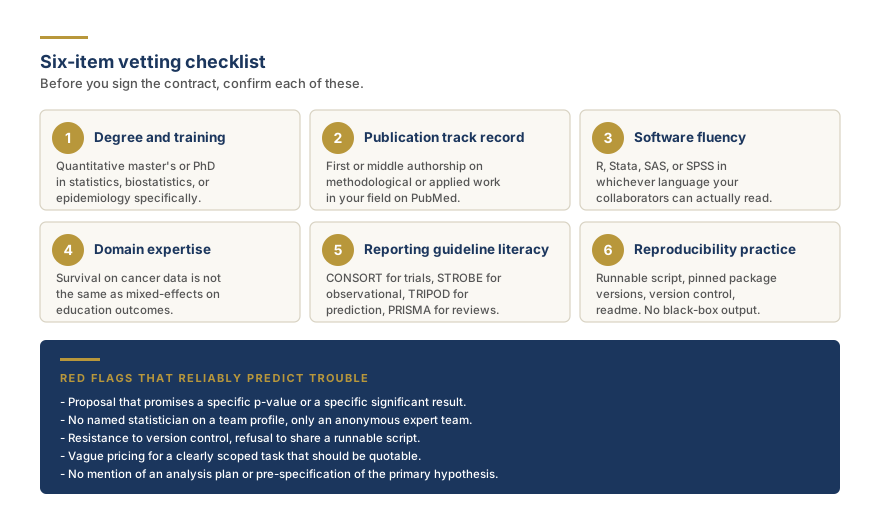
A practical six-item vetting checklist before you hire:
Degree and training. Look for a quantitative master's or doctorate in statistics, biostatistics, epidemiology, or a closely related discipline. A computer science or general data science background is not a substitute when the analysis must satisfy a clinical or epidemiological reviewer.
Publication track record. Search PubMed or Google Scholar for the contractor's name and look for first or middle authorship on methodological or applied papers in your field. Authors who have published in your area will understand the field-specific conventions that catch reviewers' attention.
Software fluency. Confirm the contractor writes in the language your team uses. R and Stata are the academic defaults. SAS is the regulatory default for industry-sponsored trials. SPSS is common in nursing and psychology but is increasingly disfavored for reproducibility reasons. Python is acceptable for analysis but rarer in clinical biostatistics. If you cannot read the contractor's code, you cannot verify their work.
Domain expertise. A statistician who has run survival analyses on cancer data is not necessarily the right hire for a longitudinal mixed-effects model on educational outcomes. Domain expertise determines whether the contractor recognizes the practical pitfalls that a textbook does not flag.
Reporting guideline literacy. Ask whether they know CONSORT for randomized trials, STROBE for observational studies, TRIPOD for prediction models, and PRISMA for systematic reviews. A statistician who has never read the relevant reporting guideline will not produce output that satisfies a methodological reviewer.
Reproducibility practice. Ask whether they deliver a runnable script, whether they use version control, and whether they pin software versions. A statistician who emails you a spreadsheet of point estimates with no script attached is a reproducibility risk.
Red Flags That Reliably Predict Trouble
Most failed freelance engagements share a small set of warning signs that are visible during the proposal stage. The single most common red flag is a proposal that promises a specific p-value or a specific significant result. A trustworthy statistician promises an analysis plan, not an outcome.
A second reliable red flag is no named statistician on a team profile. Some marketplace listings advertise a team of experts but never identify which individual will actually run the analysis. Without a named contractor you cannot vet credentials, cannot enforce continuity, and cannot follow up when the same task comes back later.
A third red flag is resistance to version control. A contractor who insists on working only in a graphical interface and refuses to share the underlying script is selling you a black box. The analysis will pass through your hands once and then become unreproducible.
A fourth red flag is vague pricing for a clearly scoped task. If the task is well defined and the contractor will not name a price, the contractor is testing how much you will pay rather than valuing the work fairly. A fifth red flag is no mention of an analysis plan or pre-specification, which suggests the contractor will fish for significance rather than test pre-specified hypotheses.
Common Deliverables Worth Pricing Separately
Freelance statistical engagements vary enormously in scope, and the contract is much easier to manage when the deliverables are itemized rather than bundled. The standard deliverable list for healthcare-adjacent research includes:
Descriptive tables. A baseline characteristics table, typically Table 1 of a manuscript, summarizing demographics and key covariates with appropriate measures of central tendency, dispersion, and group comparisons.
Primary regression models. Linear, logistic, Cox, or generalized linear mixed-effects models for the main outcome, including model selection rationale, diagnostic plots, and effect estimates with confidence intervals.
Sensitivity analyses. Alternative model specifications, missing-data approaches, outlier handling, and subgroup analyses that test the robustness of the primary finding.
Sample size and power analysis. A pre-study calculation for grant or protocol use, typically including effect size justification, assumed dispersion, alpha, beta, and sensitivity to assumption changes.
Survival analysis. Kaplan-Meier curves, log-rank tests, Cox proportional hazards models with diagnostic tests, and time-dependent covariate analyses where indicated.
Bayesian models. Posterior distributions, credible intervals, prior sensitivity analyses, and convergence diagnostics for studies that adopt a Bayesian framework rather than a frequentist one.
Manuscript-ready figures. Forest plots, regression coefficient plots, Kaplan-Meier curves, calibration plots, and other output formatted to journal specifications.
Itemizing the deliverables in the statement of work means that scope changes are explicit, that pricing is transparent, and that you can drop or add specific outputs as the project evolves.
Need statistical analysis support?
Our PhD statisticians handle data analysis, produce reproducible R code, and write results sections that satisfy peer reviewers.
Freelance statisticians are the right choice when the task is genuinely contained, when the methodology is well established, and when the timeline can accommodate marketplace overhead such as proposal review and contracting.
A small post-hoc supplementary analysis requested by a reviewer is often a clean freelance task. A niche language requirement, for example a SAS macro for a regulatory submission where your in-house team works in R, can sometimes only be filled by a marketplace contractor. A specific methodological technique that your collaborators have never used, for example multilevel structural equation modeling for an educational outcomes paper, may justify a one-off engagement with a specialist contractor.
Freelance is also appropriate for early-stage exploratory work where the research question is still evolving and a full dedicated engagement would over-invest in a direction that may change. A short hourly engagement with a marketplace contractor can validate that the data structure supports the intended analysis before a larger investment.
When a Dedicated Service Is the Right Choice
For high-stakes work the calculus shifts. A grant submission, a thesis chapter, a manuscript revision after major comments, or a regulatory submission all benefit from a dedicated team rather than a single freelance contractor.
Dedicated services typically include a named senior biostatistician who personally reviews the analysis before delivery, internal peer review that catches errors a single contractor might miss, project management that keeps the work on schedule against a journal or funder deadline, and a documented audit trail that satisfies reviewers and editors. They also typically offer included revision rounds, which matters more than most researchers expect: a single round of journal-reviewer comments often requires more work than the original analysis.
For systematic reviews and meta-analyses specifically, a dedicated team that has run the same pipeline before is much faster and lower-risk than a freelance statistician who is encountering the methodology fresh. Our guide to hiring a meta-analysis expert walks through the specific scoping questions that matter for evidence-synthesis engagements. For diagnostic accuracy meta-analyses, for network meta-analyses, and for individual participant data meta-analyses, the marginal cost of going dedicated is typically dwarfed by the cost of a delayed submission.
See our deeper analysis on dedicated biostatistics consulting for the full comparison between freelance and dedicated engagement structures, including the typical scope items that distinguish each path. The companion guide on when to hire a biostatistician breaks down the trigger events in a research lifecycle that justify the dedicated route over the freelance one.
Contracting Basics You Should Not Skip
Freelance contracts often skip the legal scaffolding that protects both parties when something goes wrong. Six items belong in every freelance statistics contract:
Scope of work. A written description of the specific deliverables, the input data, the output format, and the methodological scope. Scope of work documents that fit on half a page are usually under-specified.
Intellectual property assignment. A clear statement that the analysis script and the resulting outputs are owned by the researcher upon payment. Without this clause, marketplace contractors may retain rights to the code and may reuse it for other clients.
Data sharing agreement. A description of how the data will be transferred, who has access, where it will be stored, and when it will be deleted. For human-subjects data, the contractor must be covered by the relevant research ethics approval and data-protection legislation.
Non-disclosure agreement. A clause preventing the contractor from disclosing the research question, the data, or the results to third parties for a defined period.
Revision rounds. A pre-agreed number of revision cycles included in the base fee, plus the rate for additional revisions beyond that. Without this clause, scope creep is the single most common source of disputes.
Authorship. A statement on whether the contractor expects authorship credit. International Committee of Medical Journal Editors guidance specifies that paid statistical work is acknowledgement-eligible rather than authorship-eligible unless the contractor also contributes substantively to the manuscript and approves the final version.
Cost Drivers Without Quoting Current Rates
We do not quote current rates because freelance statistics pricing changes frequently, varies by region, and depends on the engagement structure. Our companion piece on biostatistics consulting rates explained explains the cost-driver framework in more detail. What is stable across years and platforms is the set of cost drivers that determine where any given engagement lands on the price scale.
The dominant driver is credentialed experience, with senior biostatisticians charging multiples of what early-career data analysts charge. A doctoral statistician with twenty years of publication track record will charge differently from a recent master's graduate offering hourly work on a marketplace. The second driver is methodological complexity, with standard regression analyses priced well below Bayesian hierarchical models, structural equation models, and joint longitudinal-survival analyses. The third is deadline pressure, with rush turnaround commanding a premium that scales nonlinearly with how much weekend or overnight work is required.
A fourth driver is deliverable specification. A bare set of point estimates is cheaper than a fully formatted set of tables, figures, and a written results paragraph. A fifth is revision scope, with engagements that include unlimited revisions priced above engagements that include a fixed number.
When you receive proposals, the most informative question to ask is what specifically drives the proposed price. A contractor who can articulate which cost drivers apply to your project is more likely to deliver on plan than a contractor who quotes a single round number with no breakdown.
Software and Reproducibility Expectations
Software choice is not neutral. The language a contractor uses determines whether your collaborators can read the code, whether the analysis is reproducible in five years, and whether journal reviewers will accept the workflow.
R is the academic default for healthcare biostatistics and is free, open-source, and well supported for systematic review methodology through packages such as metafor, robvis, and meta. Stata is widely used in clinical epidemiology and has excellent built-in support for survival analysis, panel data, and survey-weighted designs. SAS is the regulatory default for industry-sponsored clinical trials and is required by some pharmacovigilance and submission pipelines. SPSS is still common in nursing, education, and psychology but is increasingly disfavored because point-and-click workflows are difficult to reproduce and the proprietary syntax is harder to version-control.
A freelance contractor should deliver a runnable script in the language you specified, a clear list of package or library dependencies with pinned version numbers, a brief readme that documents how to reproduce the output, and the raw output files alongside the script. If the contractor does not provide a script, you have purchased a result rather than an analysis, and you cannot audit, extend, or replicate the work.
For reproducibility-sensitive engagements such as regulatory submissions or systematic reviews intended for indexed publication, ask the contractor to commit to a Git repository, to pin software versions, and to include a session-info dump documenting the exact environment in which the analysis was run.
How to Brief a Freelance Statistician
A good brief saves hours of misalignment and changes the price of an engagement by more than any other factor under your control. The seven elements that belong in a written brief before you send it to candidate contractors:
A one-paragraph study description including the research question, the design, and the target sample size. A short data dictionary describing each variable, its type, its allowed values, and any missing-data conventions. A clear primary hypothesis with the corresponding statistical test or model. A list of pre-specified covariates or stratification variables. A statement of the target output format, including whether you need a written results paragraph, manuscript-formatted tables, or only point estimates. A statement of the target deadline with any intermediate milestones. A statement of the software language required for delivery.
Briefs that include all seven elements receive proposals that are roughly comparable across contractors, which makes the hiring decision based on quality rather than on guesswork about scope. Briefs that omit elements receive proposals that range across an order of magnitude in price because each contractor is silently assuming a different scope.
Frequently Asked Questions
Where can I hire a freelance statistician?
The most common places are Upwork, Kolabtree, Stat Pals, university statistics and biostatistics department bulletin boards, and direct LinkedIn outreach to authors of published papers in your methodological area. For healthcare research, Kolabtree and LinkedIn outreach typically give the best signal-to-noise ratio. For general data cleaning and visualization, Upwork is faster and has a deeper pool. A dedicated biostatistics service is usually a better fit than a marketplace freelancer when the work supports a grant, a thesis, or a manuscript revision.
How much does a freelance statistician cost?
Freelance statistician rates vary by experience, methodological complexity, deadline pressure, deliverable specification, and region. We do not publish current rates because they change frequently and vary across platforms. The cost drivers that matter most are credentialed experience, methodological complexity, deadline pressure, and the depth of deliverable. A senior biostatistician on a rush deadline with manuscript-ready outputs is multiples more expensive than a recent graduate offering point estimates only. When evaluating proposals, ask each contractor to articulate which cost drivers apply to your project.
Is hiring a freelance statistician worth it?
Yes for contained, well-defined tasks where you can write a clear brief, vet credentials, and accept the marketplace overhead of proposal review and contracting. For high-stakes work such as grant submissions, thesis defenses, and journal revisions, a dedicated biostatistics service is usually a better fit because it includes named senior review, internal peer review, project management, and revision rounds. Freelance is the right choice when the scope is small and the methodology is established. Dedicated is the right choice when accountability matters.
What questions should I ask a freelance statistician?
Ask for a sample report from a previous project that resembles your output. Ask which reporting guideline they would apply, for example CONSORT for trials, STROBE for observational studies, or PRISMA for systematic reviews. Ask which software language they will deliver in and whether you will receive a runnable script. Ask how many revision rounds are included. Ask whether they expect authorship or acknowledgement. Ask for their methodological approach to your specific question, not just a price.
Can a freelance statistician write my thesis?
A freelance statistician can run the statistical analysis, draft a methods section, draft a results section, and produce manuscript-ready tables and figures. The thesis itself, the literature review, the discussion, and the academic argumentation must be written by you. Most universities also expect a named methodological supervisor, which a marketplace freelancer cannot fulfill. For thesis-scale work, a dedicated biostatistics service that operates as an acknowledged collaborator is a closer fit than a one-off marketplace engagement.
What software should a freelance statistician know?
The four mainstream languages are R, Stata, SAS, and SPSS, with Python increasingly used in data-science-adjacent biostatistics. R is the academic default for healthcare biostatistics and is the language we recommend for most published research. Stata is widely used in epidemiology and survey-weighted analyses. SAS is the regulatory default for industry-sponsored trials. SPSS is still common in nursing, education, and psychology but is increasingly disfavored for reproducibility reasons. The contractor should deliver a runnable script in whichever language your collaborators can actually read.
Pro Tip
Write a seven-element brief covering study description, data dictionary, primary hypothesis, pre-specified covariates, target output, deadline, and software language before contacting candidates.
Pro Tip
Ask for a sample report from a previous comparable project and read the methods narrative carefully.
Pro Tip
Require a runnable script with pinned package versions and a readme, not just point estimates.
Pro Tip
Set an hour-ceiling on hourly engagements and itemize deliverables on fixed-fee engagements.
Pro Tip
Build in a pre-agreed number of revision rounds in the base fee to prevent scope-creep disputes.
Frequently Asked Questions
6
The most common places are Upwork, Kolabtree, Stat Pals, university statistics and biostatistics department bulletin boards, and direct LinkedIn outreach to authors of published papers in your methodological area. For healthcare research, Kolabtree and LinkedIn outreach typically give the best signal-to-noise ratio. For general data cleaning and visualization, Upwork is faster and has a deeper pool. A dedicated biostatistics service is usually a better fit than a marketplace freelancer when the work supports a grant, a thesis, or a manuscript revision.
Freelance statistician rates vary by experience, methodological complexity, deadline pressure, deliverable specification, and region. We do not publish current rates because they change frequently and vary across platforms. The cost drivers that matter most are credentialed experience, methodological complexity, deadline pressure, and the depth of deliverable. A senior biostatistician on a rush deadline with manuscript-ready outputs is multiples more expensive than a recent graduate offering point estimates only. When evaluating proposals, ask each contractor to articulate which cost drivers apply to your project.
Yes for contained, well-defined tasks where you can write a clear brief, vet credentials, and accept the marketplace overhead of proposal review and contracting. For high-stakes work such as grant submissions, thesis defenses, and journal revisions, a dedicated biostatistics service is usually a better fit because it includes named senior review, internal peer review, project management, and revision rounds. Freelance is the right choice when the scope is small and the methodology is established. Dedicated is the right choice when accountability matters.
Ask for a sample report from a previous project that resembles your output. Ask which reporting guideline they would apply, for example CONSORT for trials, STROBE for observational studies, or PRISMA for systematic reviews. Ask which software language they will deliver in and whether you will receive a runnable script. Ask how many revision rounds are included. Ask whether they expect authorship or acknowledgement. Ask for their methodological approach to your specific question, not just a price.
A freelance statistician can run the statistical analysis, draft a methods section, draft a results section, and produce manuscript-ready tables and figures. The thesis itself, the literature review, the discussion, and the academic argumentation must be written by you. Most universities also expect a named methodological supervisor, which a marketplace freelancer cannot fulfill. For thesis-scale work, a dedicated biostatistics service that operates as an acknowledged collaborator is a closer fit than a one-off marketplace engagement.
The four mainstream languages are R, Stata, SAS, and SPSS, with Python increasingly used in data-science-adjacent biostatistics. R is the academic default for healthcare biostatistics and is the language we recommend for most published research. Stata is widely used in epidemiology and survey-weighted analyses. SAS is the regulatory default for industry-sponsored trials. SPSS is still common in nursing, education, and psychology but is increasingly disfavored for reproducibility reasons. The contractor should deliver a runnable script in whichever language your collaborators can actually read.
Share
Found this useful? Share it with your colleagues.
Need statistical analysis support?
Our PhD statisticians handle data analysis, produce reproducible R code, and write results sections that satisfy peer reviewers.
Need a Statistician? Our PhD Team Handles the Numbers.
From data cleaning to advanced statistical analysis, reproducible R code, and a results section ready for peer review. We handle the stats so you focus on the science.
Our promise: Free re-run and re-write if reviewers question the analysis or reporting.
4.9 / 5Quote within a few hoursReproducible R or Stata codePhD methodologistConfidential by default
Dr. Sarah Mitchell holds a PhD in Biostatistics from Johns Hopkins Bloomberg School of Public Health and has over 15 years of experience in systematic review methodology and meta-analysis. She has authored or co-authored 40+ peer-reviewed publications in journals including the Journal of Clinical Epidemiology, BMC Medical Research Methodology, and Research Synthesis Methods. A former Cochrane Review Group statistician and current editorial board member of Systematic Reviews, Dr. Mitchell has supervised 200+ evidence synthesis projects across clinical medicine, public health, and social sciences.
Need a Statistician? Our PhD Team Handles the Numbers.
From data cleaning to advanced statistical analysis, reproducible R code, and a results section ready for peer review. We handle the stats so you focus on the science.
CHEERS 2022 checklist explained: all 28 items, what changed from CHEERS 2013, and how to report a cost-effectiveness analysis so payers and journals can use it.
SPIRIT 2025 checklist explained: all 34 items by section, what changed from SPIRIT 2013, and how the protocol lines up with CONSORT 2025 when you report the trial.
ARRIVE 2.0 guidelines explained: the Essential 10 and the Recommended Set, what changed from ARRIVE 2010, and the items journals check in animal research reports.