Kolabtree Alternatives: Marketplaces vs Service Teams
Kolabtree is a PhD-vetted freelance research marketplace. Alternatives include Cactus, Editage, Enago, Scribendi, Pubrica, and dedicated service teams.
Dr. Sarah Mitchell
May 13, 2026
Key Takeaways
Kolabtree is a freelance marketplace that connects researchers with PhD-level scientists for short-term projects in statistics, manuscript editing, scientific writing, regulatory writing, R&D consulting, and bench-science protocol design. Founded 2015, headquartered Cambridge UK.
The marketplace model fits bounded one-off tasks where the researcher can self-vet the methodology and is willing to act as project manager. Examples: a single regression model, a power calculation, a Cox regression on a clean dataset, or a manuscript line-edit.
The dedicated service team model fits multi-stage research workflows where integration is the value driver. Examples: full systematic review, end-to-end meta-analysis, regulatory submissions, IP-sensitive consulting, and projects with 6-week to 6-month timelines.
Alternatives by category include Cactus Communications, Editage, Enago, Scribendi, Wordvice, Charlesworth, Springer Nature Author Services, and Elsevier Author Services (editing-led) plus biostatistics consulting firms and dedicated research service teams (statistics-led and integrated).
Five quality signals distinguish reliable providers across all platforms: published outputs by named individuals, named specialist assignment, willingness to share sample reports, written dispute and revision policy, and responsive pre-engagement scoping.
Kolabtree is an online marketplace that connects researchers, life science companies, and small biotechs with freelance PhD-level scientists for short-term projects, charging a platform fee on top of the freelancer's project rate. The platform covers statistical analysis, manuscript editing, scientific writing, regulatory writing, R&D consulting, and bench science protocol design. Alternatives to Kolabtree fall into two distinct categories: other freelance marketplaces (Upwork's research-and-development category, Toptal's quantitative-finance vertical, Fiverr Pro) and dedicated research service teams that offer end-to-end project ownership rather than freelance matchmaking. This guide describes how Kolabtree works, where the marketplace model is the right fit, where a dedicated service team fits better, and the quality signals that distinguish reliable providers regardless of platform.
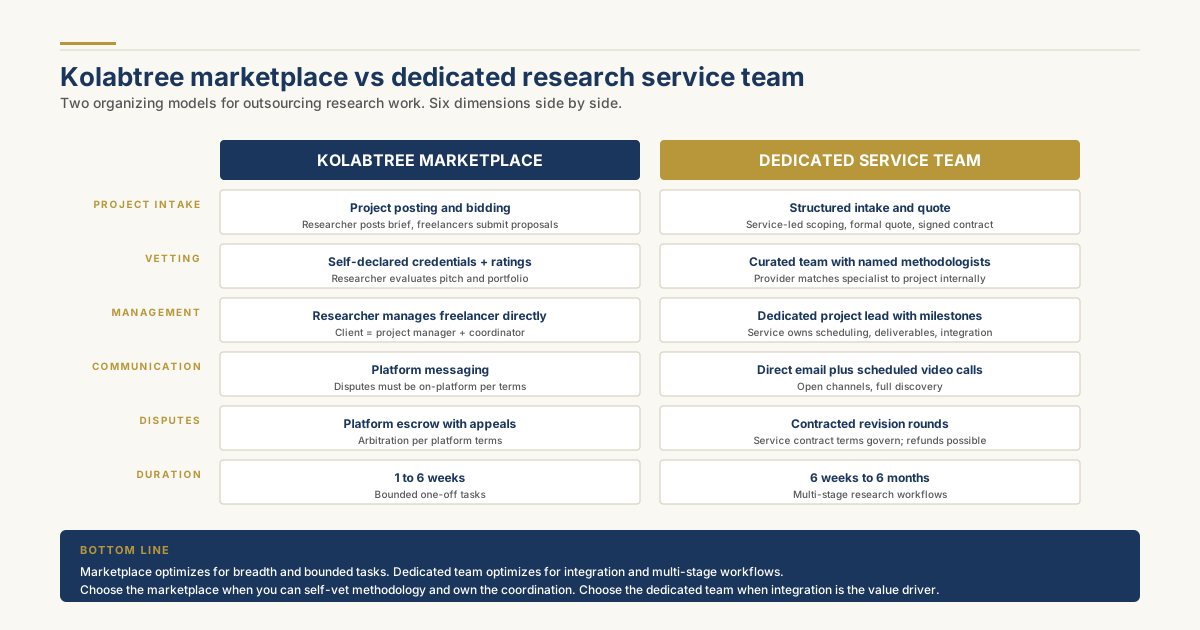
Kolabtree marketplace versus dedicated research service team: intake, vetting, management, disputes
Kolabtree was founded in 2015 by Ashmita Das and is headquartered in Cambridge, United Kingdom. The platform has grown to a roster of more than 25,000 listed freelancers in 2026, with project volume concentrated in statistical analysis, manuscript editing, and bench-science protocol consulting. Pricing is variable: the freelancer sets the rate, the platform takes a percentage commission, and projects are typically scoped at fixed-fee or hourly billing. Many researchers find Kolabtree useful for niche short-term tasks; others find that the marketplace model trades depth for breadth in ways that matter for multi-stage projects.
Freelance Marketplaces Versus Dedicated Research Service Teams
The central distinction is how the project is organized after the contract is signed. On a freelance marketplace the researcher remains the project manager: scoping the work, communicating directly with the freelancer, reviewing deliverables, and resolving disputes through the platform's escrow process. On a dedicated service team the provider takes project management: assigning a named methodologist or statistician, scheduling milestones, drafting deliverables in iterations, and absorbing the operational overhead of communication and revision.
Three pragmatic consequences follow from that organizational difference.
Vetting depth differs. A marketplace vets freelancers at signup through credential checks and rating accumulation, but the platform itself does not match the right specialist to the right project. The researcher does that matching, which means the researcher must understand the methodology well enough to evaluate the freelancer's pitch and portfolio. A dedicated service team vets candidates at hiring time, retains them on payroll or long-term contract, and matches projects internally through a project lead. The vetting becomes the provider's problem rather than the client's.
Project continuity differs. Marketplace freelancers are sometimes unavailable mid-project (illness, competing projects, departure from the platform), and the researcher must either wait or re-scope to a different freelancer. Dedicated teams maintain redundancy: if the lead methodologist is unavailable, a colleague at the firm takes the project. For multi-stage systematic reviews and meta-analyses, the continuity question is load-bearing.
Dispute resolution differs. Marketplaces have escrow and arbitration mechanisms; disputes are handled by the platform per the platform's terms. Dedicated services have direct contracts with the client; disputes are handled through revision rounds, the service's contract terms, or, ultimately, refunds. Neither is inherently better, but the venues are different.
What Kolabtree Is and How the Platform Works
The platform workflow has five stages. The researcher posts a project description with budget and timeline. Freelancers submit proposals (some by direct invitation, some through the open project board). The researcher selects a freelancer, signs the platform's NDA template, and funds the project to escrow. The freelancer delivers; the researcher reviews and approves; the platform releases funds and takes its commission. The platform retains a record of the project, the deliverables, and the rating for future search.
Most projects fall into one of six service categories. Statistical analysis is the largest category by project volume, ranging from one-off hypothesis tests to full multivariable models to dataset cleaning and exploratory analysis. Manuscript editing covers language polishing, formatting to journal style, and structural editing. Scientific writing covers drafting manuscripts, grant proposals, and white papers from researcher-supplied data and outlines. Regulatory writing covers FDA, EMA, and PMDA submission documents (Common Technical Document modules, clinical study reports). R&D consulting covers protocol design, assay development, and methodology review for industry clients. Bench science protocols cover laboratory technique advice and SOP drafting.
Pricing is freelancer-set. Hourly rates on Kolabtree vary widely by specialty and seniority, with senior specialists (full professors, former pharmaceutical-industry leads) commanding the upper end. Fixed-fee projects vary widely depending on scope. The platform commission is taken from the freelancer's side of the transaction.
Strengths of the Marketplace Model
The marketplace approach has three genuine strengths that explain the platform's growth.
Breadth of expertise. A researcher needing a specific niche specialty (e.g., a statistician with expertise in survival analysis of competing risks for oncology trials, or a regulatory writer with a track record on rare-disease orphan submissions) can search the platform's roster and find candidates with that specific profile. A dedicated service team has limited bandwidth and may not house a specialist in every niche.
Variable pricing. Researchers with constrained budgets can find junior PhDs willing to take on smaller projects at lower hourly rates, while researchers with larger budgets can engage senior specialists. The pricing flexibility appeals to academic researchers funded by grants, where the budget for statistical support is fixed and the deliverable can be scoped to fit.
Contract-by-project flexibility. Engagements are bounded by project scope rather than retainer or annual contract. A researcher with one specific analytical question can engage a freelancer for that question alone, without committing to ongoing work.
Weaknesses of the Marketplace Model
The same architectural choices that produce the strengths produce three predictable weaknesses.
Variable vetting depth. The platform vets credentials at signup but cannot verify the quality of work until a project is completed and rated. A freelancer with a strong CV but limited published outputs in the researcher's specific methodology may produce work that is technically defensible but suboptimal. The researcher must do the methodology vetting themselves, which is hard if the researcher is engaging the freelancer specifically because the researcher lacks that methodology.
No centralized project management. The researcher is the project manager. For a single-stage task this is fine. For a multi-stage systematic review (protocol drafting, search strategy, screening, extraction, risk of bias, meta-analysis, manuscript drafting, peer-review response) this means the researcher must coordinate across multiple freelancers, integrate their outputs, and ensure methodological consistency. Time investment in coordination can exceed the time savings the platform was supposed to offer.
NDA enforcement complexity. Platform NDAs are template documents and apply to the specific freelancer. If a freelancer subcontracts to a colleague (sometimes silently), the NDA's enforcement is unclear. For pre-publication research, IP-sensitive consulting, or regulatory submissions, the NDA structure of a dedicated service team (a single contracted entity bound to confidentiality) is cleaner.
Communication friction. Platform messaging adds a layer of mediation that can slow projects. Email and video calls are often the workaround, but the platform's terms typically require disputes to use the platform's record, so important context must be ported back. For projects where rapid iteration is the value driver, the friction can be operationally significant.
When a Marketplace Is the Right Fit
Three project profiles match the marketplace model well.
Small one-off statistical tasks. A single hypothesis test, a Cox regression on a clean dataset with a clearly defined comparison, a power calculation for a planned trial. These are bounded, well-specified, and short, and a freelancer with the right methodology can deliver in a few days.
Niche specialty access. A researcher needs an expert in a specific niche (e.g., Bayesian network meta-analysis with NUTS sampling, Mendelian randomization with weighted median estimators, latent class analysis with finite mixtures). A marketplace search can surface candidates with exactly that profile.
Manuscript polishing and language editing. Editing-focused tasks where the deliverable is well-defined (line-edit the manuscript, format to journal style, prepare a cover letter) and the timeline is short.
Need professional help with your research?
Our PhD methodologists deliver complete systematic reviews and meta-analyses, from protocol to manuscript.
Four project profiles match the dedicated service model better.
Multi-stage systematic reviews and meta-analyses. Protocol drafting, PROSPERO registration, search strategy peer review, two-reviewer screening, extraction, risk of bias, meta-analysis service deliverables, manuscript drafting, peer-review response. The integration across stages is the value driver. A dedicated team owning the project end-to-end ensures methodological consistency that a sequence of freelancers cannot guarantee.
Methodology plus writing under one roof. When the analysis and the manuscript writing are intertwined (the writer needs to understand the analysis, the analyst needs to understand the rhetorical structure of the discussion), having both functions within one team produces a better final document than coordinating between two freelancers.
Long timelines and protocol-driven work. Projects with a 6 to 12 month horizon benefit from team continuity, named project leads, scheduled milestones, and a contracted commitment to deliver on the protocol. Freelance marketplace engagements rarely fit this timeline.
Industry consulting and regulatory work. Pre-submission consulting, response to FDA or EMA queries, sponsor-investigator submissions. The IP-sensitivity, the multi-party communication, and the regulatory record-keeping fit a contracted service better than a marketplace freelance engagement. The freelancer versus dedicated systematic review service comparison covers the specific systematic-review case in depth.
Other Alternatives by Category
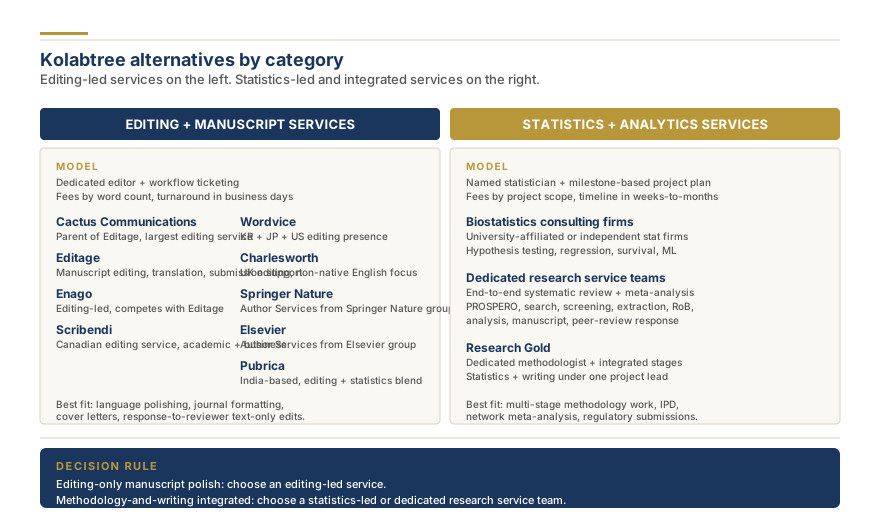
The full set of alternatives to Kolabtree spans editing-led services, statistics-led services, and integrated providers.
Kolabtree alternatives by category: editing-led, statistics-led, integrated
Cactus Communications. Parent of Editage and the largest editing-led service in the academic editing market. Project intake is dedicated editor with workflow ticketing; deliverables are line-edited manuscripts, cover letters, response-to-reviewer letters, and journal-formatting. Turnaround is typically 3 to 10 business days for editing; statistical analysis is offered through a separate service line.
Editage. Same parent (Cactus) as above; Editage is the brand-facing service. Manuscript editing, translation, journal submission support, plot redrawing. Used heavily by Asia-Pacific researchers.
Enago. Editing-led service competing directly with Editage in the same market. Comparable scope and pricing.
Scribendi. Canadian editing service with academic and business divisions. Editing-led; less statistical support. The detailed Scribendi compared with Research Gold walkthrough covers the differences with a service that integrates statistics and methodology.
Pubrica. India-based service covering manuscript editing, statistical analysis, and systematic review support. Pricing is among the lowest in the market; vetting depth varies. The Pubrica compared with Research Gold comparison covers the model differences.
Charlesworth. UK-based editing service that emphasizes language editing for non-native-English authors and journal submission support.
Springer Nature Author Services. In-house editing and language services from the Springer Nature publishing group. Pricing is at the higher end; turnaround is reliable.
Elsevier Author Services. Same model from the Elsevier publishing group. Both Springer and Elsevier services are typically used by authors already submitting to journals in those families.
Wordvice. Editing-led service with a strong presence in Korea, Japan, and the United States.
For statistical work specifically, the closest comparisons are not editing services but biostatistics consulting firms and dedicated research service teams. The biostatistical consulting support and statistical analysis support categories at Research Gold are positioned exactly here: methodology-led, named statistician, milestone-based project plan, with manuscript drafting as an integrated rather than separate service.
How Research Gold's Dedicated Model Differs
Research Gold operates as a dedicated service team rather than a marketplace. The intake is a structured quote process; the project is assigned to a named methodologist; the deliverables are scoped at the quote stage with milestones; communication is direct email plus scheduled video calls; revisions are bounded by the service contract; and the project ends with a manuscript-ready submission package including statistical code, figures, tables, and the response-to-reviewer letter if peer review has already occurred.
The model trades the marketplace's pricing flexibility and breadth for vetted methodology, project continuity, and integrated stages. For one-off statistical tasks at the lowest possible price, the marketplace wins on cost. For multi-stage research projects where the integration is the value driver, the dedicated team produces a better final product at the cost of higher per-hour pricing.
Decision Checklist for Choosing Between Kolabtree and a Dedicated Provider
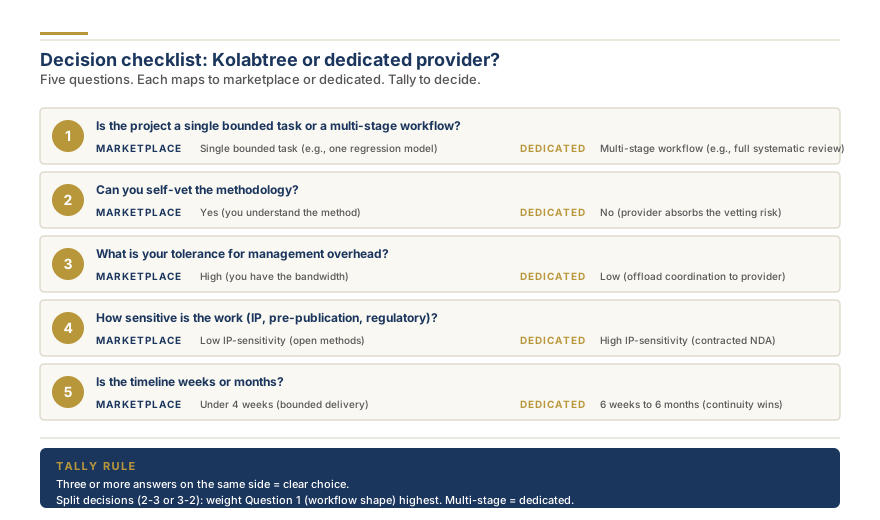
Five-question decision checklist: marketplace versus dedicated service team
Five questions resolve most provider-choice decisions.
Is the project a single bounded task or a multi-stage workflow? Bounded tasks fit a marketplace. Multi-stage workflows fit a dedicated team. Systematic reviews, meta-analyses, and end-to-end statistical support for a manuscript are multi-stage by definition.
Can you self-vet the methodology? If you understand the methodology well enough to judge the freelancer's pitch, the marketplace works. If you are engaging a specialist precisely because you lack that methodology, the marketplace exposes you to vetting risk; a dedicated team's project lead absorbs that risk.
What is your tolerance for management overhead? Marketplace projects require active researcher management. Dedicated team projects offload that to the provider. Researchers with limited time should prefer the dedicated model.
How sensitive is the work? IP-sensitive consulting, pre-submission regulatory work, and pre-publication research have tighter NDA needs. Dedicated service contracts cleanly satisfy those needs; marketplace NDAs are template-based.
Is the timeline weeks or months? Short timelines (under 4 weeks) fit either. Longer timelines benefit from team continuity that marketplaces struggle to guarantee.
Quality Signals to Look For Regardless of Platform
Five signals distinguish reliable providers across all platforms.
Published outputs. Does the provider (or freelancer) have a public list of manuscripts on which they were the named statistician, methodologist, or editor? If yes, this is the strongest single signal of capability. If no, the credentials must be evaluated on their own.
Named specialist. Is the project assigned to a specific named individual (or a named project lead managing a small team), or is it a generic "your account manager will assign someone"? Named specialists are accountable; generic assignment is not.
Sample reports. Will the provider share an anonymized example of prior deliverable (statistical report, edited manuscript, response-to-reviewer letter)? A sample report demonstrates the quality and format of what you will receive.
Dispute and revision process. What is the written policy on revisions and disputes? A dedicated service team should have a contractual revision policy (often two or three revision rounds included in the quote, additional rounds priced separately). A marketplace freelancer's dispute process is the platform's, not the freelancer's.
Responsiveness during pre-engagement. How quickly does the provider respond to the initial quote request, and how thoroughly does the provider scope the project? Slow or vague pre-engagement responses are a leading indicator of slow or vague project execution.
Combining the five signals across a short list of candidates (whether on Kolabtree or on a dedicated platform) typically produces a defensible provider choice. The hiring a freelance statistician guide drills further into the statistician-specific vetting checklist.
Frequently Asked Questions
Is Kolabtree legit?
Kolabtree is a legitimate, operating freelance marketplace, founded in 2015 and headquartered in Cambridge, United Kingdom. It has an established record of completed projects, an active freelancer roster of more than 25,000 PhD-level scientists in 2026, and a published escrow and dispute process. Like any marketplace, the quality of individual freelancers varies; the platform itself is real and operational.
How does Kolabtree work?
A researcher posts a project description with budget and timeline. Freelancers submit proposals (by direct invitation or through the open board). The researcher selects a freelancer, signs the platform's NDA, and funds the project to escrow. The freelancer delivers and the researcher reviews. On approval, the platform releases funds and takes a commission. Project records, deliverables, and ratings are retained on the platform for future search.
Are there alternatives to Kolabtree?
Yes, in two categories. Other freelance marketplaces include Upwork's research and development category, Toptal's quantitative-finance vertical, and Fiverr Pro. Dedicated research service teams include Research Gold (methodology and statistics-led), Cactus Communications, Editage, Enago, Pubrica, Scribendi, Wordvice, Charlesworth, Springer Nature Author Services, and Elsevier Author Services. The marketplace model fits bounded one-off tasks; the dedicated team model fits multi-stage research workflows.
Can I hire a statistician on Kolabtree?
Yes. Statistical analysis is one of Kolabtree's largest service categories, with freelancers offering hypothesis testing, regression modeling, survival analysis, meta-analysis, machine learning, and Bayesian analysis. Rates vary by freelancer seniority, with senior specialists commanding the upper end of the range. For multi-stage statistical work integrated with manuscript writing, a dedicated statistics consulting firm is often a better fit.
What does Kolabtree charge?
Freelancers set their own rates (hourly or fixed-fee), and the platform takes a commission from the freelancer's side. There is no direct fee to the researcher beyond the project's quoted price. Hourly rates vary by specialty and seniority; specialized work commands higher rates. The total project cost depends on scope and the freelancer's pricing.
Is Kolabtree better than Upwork for research?
For research-specific tasks, Kolabtree's PhD-vetted roster is more specialized than Upwork's general-purpose freelancer pool, so the median freelancer on Kolabtree is more likely to have the credentials needed for academic work. Upwork has greater overall volume and may have lower-priced options for general-purpose tasks. For statistical analysis, manuscript editing, and scientific writing, Kolabtree's specialization is a real advantage; for adjacent tasks (transcription, basic data entry), Upwork is competitive.
Pro Tip
Use a five-question checklist before choosing: (1) bounded task or multi-stage workflow? (2) can you self-vet the methodology? (3) what is your tolerance for management overhead? (4) how sensitive is the work? (5) is the timeline weeks or months?
Pro Tip
Always request a sample report from any provider before signing. The sample shows the deliverable quality and the document format. Providers unwilling to share an anonymized sample are a yellow flag.
Pro Tip
Verify the named specialist's published outputs (PubMed, Google Scholar) rather than relying on platform ratings alone. Ratings reflect platform behavior; published outputs reflect methodological capability.
Pro Tip
Read the written revision and dispute policy before funding the escrow or signing the contract. A dedicated service should include two or three revision rounds; a marketplace freelancer's disputes go through the platform's escrow process.
Pro Tip
For systematic reviews and meta-analyses with multiple integrated stages, prefer a dedicated team over coordinating multiple freelancers. The coordination cost of multi-freelancer projects often exceeds the cost savings the marketplace was supposed to offer.
Frequently Asked Questions
6
Kolabtree is a legitimate, operating freelance marketplace, founded in 2015 and headquartered in Cambridge, United Kingdom. It has an established record of completed projects, an active freelancer roster of more than 25,000 PhD-level scientists in 2026, and a published escrow and dispute process. Like any marketplace, the quality of individual freelancers varies; the platform itself is real and operational.
A researcher posts a project description with budget and timeline. Freelancers submit proposals (by direct invitation or through the open board). The researcher selects a freelancer, signs the platform's NDA, and funds the project to escrow. The freelancer delivers and the researcher reviews. On approval, the platform releases funds and takes a commission. Project records, deliverables, and ratings are retained on the platform for future search.
Yes, in two categories. Other freelance marketplaces include Upwork's research and development category, Toptal's quantitative-finance vertical, and Fiverr Pro. Dedicated research service teams include Research Gold (methodology and statistics-led), Cactus Communications, Editage, Enago, Pubrica, Scribendi, Wordvice, Charlesworth, Springer Nature Author Services, and Elsevier Author Services. The marketplace model fits bounded one-off tasks; the dedicated team model fits multi-stage research workflows.
Yes. Statistical analysis is one of Kolabtree's largest service categories, with freelancers offering hypothesis testing, regression modeling, survival analysis, meta-analysis, machine learning, and Bayesian analysis. Rates vary by freelancer seniority, with senior specialists commanding the upper end. For multi-stage statistical work integrated with manuscript writing, a dedicated statistics consulting firm is often a better fit.
Freelancers set their own rates (hourly or fixed-fee), and the platform takes a commission from the freelancer's side. There is no direct fee to the researcher beyond the project's quoted price. Hourly rates vary by specialty and seniority; specialized work commands higher rates. The total project cost depends on scope and the freelancer's pricing.
For research-specific tasks, Kolabtree's PhD-vetted roster is more specialized than Upwork's general-purpose freelancer pool, so the median freelancer on Kolabtree is more likely to have the credentials needed for academic work. Upwork has greater overall volume and may have lower-priced options for general-purpose tasks. For statistical analysis, manuscript editing, and scientific writing, Kolabtree's specialization is a real advantage; for adjacent tasks (transcription, basic data entry), Upwork is competitive.
Share
Found this useful? Share it with your colleagues.
Need professional help with your research?
Our PhD methodologists deliver complete systematic reviews and meta-analyses, from protocol to manuscript.
From protocol to publication-ready manuscript. Our PhD-level methodologists handle systematic reviews, meta-analyses, scoping reviews, and more. Most projects deliver in under 2 weeks.
Our promise: Free rework on search, screening, or synthesis if reviewers push back.
4.9 / 5Quote within a few hoursPRISMA 2020 + Cochrane HandbookPhD methodologistConfidential by default
Dr. Sarah Mitchell holds a PhD in Biostatistics from Johns Hopkins Bloomberg School of Public Health and has over 15 years of experience in systematic review methodology and meta-analysis. She has authored or co-authored 40+ peer-reviewed publications in journals including the Journal of Clinical Epidemiology, BMC Medical Research Methodology, and Research Synthesis Methods. A former Cochrane Review Group statistician and current editorial board member of Systematic Reviews, Dr. Mitchell has supervised 200+ evidence synthesis projects across clinical medicine, public health, and social sciences.
From protocol to publication-ready manuscript. Our PhD-level methodologists handle systematic reviews, meta-analyses, scoping reviews, and more. Most projects deliver in under 2 weeks.
CHEERS 2022 checklist explained: all 28 items, what changed from CHEERS 2013, and how to report a cost-effectiveness analysis so payers and journals can use it.
SPIRIT 2025 checklist explained: all 34 items by section, what changed from SPIRIT 2013, and how the protocol lines up with CONSORT 2025 when you report the trial.
ARRIVE 2.0 guidelines explained: the Essential 10 and the Recommended Set, what changed from ARRIVE 2010, and the items journals check in animal research reports.