RevMan: Cochrane Review Software (RevMan 5 and RevMan Web)
RevMan explained: Cochrane's review software, RevMan 5 versus RevMan Web, native features, limitations, licensing, and alternatives like R metafor, Stata, and JASP.
Dr. Sarah Mitchell
May 14, 2026
Fighting with RevMan, or need methods it does not support such as network meta-analysis, REML, or prediction intervals? PhD biostatisticians run the full analysis and return journal-ready figures with reproducible code. Get a free quote.
Key Takeaways
RevMan is Cochrane's systematic review software, available in the legacy RevMan 5 desktop application and the current RevMan Web cloud platform.
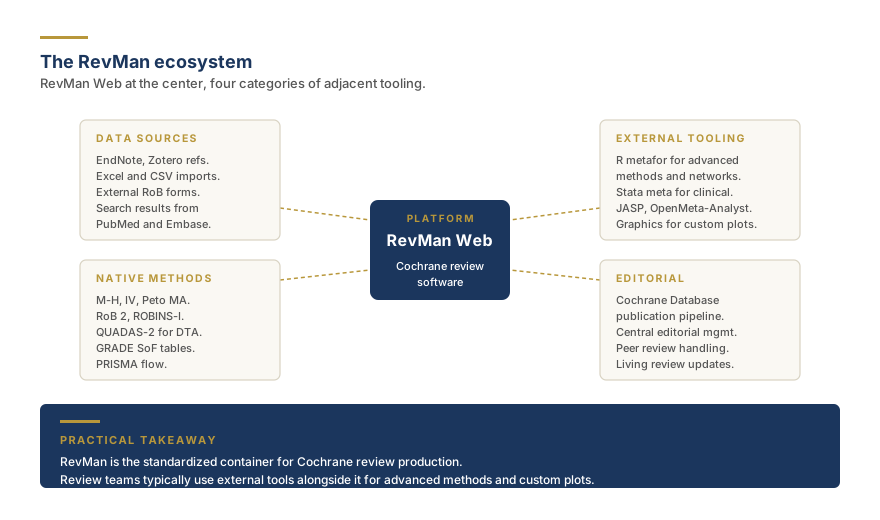
RevMan handles data extraction tables, forest plots, risk-of-bias tables for RoB 2, ROBINS-I, and QUADAS-2, and GRADE Summary of Findings tables natively.
RevMan does not natively support network meta-analysis, REML variance estimation, prediction intervals, Bayesian methods, or custom plots; external tooling such as R metafor fills these gaps.
RevMan is free for active Cochrane authors and available to non-Cochrane users through a paid institutional license.
For new Cochrane reviews use RevMan Web; legacy RevMan 5 reviews migrate through Cochrane's conversion utility, with RoB 2 entries often requiring re-entry.
RevMan is the systematic review software developed by Cochrane for preparing, maintaining, and updating Cochrane systematic reviews, with built-in support for meta-analysis forest plots, risk-of-bias tables, and GRADE summary of findings. The acronym stands for Review Manager, the family name has been the Cochrane Collaboration standard since the 1980s, and the platform now exists in two generations: the legacy RevMan 5 desktop application and the current cloud-based RevMan Web. Understanding which generation to use, what RevMan does natively, and where its limits sit is essential for any review team working inside the Cochrane workflow and useful even for teams considering RevMan as a starting platform for a non-Cochrane review.
RevMan at a Glance
Question
Quick answer
What is the current version?
RevMan Web, browser-based. RevMan 5 desktop is legacy; active development ended in 2020
Is it free?
Free for active Cochrane authors. Everyone else needs a paid institutional license
Where do I get it?
Cochrane editorial portal (authors) or institutional login (licensed users). The RevMan 5 installer remains downloadable for legacy .rm5 reviews
What runs it?
RevMan Web: any modern browser. RevMan 5: Windows, macOS, Linux
What is it built for?
Standard pairwise meta-analysis of intervention reviews in the Cochrane format, with forest plots, risk-of-bias tables, and GRADE Summary of Findings
The sections below unpack each row: access and licensing first, then the feature set, the limits, and how RevMan compares to R, Stata, and JASP.
How to Get RevMan: Licensing and Access
RevMan licensing is one of the practical features that distinguishes the platform from commercial competitors. For Cochrane authors, both RevMan 5 and RevMan Web are free as part of Cochrane membership. The license is tied to active Cochrane review production and is administered through the Cochrane editorial groups.
For non-Cochrane users, RevMan Web is available under a paid institutional license that Cochrane sells to institutions, training programs, and individual researchers. The institutional license includes the full RevMan Web feature set but does not include the editorial integration that is reserved for Cochrane authors.
The Cochrane-author free license is one of the strongest arguments for choosing the Cochrane review pathway when feasible. Equivalent commercial systematic review platforms charge institutional fees that compound across a multi-year review project. For teams already inside the Cochrane editorial system, RevMan is effectively a free benefit.
For teams that want RevMan-style structure without the Cochrane editorial commitment, the RevMan alternatives for non-Cochrane reviews span open-source desktop tools, R-based pipelines, and commercial platforms. The trade-offs differ across these options and depend on the team's coding fluency and budget.
RevMan Web and RevMan 5: Two Generations of One Workflow
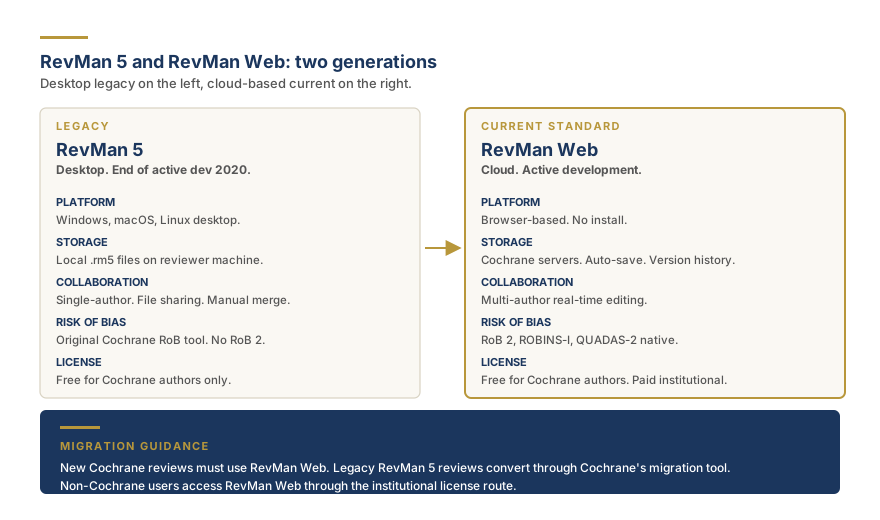
RevMan 5 is the desktop application that Cochrane authors used for nearly two decades. It runs as a standalone program on Windows, macOS, and Linux, stores reviews as proprietary .rm5 files, and is locally installed on the reviewer's machine. RevMan 5 reached end of active development in 2020, although authors with legacy reviews can still install it and Cochrane continues to provide compatibility tooling.
RevMan Web is the cloud-based successor that Cochrane now expects all new Cochrane reviews to use. RevMan Web runs in the browser, stores the review on Cochrane servers, supports multi-author collaboration with real-time editing, integrates with Cochrane's central systems for editorial management and publication, and includes updated analytical features such as native support for the RoB 2 risk-of-bias tool. The migration from RevMan 5 to RevMan Web has been the largest single platform change in the history of Cochrane review production.
For new reviews the choice is settled: use RevMan Web. For legacy reviews, the choice depends on whether the existing .rm5 file has been migrated through Cochrane's conversion tool and whether the editorial group has signaled a hard cutover. Most active Cochrane Review Groups have completed the transition.
Core Features You Get Out of the Box
RevMan, in either generation, ships with a set of features that cover the methodological backbone of a standard healthcare systematic review:
Data extraction tables with fixed columns for study identification, methods, participants, interventions, outcomes, and notes. The tables are linked to the analysis backend so that any cell change propagates to the forest plot.
Automatic forest plots for fixed-effect and random-effects meta-analysis using the Mantel-Haenszel, inverse variance, or Peto methods, with subgroup analysis, heterogeneity statistics, and the standard Cochrane visual conventions.
Risk-of-bias tables for the Cochrane Handbook reference standard tools. RevMan 5 supported the original Cochrane risk-of-bias tool. RevMan Web supports RoB 2 for randomized trials, ROBINS-I for non-randomized studies, and QUADAS-2 for diagnostic accuracy studies as part of the platform. If you only need the domain judgements and a traffic-light figure without a license, our online RoB 2 assessment builder covers that step in the browser.
Summary of Findings tables that integrate with the GRADE approach, presenting absolute and relative effects with certainty ratings and footnotes in the format expected by Cochrane reviewers. A standalone GRADE certainty rating tool is useful for drafting the certainty judgements before entering them into RevMan.
Characteristics of included studies tables that summarize study design, participants, interventions, outcomes, and notes in the structured format Cochrane reviews require.
Reference management through built-in handling of citation metadata, deduplication, and inclusion-exclusion tracking, though most teams use a separate reference manager such as EndNote or Zotero for primary deduplication.
What RevMan Does Well
RevMan's strongest feature is consistency. Every output looks like every other Cochrane review, which is exactly what Cochrane authors and editors want. A reviewer who has worked through one Cochrane review can navigate any other Cochrane review's RevMan file without orientation, which is a methodological advantage no general-purpose statistics package can match.
RevMan also does standard meta-analysis methods well. Mantel-Haenszel, inverse variance, and Peto methods are implemented correctly with appropriate continuity corrections and heterogeneity statistics. Forest plots respect Cochrane visual conventions, including weight columns, summary diamonds at the bottom of subgroups and overall, and clearly labeled axis ticks.
The team-collaboration features in RevMan Web are a step change over RevMan 5. Multiple authors can edit a review simultaneously, the platform tracks individual contributions for authorship transparency, and the cloud-based storage removes the version-merging headaches that plagued the desktop generation. For multi-site review teams, RevMan Web is qualitatively easier to manage than RevMan 5.
RevMan's editorial integration is also worth noting. Submitted Cochrane reviews flow directly from RevMan Web into the Cochrane editorial system, which reduces the formatting overhead that journal submission typically involves. For Cochrane authors, this integration alone justifies the platform.
Need professional help with your research?
Our PhD methodologists deliver complete systematic reviews and meta-analyses, from protocol to manuscript.
RevMan's narrow methodological scope is the most important limitation to plan around. The platform does not natively support several methods that are standard in non-Cochrane meta-analysis:
Network meta-analysis is not supported in RevMan. Cochrane authors who run network meta-analyses use external tools such as R's netmeta package, GeMTC, WinBUGS, or a browser-based network meta-analysis tool, then import the resulting figures and tables as static images into RevMan.
REML estimation of the between-study variance is not implemented. RevMan uses the DerSimonian-Laird estimator by default, which performs poorly when the number of studies is small. Reviewers who want REML or other modern variance estimators must run the analysis externally.
Prediction intervals are not generated automatically. For a comprehensive prediction-interval treatment, reviewers run the analysis in R using metafor or in Stata using meta and report the prediction interval as a supplementary figure.
Bayesian meta-analysis with custom priors is not supported. Bayesian methods are increasingly important in evidence synthesis, particularly for rare-event meta-analyses and for network meta-analysis, and require external tooling.
Custom plots beyond the standard forest plot template are not supported. Galbraith plots, Baujat plots, GOSH plots, leave-one-out sensitivity plots, and contour-enhanced funnel plots all require external graphics software or browser tools such as our GOSH plot generator and contour-enhanced funnel plot maker.
Qualitative synthesis in the systematic review sense, including meta-ethnography, framework synthesis, and thematic synthesis, is not supported by RevMan. RevMan is fundamentally a quantitative-synthesis platform.
Individual participant data meta-analysis with one-stage models, two-stage models with custom random effects, or treatment-effect interactions is not supported. IPD reviews use Stata or R for the core analysis and use RevMan only for the aggregate sensitivity analyses if at all.
This list looks long, but for most healthcare intervention reviews running standard aggregate meta-analyses with two-arm comparisons, RevMan's feature set is sufficient. The limitations matter most for methodologically ambitious reviews and for non-Cochrane reviews that want to use more flexible methods.
When your protocol calls for methods on this unsupported list, network meta-analysis, prediction intervals, or REML estimation, the practical options are learning R or handing the statistics to a PhD methodologist who returns journal-ready figures, tables, and reproducible code while you keep drafting in RevMan. Tell us what your review needs and we will scope it within a day.
Where RevMan's Standardization Comes From
The original Review Manager dates to the late 1980s and grew out of the Nordic Cochrane Centre's effort to standardize the data structures, statistical procedures, and visual outputs of the systematic reviews that the Cochrane Collaboration was beginning to publish at scale. Before RevMan, each Cochrane review team prepared meta-analyses in whichever software was available locally, which produced reviews that varied in figure style, data table format, and statistical defaults.
RevMan's standardization mandate is the single most important feature to understand. Every Cochrane review opened in RevMan, regardless of topic area or author team, has the same structural skeleton: an outline of background, methods, results, discussion, and references; a defined set of comparisons each containing one or more outcomes; data extraction tables in a fixed grid; standard forest plot conventions; a uniform Summary of Findings table; and journal-ready output formatted to The Cochrane Database of Systematic Reviews style.
This standardization is invisible to authors who have only used RevMan, who experience it simply as the way reviews are written. It becomes very visible to authors who try to migrate non-Cochrane reviews into RevMan or vice versa. The standardization is also what makes RevMan unsuitable for some advanced analytical workflows that require custom plots, non-standard effect measures, or methodological extensions that the platform does not anticipate.
RevMan Compared to R, Stata, JASP, and OpenMeta-Analyst
The most common comparison is RevMan against R with the metafor or meta packages. R is dramatically more flexible: any meta-analytic method that exists has an R implementation, and the metafor package alone covers fixed-effect, random-effects, mixed-effects, multivariate, and network meta-analysis with a wide range of variance estimators, moderator analyses, and diagnostic plots. R is also free and open source.
The cost is the learning curve. A reviewer who has never used R will spend weeks becoming productive, and a review team without coding skills will not be productive at all. RevMan is point-and-click. R is script-based. For meta-analysis in R as an alternative, the time investment pays off across many reviews but is hard to justify for a single one-off project.
Stata is a midpoint. The native meta-analysis command introduced in Stata 16 is more accessible than R and covers most methods that healthcare meta-analyses need. Stata is paid software, costs an institutional or individual license, and is widely used in clinical epidemiology. For teams already on Stata, the meta command is the natural choice.
JASP is a free desktop application with a graphical interface that supports both frequentist and Bayesian meta-analysis. JASP is easier to learn than R but has fewer methodological options and is not designed for the structured Cochrane review workflow.
OpenMeta-Analyst is a free desktop application focused specifically on meta-analysis. It supports a range of methods and is more flexible than RevMan but lacks the cloud collaboration, editorial integration, and risk-of-bias tooling that RevMan provides.
For a Cochrane review, RevMan Web is the default and the practical choice. For a non-Cochrane review with simple methods, RevMan or a free alternative such as JASP works well. For a methodologically ambitious review, R or Stata is the better fit.
When to Choose RevMan and When Not to
The decision framework for RevMan turns on three questions about the review.
Is this a Cochrane review? If yes, use RevMan Web. The editorial integration, the Cochrane-author free license, and the institutional support all point in the same direction. Non-Cochrane alternatives create friction at the editorial stage that is not worth the methodological flexibility for most reviews.
Does the team include a confident statistical analyst? If no, RevMan's point-and-click interface is a major advantage. Most healthcare research teams do not have a permanent statistician, and a platform that produces correct forest plots and Summary of Findings tables from a structured data input is a substantive risk reduction.
Does the analysis require methods RevMan does not support? If yes, the analysis runs in R or Stata, and RevMan plays a supporting role for the standardized data tables and the forest plots that fall within its scope. If the answer is no and the analysis is a standard aggregate meta-analysis of two-arm trials, RevMan is sufficient.
Most Cochrane reviews answer yes to the first question, which settles the choice. Non-Cochrane reviews face a more open decision and should choose based on team skill mix and methodological scope rather than on familiarity alone. For a deeper comparison of the Cochrane versus non-Cochrane reviews decision, the editorial, methodological, and reputational differences interact in ways that affect the platform choice.
Your extraction is done but the analysis is stuck? Send us your data tables and we deliver the forest plots, heterogeneity statistics, and Summary of Findings tables your review needs. Get a free quote.
Importing Data into RevMan
The two main paths for getting data into RevMan are direct entry through the data extraction tables and import from external files. Direct entry is the default for small reviews and for reviews where the team is building the extraction grid as they go. Each included study is added through a structured form, and the outcome data are entered into the comparison-outcome grid as they are extracted.
For larger reviews and for teams that prefer to extract first and import second, RevMan supports import from CSV files and from Microsoft Excel with appropriate column structure. The import process maps spreadsheet columns to RevMan's internal data model, which means the spreadsheet must follow the expected layout. Most review teams prepare a template Excel workbook with the required columns and use it consistently across studies.
For dichotomous outcomes, the imported data typically include events in the intervention arm, total in the intervention arm, events in the control arm, and total in the control arm. For continuous outcomes, the imported data include mean and standard deviation for each arm and the arm sample sizes. For time-to-event outcomes, RevMan accepts log hazard ratios and their standard errors as the inverse-variance input.
The single most common import error is incorrect handling of zero events in one or both arms. RevMan applies a continuity correction by default, but for very rare events the Peto odds ratio or an exact method is methodologically preferable, and the choice affects the imported values.
Exporting RevMan Output for Manuscripts
RevMan output is designed to flow directly into Cochrane reviews, but the forest plots, Summary of Findings tables, and characteristics tables are also widely used as figures and tables in non-Cochrane manuscripts. RevMan supports export of forest plots as portable network graphics (PNG) or encapsulated PostScript for high-resolution print figures.
For non-Cochrane journals that require specific figure formats, the typical workflow is to export the forest plot from RevMan at high resolution, then post-process in a graphics application such as Inkscape or Adobe Illustrator to match the journal's required font and layout. RevMan's default font and color choices align with Cochrane house style but may not align with the target journal.
Summary of Findings tables export as rich-text format (RTF) or as Microsoft Word documents, preserving the structured table format that the GRADE working group recommends. These tables paste cleanly into manuscript drafts in most journal templates.
For network meta-analysis figures, forest plots of non-standard effect measures, and other outputs not natively supported by RevMan, the figures are produced in R or another statistics package and imported as static images into the RevMan review or the manuscript.
Updating Reviews and Long-Term Maintenance
Cochrane reviews are expected to be living documents that are updated when significant new evidence appears. RevMan is built around this update workflow. The structured data tables, the standardized comparisons, and the editorial metadata are all preserved across updates, which means an update is incremental rather than a rebuild.
For RevMan 5 reviews, updates are performed by opening the .rm5 file, adding the new studies to the relevant comparisons, re-running the meta-analyses, and revising the narrative sections. The forest plots and Summary of Findings tables regenerate automatically from the updated data.
For RevMan Web reviews, the workflow is similar but happens entirely in the browser with cloud-based version tracking. Multiple authors can collaborate on the update, and the editorial system can manage the transition from update draft to published update with less manual intervention than the RevMan 5 process required.
For teams transitioning from RevMan 5 to RevMan Web, Cochrane provides a conversion utility that migrates the .rm5 file structure into the Web platform. The conversion preserves data, comparisons, and most narrative content. Risk-of-bias entries built around the old Cochrane tool may need re-entry in the RoB 2 format for relevant reviews.
For non-Cochrane reviews that want a similar update workflow without RevMan, the equivalent is to maintain the extraction spreadsheet and the analysis script in a versioned repository, regenerate the figures from the updated data, and edit the manuscript narrative. The Cochrane integrated environment is what is missing in the non-Cochrane workflow, not the technical capability.
Frequently Asked Questions
Is RevMan free for Cochrane authors?
Yes. Both RevMan 5 and RevMan Web are free for active Cochrane authors as part of Cochrane membership. The license is tied to active Cochrane review production and is administered through the Cochrane editorial groups. For non-Cochrane users, RevMan Web is available under a paid institutional license that Cochrane sells to institutions, training programs, and individual researchers. The free Cochrane-author license is one of the strongest practical arguments for choosing the Cochrane review pathway when feasible.
What is the difference between RevMan 5 and RevMan Web?
RevMan 5 is the legacy desktop application that runs locally on Windows, macOS, or Linux and stores reviews as proprietary .rm5 files. RevMan Web is the current cloud-based successor that runs in the browser, stores reviews on Cochrane servers, and supports real-time multi-author collaboration. RevMan Web is required for new Cochrane reviews and includes updated analytical features such as native support for RoB 2. RevMan 5 reached end of active development in 2020.
Can I use RevMan for a non-Cochrane review?
Yes, but you need an institutional license rather than the free Cochrane-author license. The license includes the full RevMan Web feature set but does not include the editorial integration that is reserved for Cochrane authors. For non-Cochrane teams that want RevMan-style structure without the institutional cost, open-source alternatives such as JASP and OpenMeta-Analyst cover similar ground for simple aggregate meta-analyses, and R with the metafor package covers more advanced methods.
Does RevMan do network meta-analysis?
No. Network meta-analysis is not supported natively in RevMan. Cochrane authors who run network meta-analyses use external tools such as R's netmeta package, GeMTC, or WinBUGS for the analysis itself, then import the resulting tables and figures as static elements into the RevMan review. This is the standard Cochrane workflow for network meta-analysis and is consistent with the meta-analysis fundamentals treatment of pairwise versus network comparisons.
Where do I download RevMan?
For Cochrane authors, RevMan Web is accessed through the Cochrane editorial portal and does not require a separate download. For non-Cochrane institutional users, RevMan Web is accessed through a Cochrane-provided login after the institutional license is in place. RevMan 5, the legacy desktop application, is still available for download from the Cochrane website for authors maintaining legacy reviews, although new reviews are expected to use RevMan Web rather than RevMan 5.
Is RevMan still being updated?
RevMan Web is actively maintained and updated by Cochrane, with regular releases that add features, fix bugs, and incorporate updated methodological guidance from the Cochrane Handbook. RevMan 5 reached end of active development in 2020 and is no longer receiving feature updates, although Cochrane continues to provide compatibility tooling for migration to RevMan Web. For new reviews, RevMan Web is the supported platform. For deeper detail on the platform itself, our companion RevMan Web walkthrough covers the interface and the live workflow.
Pro Tip
Choose RevMan Web for any new Cochrane review and migrate legacy .rm5 files through the official Cochrane conversion utility.
Pro Tip
Use R metafor or Stata meta for network meta-analysis, REML estimation, prediction intervals, and custom plots, then import the static figures into the RevMan review.
Pro Tip
Prepare a template Excel workbook with the columns RevMan expects before extracting data from included studies.
Pro Tip
Export forest plots from RevMan at high resolution and post-process in Inkscape or Adobe Illustrator if the target journal requires non-Cochrane formatting.
Pro Tip
Maintain a versioned analysis script alongside RevMan for any externally computed analyses so the review is updateable as a living document.
Frequently Asked Questions
6
Yes. Both RevMan 5 and RevMan Web are free for active Cochrane authors as part of Cochrane membership. The license is tied to active Cochrane review production and is administered through the Cochrane editorial groups. For non-Cochrane users, RevMan Web is available under a paid institutional license that Cochrane sells to institutions, training programs, and individual researchers. The free Cochrane-author license is one of the strongest practical arguments for choosing the Cochrane review pathway when feasible.
RevMan 5 is the legacy desktop application that runs locally on Windows, macOS, or Linux and stores reviews as proprietary .rm5 files. RevMan Web is the current cloud-based successor that runs in the browser, stores reviews on Cochrane servers, and supports real-time multi-author collaboration. RevMan Web is required for new Cochrane reviews and includes updated analytical features such as native support for RoB 2. RevMan 5 reached end of active development in 2020.
Yes, but you need an institutional license rather than the free Cochrane-author license. The license includes the full RevMan Web feature set but does not include the editorial integration that is reserved for Cochrane authors. For non-Cochrane teams that want RevMan-style structure without the institutional cost, open-source alternatives such as JASP and OpenMeta-Analyst cover similar ground for simple aggregate meta-analyses, and R with the metafor package covers more advanced methods.
No. Network meta-analysis is not supported natively in RevMan. Cochrane authors who run network meta-analyses use external tools such as R's netmeta package, GeMTC, or WinBUGS for the analysis itself, then import the resulting tables and figures as static elements into the RevMan review. This is the standard Cochrane workflow for network meta-analysis.
For Cochrane authors, RevMan Web is accessed through the Cochrane editorial portal and does not require a separate download. For non-Cochrane institutional users, RevMan Web is accessed through a Cochrane-provided login after the institutional license is in place. RevMan 5, the legacy desktop application, is still available for download from the Cochrane website for authors maintaining legacy reviews, although new reviews are expected to use RevMan Web rather than RevMan 5.
RevMan Web is actively maintained and updated by Cochrane, with regular releases that add features, fix bugs, and incorporate updated methodological guidance from the Cochrane Handbook. RevMan 5 reached end of active development in 2020 and is no longer receiving feature updates, although Cochrane continues to provide compatibility tooling for migration to RevMan Web.
Share
Found this useful? Share it with your colleagues.
Need professional help with your research?
Our PhD methodologists deliver complete systematic reviews and meta-analyses, from protocol to manuscript.
From protocol to publication-ready manuscript. Our PhD-level methodologists handle systematic reviews, meta-analyses, scoping reviews, and more. Most projects deliver in under 2 weeks.
Our promise: Free rework on search, screening, or synthesis if reviewers push back.
4.9 / 5Quote within a few hoursPRISMA 2020 + Cochrane HandbookPhD methodologistConfidential by default
Dr. Sarah Mitchell holds a PhD in Biostatistics from Johns Hopkins Bloomberg School of Public Health and has over 15 years of experience in systematic review methodology and meta-analysis. She has authored or co-authored 40+ peer-reviewed publications in journals including the Journal of Clinical Epidemiology, BMC Medical Research Methodology, and Research Synthesis Methods. A former Cochrane Review Group statistician and current editorial board member of Systematic Reviews, Dr. Mitchell has supervised 200+ evidence synthesis projects across clinical medicine, public health, and social sciences.
RevMan covers the standard Cochrane workflow. For everything it cannot do, our biostatisticians handle network meta-analysis, Bayesian models, and custom figures, then hand back outputs that drop straight into your review. See the meta-analysis service or get a free quote.
Let a PhD Expert Handle Your Research
From protocol to publication-ready manuscript. Our PhD-level methodologists handle systematic reviews, meta-analyses, scoping reviews, and more. Most projects deliver in under 2 weeks.
CHEERS 2022 checklist explained: all 28 items, what changed from CHEERS 2013, and how to report a cost-effectiveness analysis so payers and journals can use it.
SPIRIT 2025 checklist explained: all 34 items by section, what changed from SPIRIT 2013, and how the protocol lines up with CONSORT 2025 when you report the trial.
ARRIVE 2.0 guidelines explained: the Essential 10 and the Recommended Set, what changed from ARRIVE 2010, and the items journals check in animal research reports.