Cochrane Handbook: Version 6.5, Structure, and How to Use It
Cochrane Handbook v6.5 guide: editors, four-part structure, MECIR alignment, PRISMA and GRADE relationship, and which chapters first-time reviewers should read.
Dr. Sarah Mitchell
May 14, 2026
Key Takeaways
Cochrane Handbook Version 6.5 (2024) is the working methodological reference for healthcare intervention systematic reviews.
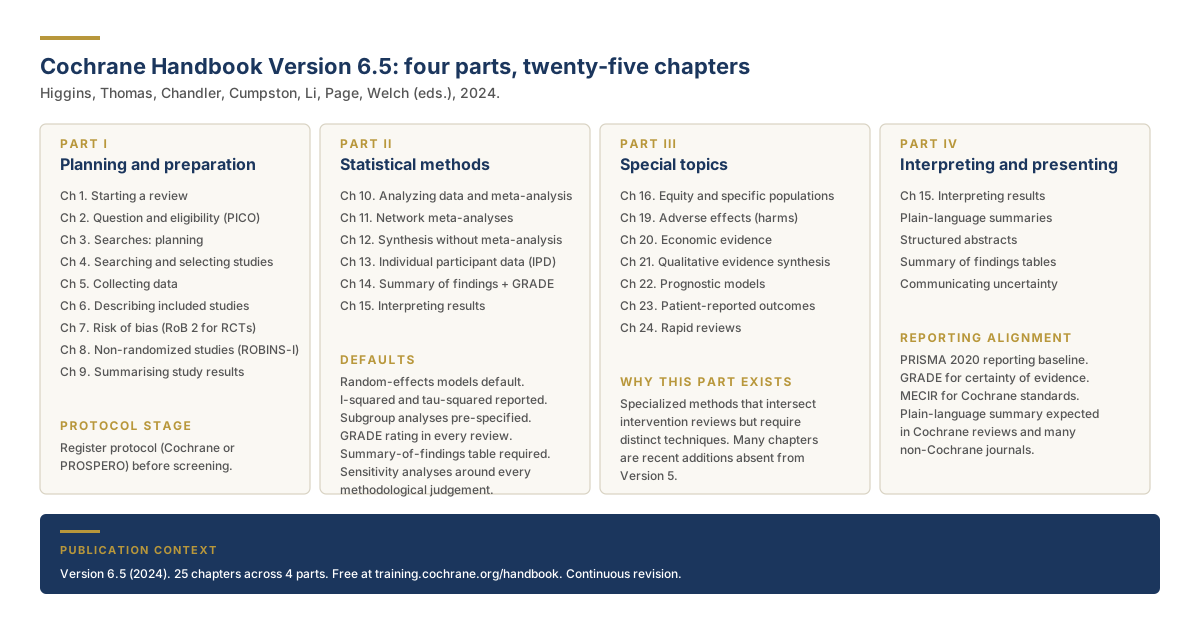
Four parts cover planning, statistical synthesis, special topics, and interpretation across twenty-five chapters.
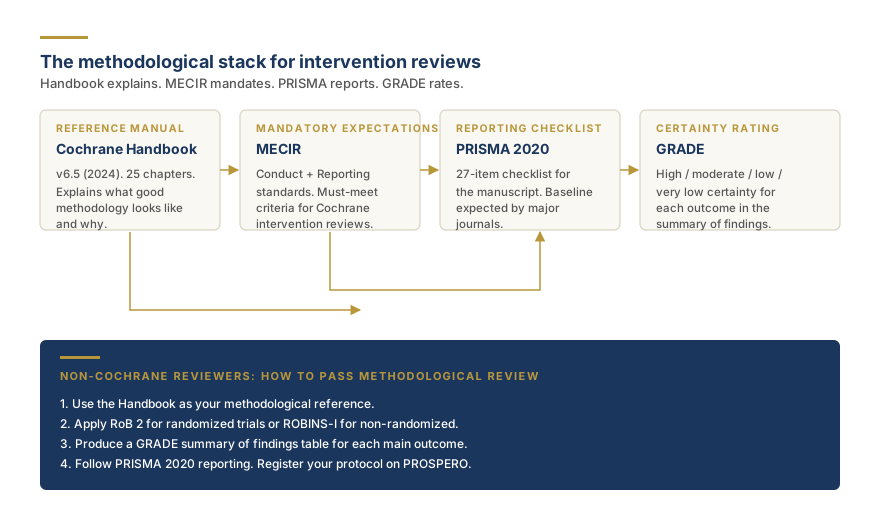
Handbook explains, MECIR mandates, PRISMA 2020 reports, GRADE rates certainty: four documents that operate together.
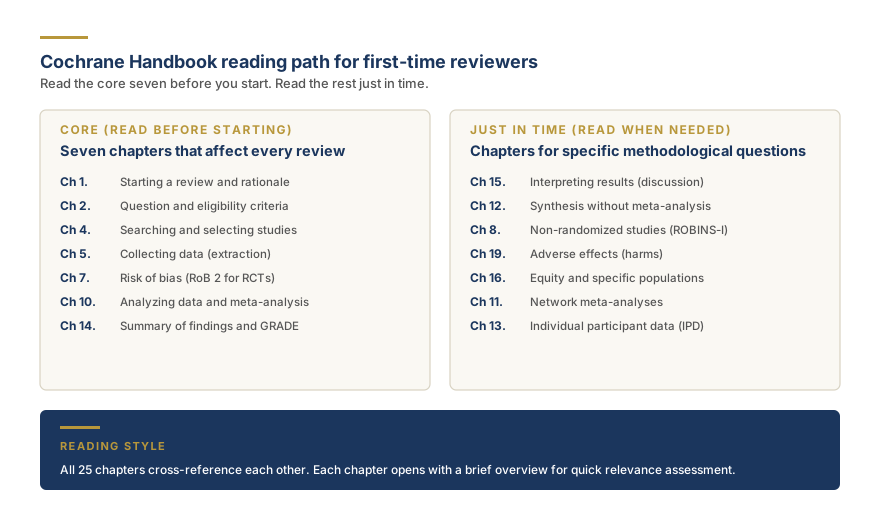
First-time reviewers should read chapters 1, 2, 4, 5, 7, 10, and 14 before starting; the rest can be just-in-time.
Freely accessible at training.cochrane.org/handbook; cite the specific version in the protocol and methods section.
The Cochrane Handbook for Systematic Reviews of Interventions is the methodological reference manual produced by Cochrane that defines best practice for conducting and reporting systematic reviews of healthcare interventions. It is the working manual for every Cochrane Review Group and the de facto standard for non-Cochrane reviewers who want their work to meet contemporary methodological expectations.
The current edition is Version 6.5, released in 2024 and edited by Julian Higgins, James Thomas, Jacqueline Chandler, Miranda Cumpston, Tianjing Li, Matthew Page, and Vivian Welch. It is freely available online at training.cochrane.org/handbook, runs to twenty-five chapters across four major parts, and represents roughly three decades of accumulated methodological consensus.
Version 6.5 and What Changed From Earlier Editions
The Handbook traces back to 1994, when the first version was distributed inside the early Cochrane Collaboration as internal guidance. Through the late 1990s and 2000s, Julian Higgins and Sally Green expanded it into a comprehensive methodological reference that became Version 5 and its successive sub-versions, which dominated systematic-review methodology training for over a decade.
The transition to Version 6.0 in 2019 was the most significant rewrite the Handbook has ever undergone. It coincided with three methodological shifts that the field had absorbed over the prior decade: the new risk-of-bias 2 tool for randomized trials, the maturation of the GRADE framework for rating certainty of evidence, and the imminent arrival of PRISMA 2020 reporting guidance. Version 6.0 was the first edition to integrate all three.
Version 6.5 in 2024 is an incremental but substantive update on Version 6.0. The headline changes are clearer guidance on handling synthesis without meta-analysis, an expanded treatment of equity considerations in review design, updated chapters on network meta-analysis and individual participant data, and refreshed examples throughout. Earlier subversions 6.1, 6.2, 6.3, and 6.4 had each added smaller updates between 2020 and 2023.
Editors, Authorship, and Governance
The Handbook is collectively edited by a group of senior Cochrane methodologists. The current edition lists seven lead editors: Julian Higgins (chief editor since the late 1990s), James Thomas, Jacqueline Chandler, Miranda Cumpston, Tianjing Li, Matthew Page, and Vivian Welch. Each chapter has its own lead authors drawn from the Cochrane Methods Groups, which are the standing working groups responsible for methodological development in specific areas such as statistics, bias, equity, qualitative evidence, and information retrieval.
This authorship structure matters when reading the Handbook. Some chapters are tightly aligned with formal Cochrane policy; others present methods that Cochrane recommends but does not yet require of all reviews; still others describe areas where the field is evolving and the Handbook chapter functions more like a state-of-the-art synthesis than a prescription. A reviewer who treats every sentence as policy will sometimes feel overconstrained. A reviewer who reads carefully will notice the distinctions between must, should, and may.
The Handbook is updated through a continuous-revision model rather than a fixed schedule. Between major versions, individual chapters can be revised when methodological evidence warrants. The version number and the publication date are visible on every chapter page, and reviewers writing a protocol should cite the specific version they are following so future readers know which guidance was in force.
Part I: Planning, Searching, Selecting, Extracting
The first six chapters of the Handbook cover the planning and preparatory phases of a systematic review. Chapter 1 introduces the rationale and process of a review. Chapter 2 defines the review question and the eligibility criteria using a structured framework such as PICO or one of its extensions. Chapter 3 covers searches for studies. Chapter 4 describes searching for and selecting studies. Chapter 5 covers data collection. Chapter 6 covers describing included studies.
The planning chapters establish what the Cochrane methodology insists on at the front end: a registered protocol before screening begins, a structured question with explicit population, intervention, comparator, outcome, and study design criteria, a comprehensive search across multiple databases with no language restrictions in the eligibility criteria when feasible, dual independent screening, and dual independent data extraction with adjudication of disagreements. These standards are tighter than what most non-Cochrane systematic reviews achieve in practice, and they are the operational core of the Cochrane versus non-Cochrane systematic reviews distinction.
Reviewers planning a non-Cochrane review can use Part I as a checklist. Even if you do not register with Cochrane, you can register with PROSPERO, use a Cochrane-style PICO, run a search planned with an information specialist, and conduct dual screening and extraction. These steps align your review with PRISMA 2020 reporting guidelines and signal to editors and peer reviewers that you have followed methodological best practice.
Part II: Statistical Methods and Synthesis
Chapters 7 through 15 cover the statistical and synthesis methods that make Cochrane reviews quantitative when feasible. Chapter 10 covers analyzing data and undertaking meta-analyses, including fixed-effect and random-effects models, weighting schemes, and the interpretation of heterogeneity. Chapter 11 covers undertaking network meta-analyses. Chapter 12 covers synthesis of qualitative evidence and synthesis when meta-analysis is not possible. Chapter 13 covers individual participant data reviews. Chapter 14 covers summary of findings tables and GRADE certainty ratings. Chapter 15 covers interpreting results and drawing conclusions.
The statistical chapters codify the default methodological choices that distinguish Cochrane reviews. Random-effects models are the default for most meta-analyses, although the Handbook discusses when fixed-effect models are appropriate. Heterogeneity is summarized using both I-squared as a percentage of variability and tau-squared as a between-study variance, and the limits of relying on I-squared alone are explicitly noted. Subgroup analyses are restricted to a small number pre-specified in the protocol. Sensitivity analyses are recommended around every methodological judgment.
Where the Handbook is most prescriptive in Part II is the GRADE framework for rating certainty of evidence. Every Cochrane intervention review is expected to include a summary of findings table containing the GRADE certainty rating for each main outcome, the relative effect, the absolute effect estimate, and a comment summarizing the reasons for downgrading or upgrading. This format has become the de facto standard for systematic reviews well beyond Cochrane, including non-Cochrane reviews aiming for high-impact publication.
Part III: Special Topics and Extensions
Part III collects chapters on special topics that intersect with mainstream systematic review methodology but require specialized methods. Chapter 19 covers adverse effects, addressing the methodological challenges of harms reviews where outcomes are often rare, poorly reported, and inconsistent in definition. Chapter 16 covers equity and specific populations, codifying methods for reviews concerned with whether interventions work equally well across socioeconomic, demographic, and geographic groups. Chapter 21 covers qualitative evidence synthesis, drawing on the methodological literature developed by the Cochrane Qualitative and Implementation Methods Group.
Other Part III chapters cover economic evidence, prognostic models, patient-reported outcomes, and rapid reviews. Many of these chapters are recent additions that did not exist in Version 5. They reflect the expansion of Cochrane's methodological scope from a narrow focus on randomized intervention trials in the 1990s to a broader portfolio of evidence syntheses that the field now expects.
For a reviewer outside the Cochrane orbit, Part III is often the most directly useful section. A non-Cochrane reviewer planning a systematic review of healthcare harms or a qualitative synthesis or a review with explicit equity aims will find chapter-length guidance that does not exist anywhere else with comparable rigor and accessibility.
Need professional help with your research?
Our PhD methodologists deliver complete systematic reviews and meta-analyses, from protocol to manuscript.
Part IV covers interpreting and presenting review results. Chapter 15 (Interpreting results) and the reporting-oriented chapters discuss how to summarize findings, communicate uncertainty, present absolute and relative effects, write the discussion, and avoid over-claiming. This is where the Handbook's methodological rigor meets the realities of writing for clinicians, policymakers, and patients.
A consistent theme of Part IV is honesty about uncertainty. The Handbook explicitly cautions against writing conclusions that exceed what the evidence base supports, against headlines that emphasize statistical significance over clinical importance, and against ignoring the GRADE certainty rating in the abstract. Reviewers are reminded that a meta-analysis with low certainty should not be reported as if it had high certainty just because the point estimate is favorable.
The presentation chapters also cover summary of findings tables, plain-language summaries that translate findings for non-specialist readers, and the structured abstract format required for Cochrane reviews. These elements are increasingly expected by non-Cochrane journals as well, and most major medical journals now request a structured abstract and a plain-language summary of meaningful findings.
How the Handbook Relates to MECIR, PRISMA, and GRADE
The Handbook is not the only document a Cochrane reviewer needs to know. It sits alongside MECIR, the Methodological Expectations of Cochrane Intervention Reviews, which translates the Handbook's methodological guidance into a checklist of mandatory and highly desirable expectations. MECIR exists in two forms: MECIR Conduct standards for the review itself, and MECIR Reporting standards for the manuscript.
The relationship is simple. The Handbook explains what good methodology looks like and why. MECIR translates that methodology into specific must-meet expectations for Cochrane reviews. PRISMA 2020 provides the reporting checklist that the manuscript should follow when published. GRADE provides the framework for rating certainty of evidence that the Handbook and MECIR both endorse. Together these four documents constitute the operational standard for a Cochrane intervention review in 2026.
For a non-Cochrane reviewer, the Handbook is still the most useful single reference, but MECIR Reporting standards are also worth a look as a tighter checklist of expectations. PRISMA 2020 is the reporting baseline for non-Cochrane reviews submitted to major journals, and GRADE is increasingly expected for the certainty rating of each outcome.
Using the Handbook for a Non-Cochrane Review
A common question is whether the Handbook applies to reviews that are not registered as Cochrane reviews. The short answer is yes, in the sense that the methodological standards described in the Handbook are broadly applicable to any healthcare intervention review. Major non-Cochrane journals routinely expect reviewers to follow the same dual-screening, dual-extraction, risk-of-bias, and GRADE methodology that the Handbook codifies. The writing a systematic review step by step workflow that most graduate programs teach is essentially the Handbook's planning chapters in summarized form.
There are practical differences. Cochrane reviews must follow MECIR Conduct standards and pass internal Cochrane editorial and peer review. Non-Cochrane reviews are not bound by MECIR but are still expected to meet the same broad methodological bar at publication. In practice, a non-Cochrane review that uses the Handbook as its methodological reference, follows PRISMA 2020 reporting, applies RoB 2 risk of bias for randomized trials or ROBINS-I for non-randomized studies, and produces a GRADE summary of findings table will pass methodological review at most major journals.
A second practical difference is the protocol stage. Cochrane reviews publish a separate, peer-reviewed protocol before the review itself, registered in the Cochrane Database. Non-Cochrane reviews register with PROSPERO. The Handbook's protocol guidance applies in both cases: a protocol with explicit eligibility criteria, a planned search, a pre-specified analysis plan, and a pre-specified risk-of-bias and GRADE workflow.
Where to Find and Read the Handbook
The Handbook is freely available online at training.cochrane.org/handbook. Every chapter is openly accessible without a Cochrane account or institutional subscription. The chapters can be read in a web browser or downloaded as PDFs. The free access model is a deliberate choice: Cochrane wants its methodology to be the global standard, and paywalling the Handbook would have undermined that goal.
There is also a print edition published by Wiley, currently in its second edition aligned with Version 6.0 of the online text. The print edition is useful as a reference but lags behind the online version. For reviewers writing a protocol or methods section, always reference the online Version 6.5 by chapter and section number rather than the print edition.
The Cochrane Training site at training.cochrane.org also offers free online courses that follow the Handbook chapter by chapter. These courses are the most accessible entry point for new reviewers and are routinely recommended by graduate programs as supplementary training.
Chapters Every First-Time Reviewer Should Read
A first-time reviewer does not need to read all twenty-five chapters before starting work. A minimal reading list covers the chapters that will affect almost every methodological decision. Chapter 1 introduces the process and the rationale. Chapter 2 defines the review question. Chapter 4 covers searches and selection. Chapter 5 covers data collection. Chapter 7 covers risk of bias assessment and references RoB 2. Chapter 10 covers meta-analysis. Chapter 14 covers GRADE summary of findings tables.
Beyond this core, Chapter 15 on interpreting results is the most useful chapter for reviewers writing their discussion and conclusion. Chapter 12 on synthesis without meta-analysis is essential for reviews where pooling is not appropriate. Chapter 19 on adverse effects is essential for reviews that include harms outcomes.
The remaining chapters can be read on a just-in-time basis when the review encounters a specific methodological question. The Handbook is designed to support this style of reading: chapters cross-reference each other extensively, and each chapter has a brief overview at the top that allows a reader to decide quickly whether the full chapter is relevant. The systematic review fundamentals primer outlines this just-in-time approach for reviewers new to the framework.
Limitations and What the Handbook Does Not Cover
The Cochrane Handbook is specifically a manual for systematic reviews of healthcare interventions. It is not a general manual for all systematic reviews. Reviews of diagnostic test accuracy follow the separate Cochrane Handbook for Systematic Reviews of Diagnostic Test Accuracy, currently in Version 2. Reviews of prognostic models follow other Cochrane and methodological guidance. Reviews of qualitative evidence have specialized methods covered in Chapter 21, but the methodological detail goes well beyond what the Handbook can cover.
Other gaps include limited coverage of rapid reviews, where methodological practice is evolving quickly, and limited coverage of living systematic reviews, where ongoing updates require workflow infrastructure that the Handbook can describe but not solve. The Handbook also focuses on Cochrane-supported tools and methods, so coverage of non-Cochrane methodological tools is comparatively thin.
These limitations do not undermine the Handbook's central usefulness for intervention reviews. They simply mean that reviewers of diagnostic, prognostic, qualitative, or umbrella reviews need to supplement the Handbook with the appropriate specialized guidance.
Frequently Asked Questions
What is the latest version of the Cochrane Handbook?
The latest version is Version 6.5, published in 2024. It is edited by Julian Higgins, James Thomas, Jacqueline Chandler, Miranda Cumpston, Tianjing Li, Matthew Page, and Vivian Welch, and is freely available at training.cochrane.org/handbook. Version 6.5 is an incremental update on Version 6.0 from 2019, with refreshed chapters on synthesis without meta-analysis, equity, network meta-analysis, and individual participant data reviews.
Is the Cochrane Handbook free?
Yes. The full online version of the Cochrane Handbook is freely available at training.cochrane.org/handbook without a Cochrane account or institutional subscription. Every chapter can be read in a browser or downloaded as a PDF. A print edition is also published by Wiley, but the online version is the most current and is what protocols and manuscripts should cite by chapter and section.
Who writes the Cochrane Handbook?
The Cochrane Handbook is collectively edited by senior Cochrane methodologists. The current edition lists seven lead editors, with individual chapter authors drawn from the Cochrane Methods Groups, which are standing working groups responsible for methodological development in specific areas such as statistics, bias, equity, qualitative evidence, and information retrieval. Each chapter names its specific authors so readers can trace the methodological provenance.
Do I have to follow the Cochrane Handbook for a non-Cochrane review?
No, but the methodological standards described in the Handbook are broadly applicable to any healthcare intervention review and are what major journals expect at publication. A non-Cochrane reviewer who uses the Handbook as the methodological reference, follows PRISMA 2020 reporting, applies RoB 2 or ROBINS-I, and produces a GRADE summary of findings table will pass methodological review at most major journals.
What is the difference between the Cochrane Handbook and PRISMA?
The Cochrane Handbook is a methodological manual that explains how to conduct a systematic review. PRISMA is a reporting checklist that defines how to report a systematic review in a manuscript. The Handbook tells you what to do during the review; PRISMA tells you what to write up afterwards. The two complement each other: the Handbook recommends following PRISMA 2020 for reporting, and PRISMA references the Handbook for methodological detail.
How often is the Cochrane Handbook updated?
The Cochrane Handbook uses a continuous-revision model rather than a fixed schedule. Major versions appear every few years, with Version 6.0 in 2019 and Version 6.5 in 2024. Between major versions, individual chapters can be revised when methodological evidence warrants. The version number and the publication date are visible on every chapter page, and reviewers should cite the specific version they are following so that future readers know which guidance was in force.
Cite Version 6.5 by chapter and section number when writing the methods section.
Pro Tip
Pair the Handbook with MECIR Reporting standards for a tighter checklist of must-meet expectations.
Pro Tip
Use Chapter 14's summary-of-findings template as the deliverable for each main outcome in your review.
Pro Tip
Read Chapter 12 (synthesis without meta-analysis) when heterogeneity or reporting prevents pooling.
Pro Tip
For diagnostic, prognostic, or qualitative reviews, supplement with the specialized Cochrane handbook for that review type.
Frequently Asked Questions
6
The latest version is Version 6.5, published in 2024. It is edited by Julian Higgins, James Thomas, Jacqueline Chandler, Miranda Cumpston, Tianjing Li, Matthew Page, and Vivian Welch, and is freely available at training.cochrane.org/handbook. Version 6.5 is an incremental update on Version 6.0 from 2019, with refreshed chapters on synthesis without meta-analysis, equity, network meta-analysis, and individual participant data reviews.
Yes. The full online version of the Cochrane Handbook is freely available at training.cochrane.org/handbook without a Cochrane account or institutional subscription. Every chapter can be read in a browser or downloaded as a PDF. A print edition is also published by Wiley, but the online version is the most current and is what protocols and manuscripts should cite by chapter and section.
The Cochrane Handbook is collectively edited by senior Cochrane methodologists. The current edition lists seven lead editors, with individual chapter authors drawn from the Cochrane Methods Groups, which are standing working groups responsible for methodological development in specific areas such as statistics, bias, equity, qualitative evidence, and information retrieval. Each chapter names its specific authors so readers can trace the methodological provenance.
No, but the methodological standards described in the Handbook are broadly applicable to any healthcare intervention review and are what major journals expect at publication. A non-Cochrane reviewer who uses the Handbook as the methodological reference, follows PRISMA 2020 reporting, applies RoB 2 or ROBINS-I, and produces a GRADE summary of findings table will pass methodological review at most major journals.
The Cochrane Handbook is a methodological manual that explains how to conduct a systematic review. PRISMA is a reporting checklist that defines how to report a systematic review in a manuscript. The Handbook tells you what to do during the review; PRISMA tells you what to write up afterwards. The two complement each other: the Handbook recommends following PRISMA 2020 for reporting, and PRISMA references the Handbook for methodological detail.
The Cochrane Handbook uses a continuous-revision model rather than a fixed schedule. Major versions appear every few years, with Version 6.0 in 2019 and Version 6.5 in 2024. Between major versions, individual chapters can be revised when methodological evidence warrants. The version number and the publication date are visible on every chapter page, and reviewers should cite the specific version they are following so that future readers know which guidance was in force.
Share
Found this useful? Share it with your colleagues.
Need professional help with your research?
Our PhD methodologists deliver complete systematic reviews and meta-analyses, from protocol to manuscript.
From protocol to publication-ready manuscript. Our PhD-level methodologists handle systematic reviews, meta-analyses, scoping reviews, and more. Most projects deliver in under 2 weeks.
Our promise: Free rework on search, screening, or synthesis if reviewers push back.
4.9 / 5Quote within a few hoursPRISMA 2020 + Cochrane HandbookPhD methodologistConfidential by default
Dr. Sarah Mitchell holds a PhD in Biostatistics from Johns Hopkins Bloomberg School of Public Health and has over 15 years of experience in systematic review methodology and meta-analysis. She has authored or co-authored 40+ peer-reviewed publications in journals including the Journal of Clinical Epidemiology, BMC Medical Research Methodology, and Research Synthesis Methods. A former Cochrane Review Group statistician and current editorial board member of Systematic Reviews, Dr. Mitchell has supervised 200+ evidence synthesis projects across clinical medicine, public health, and social sciences.
From protocol to publication-ready manuscript. Our PhD-level methodologists handle systematic reviews, meta-analyses, scoping reviews, and more. Most projects deliver in under 2 weeks.
CHEERS 2022 checklist explained: all 28 items, what changed from CHEERS 2013, and how to report a cost-effectiveness analysis so payers and journals can use it.
SPIRIT 2025 checklist explained: all 34 items by section, what changed from SPIRIT 2013, and how the protocol lines up with CONSORT 2025 when you report the trial.
ARRIVE 2.0 guidelines explained: the Essential 10 and the Recommended Set, what changed from ARRIVE 2010, and the items journals check in animal research reports.