What Is PROSPERO? The Systematic Review Protocol Registry
PROSPERO explained: what the registry does, eligible review types, registration timing, editorial review, amendments, alternatives like OSF and INPLASY, and best practices.
Dr. Sarah Mitchell
May 14, 2026
Key Takeaways
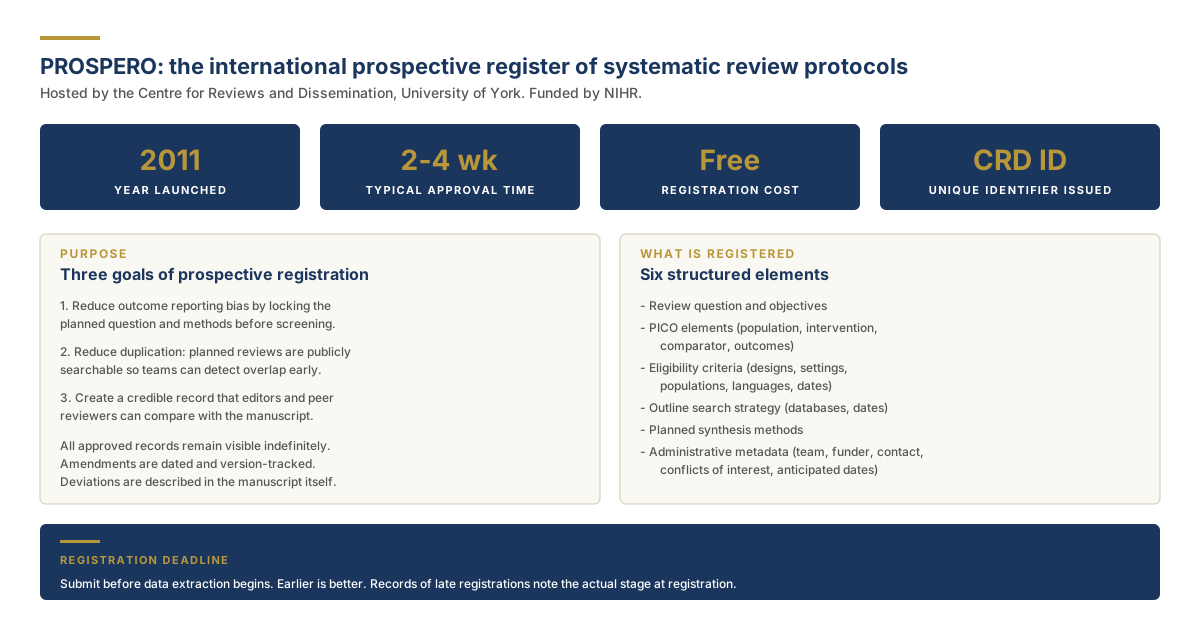
PROSPERO is the free international registry of prospective systematic review protocols, hosted by CRD at the University of York.
Registration must occur before data extraction begins; earlier is better and more credible for accountability purposes.
Eligible review types include systematic, rapid, umbrella, diagnostic accuracy, prognostic, and methodological reviews. Scoping reviews are not eligible.
A unique CRD identifier issued at approval is what journals, peer reviewers, and funders use to verify the published review matches the registered plan.
Amendments are dated and version-tracked. Deviations are described in the manuscript methods section.
PROSPERO is the international prospective register of systematic review protocols, hosted by the Centre for Reviews and Dissemination at the University of York on behalf of the National Institute for Health and Care Research. Launched in 2011 and free to use, it is the largest and most established protocol registry for systematic reviews of healthcare interventions, public health, social care, education, and clinical research.
A PROSPERO record is a structured, publicly searchable description of a planned systematic review, submitted before screening begins or at the latest before data extraction. Once approved, the review receives a unique PROSPERO identifier that journals, peer reviewers, and funders use to verify that the published review matches the registered plan. This guide covers what PROSPERO does, why it exists, who can use it, what review types are eligible, and how it fits alongside alternatives like the Open Science Framework and INPLASY.
Why Prospective Registration Reduces Bias in Systematic Reviews
Prospective registration solves a problem that took the systematic-review community two decades to articulate. Without registration, reviewers can change inclusion criteria, switch primary outcomes, or modify the analysis plan after seeing the data. These post-hoc changes look reasonable at the manuscript stage but can introduce outcome-reporting bias and inclusion bias that are invisible to peer reviewers. The mechanism is the same as in clinical trials, where the move to mandatory prospective registration on ClinicalTrials.gov reduced the gap between planned and reported outcomes.
PROSPERO addresses the analogous problem in evidence synthesis. By making the planned review question, eligibility criteria, search strategy, and synthesis methods publicly visible before any screening happens, the registry creates a credible record against which the finished review can be compared. Editors, methodologists, and peer reviewers can pull the original PROSPERO record and ask whether the manuscript matches the plan or has drifted from it without disclosure.
A second purpose of PROSPERO is deduplication. Hundreds of systematic reviews are started every week worldwide, and many overlap. A reviewer who searches PROSPERO before committing to a question can discover that a similar review is already underway and either join it, change scope, or wait for the existing review to publish. This avoids wasted effort and reduces redundant publications cluttering the literature.
What a PROSPERO Record Contains
A PROSPERO submission collects a fixed set of structured fields. The review question and objectives describe what the review aims to answer. The PICO elements, when applicable, define the population, intervention, comparator, and outcomes. The eligibility criteria specify which study designs, settings, and patient populations are included or excluded. The search strategy lists the databases and date ranges to be searched, with as much specificity as the reviewers can offer at registration. The methods of synthesis outline the planned approach to data extraction, risk of bias assessment, and quantitative or narrative synthesis. Since the platform relaunch in February 2025, the form also asks for a rationale for the review, explicit review objectives, the selection (screening) process, plans for reporting bias and certainty (GRADE) assessment, the peer review status of the protocol, and a designated review guarantor.
The record also captures administrative metadata: the review team and their institutional affiliations, the funder, conflicts of interest, the anticipated start and completion dates, and a contact author who is responsible for keeping the record current. The contact author is the named point of contact for editors and readers, and is also responsible for submitting amendments and recording deviations.
PROSPERO is publicly searchable. All approved records appear in the registry's search interface at crd.york.ac.uk/prospero. This visibility is part of the deduplication function: anyone planning a review can look up whether a similar protocol is already registered. It is also part of the accountability function: a finished review's PROSPERO ID lets any reader pull the original protocol and compare.
Eligible Review Types and the Scoping Review Exception
PROSPERO accepts a defined set of review types and explicitly excludes others. Systematic reviews of interventions, exposures, prognostic factors, prevalence, and methodology are eligible. Rapid reviews that follow systematic methodology with abbreviated steps are eligible. Umbrella reviews that synthesize existing systematic reviews are eligible. Diagnostic test accuracy reviews and prognostic reviews are eligible.
Scoping reviews are not eligible for PROSPERO. This is a deliberate scope decision: scoping reviews have a different methodological purpose (mapping a field rather than answering a focused question), and their protocols are not well-suited to the PROSPERO record structure. Scoping review protocols are typically registered on the Open Science Framework at osf.io instead, where the open structure of OSF accommodates the broader format. The systematic review fundamentals primer covers the conceptual distinction between systematic and scoping reviews.
Methodological reviews are eligible if they follow systematic-review methodology. Living systematic reviews are eligible and are tagged in the registry to alert readers that the record will be updated. Network meta-analyses are eligible. Individual participant data reviews are eligible.
Eligible Protocol Stage: When You Must Register
PROSPERO accepts registrations at any point before data extraction begins. The strongest case for accountability is registration before any screening, when no studies have been read in full text and the team cannot have been influenced by what was found. Registration at title-and-abstract screening or even at full-text screening is still accepted, but later registrations are less protective against bias and the record will indicate the stage at which registration occurred.
Registration after data extraction begins is not accepted. This rule exists because at that point the team has read the included studies in detail and could be influenced by what they have seen when defining the analysis. A protocol registered after data extraction cannot credibly claim to be prospective.
Reviewers occasionally try to register after the review is well underway, sometimes after a journal editor asks for a PROSPERO ID at peer review. In those cases the registry will accept the submission only if data extraction has not started, will record the actual stage at registration, and will note that registration was not fully prospective. Reviewers in this situation are usually better served by registering on the Open Science Framework, which has no eligibility stage requirement, and explaining the timing in the methods section.
How the Registration and Approval Process Works
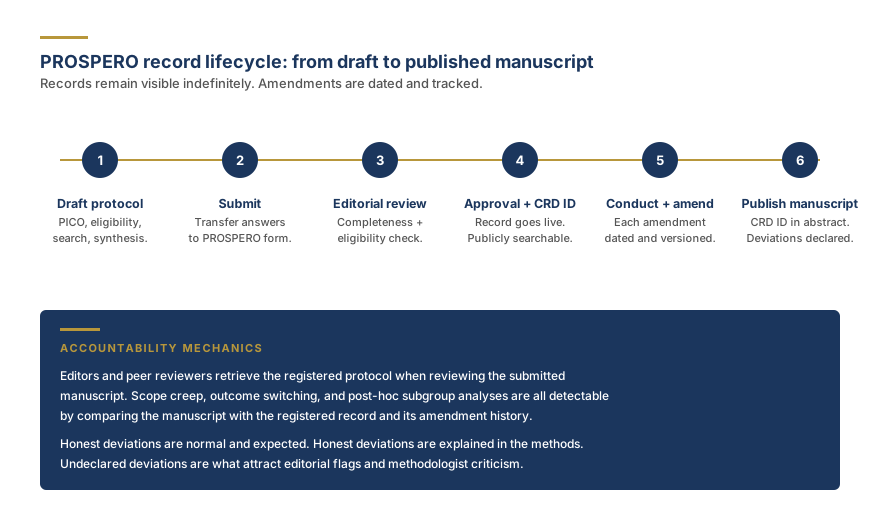
Since the new PROSPERO platform launched on 24 February 2025, submissions go through automated checks rather than a manual editorial queue. The system checks that the submission is complete and that the review type is eligible, and it compares the record against existing registrations to flag similar or duplicate reviews at the point of submission. Every listed team member must then approve the record by email before it is published. The registry does not assess scientific merit or pre-judge the conclusions.
Records are now typically published within days of submission, once all listed authors have approved them; the old weeks-long editorial queue no longer applies. The most common delay is a co-author who has not responded to the approval email. Weak submissions still cause problems, though: incomplete eligibility criteria, vague search strategies, mismatch between the stated review type and the planned methods, and confusion about whether the review is truly systematic. The step-by-step PROSPERO registration walkthrough covers the submission interface and the most common queries reviewers receive.
Once approved, the registration receives a unique PROSPERO identifier beginning CRD (for example CRD420261444111). This ID is what reviewers cite in the manuscript and in correspondence with journals. The record is then publicly visible and remains so indefinitely. The registry does not delete records, even if the review is abandoned or withdrawn. This permanence is what makes PROSPERO usable for accountability purposes.
Want expert help planning your review?
We develop the protocol, deliver it in PROSPERO submission format for you to file, build search strategies, and deliver the complete review. Start strong, finish published.
PROSPERO distinguishes between amendments to the protocol, which are changes made before the relevant work has started, and deviations from the protocol, which are departures discovered during the conduct of the review. Both are expected at some level in any honest review: real-world data extraction often reveals issues the protocol could not have anticipated. The registry's expectation is that changes are documented transparently rather than concealed.
Amendments are submitted through the PROSPERO interface and result in a new dated version of the record. Previous versions remain visible: a reader can always see the original record and every subsequent amendment. This version history is part of the accountability mechanism. A reviewer who quietly changes the primary outcome a week before manuscript submission will leave a trail that editors and methodologists can find.
Deviations are described in the methods section of the published manuscript rather than in the PROSPERO record itself, because by the time deviations are recognized the review is usually well into the synthesis stage. The relevant PRISMA 2020 item asks authors to describe any departures from the protocol and their reasons. A manuscript that lists three or four well-documented deviations from a registered protocol reads as honest; a manuscript that lists no deviations and conspicuously changes the primary outcome reads as suspicious.
How Journals and Funders Use PROSPERO IDs
Major medical journals routinely require a PROSPERO ID at the manuscript submission stage for systematic reviews of healthcare interventions. The ID is reported in the abstract, the methods section, and sometimes in the title page metadata. Editors use the ID to pull the original protocol when assigning peer reviewers and to check the registered plan against the submitted manuscript.
Peer reviewers, when given access to the PROSPERO record, frequently use it to spot scope creep, outcome switching, or post-hoc subgroup analyses. A reviewer who sees that the registered protocol specified two primary outcomes but the manuscript reports only one, with the other relegated to a sentence in the discussion, will flag the discrepancy. The same applies to subgroups: subgroup analyses that appear in the manuscript without appearing in the registered protocol will draw a request for justification.
Funders also use PROSPERO for post-award monitoring. A funded systematic review that does not appear in PROSPERO within a reasonable time after the start date raises a flag, as does a review that registers but then makes substantial changes to the question or methods. Some funders also require PROSPERO registration as a condition of funding, written into the grant agreement.
Searching PROSPERO Before Starting a Review
Before committing to a systematic review topic, every team should search PROSPERO for similar protocols already registered. The registry's search interface accepts free-text queries, MeSH-style keyword combinations, and structured filters by review type, status, and registration date. A few minutes spent searching can prevent months of wasted work.
Useful search patterns include the disease or condition combined with the intervention or exposure, the outcome of interest when it is reasonably specific, and the review type filter to focus on the relevant methodology. The status filter distinguishes between ongoing reviews, completed reviews, and reviews that have been published. An ongoing review with a registration date in the past six months is a different kind of overlap than a review that has been registered for three years without progress, and the implications for your team's planning are different.
If a closely related review is already registered, the practical options are to change scope (different population, different outcome, different time period), adopt a different review type (umbrella review of the topic instead of a fresh systematic review), or contact the registered team about collaboration. Continuing with a duplicative protocol is rarely the right choice. The comprehensive search strategy guide covers the broader literature-search workflow that complements a PROSPERO search.
Alternatives: OSF, INPLASY, and Research Registry
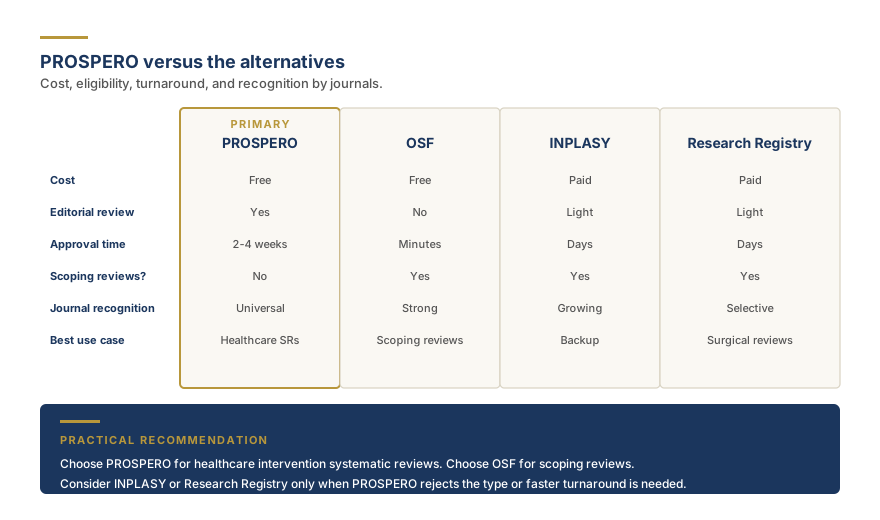
PROSPERO is not the only registry. The Open Science Framework at osf.io accepts protocols for all review types, including scoping reviews and methodologically unconventional protocols. OSF has no review or approval step: registrations are timestamped and immutable, but the platform does not editorially review submissions. This makes OSF faster (registration takes minutes) but less curated than PROSPERO. For scoping reviews, OSF is the default registry.
INPLASY at inplasy.com is a paid registry that accepts a broader range of review types than PROSPERO and offers faster turnaround. It has grown rapidly since launch and is accepted by many journals, but it is not as universally recognized as PROSPERO and the paid model introduces an access barrier. Research Registry is another paid alternative with similar properties.
For most healthcare intervention reviews, the right choice is PROSPERO, both because it is free and because it is the registry editors, funders, and methodologists recognize first. The exception is scoping reviews, where OSF is the standard. For reviews where PROSPERO has rejected the protocol type or where the team needs faster turnaround, INPLASY can be a reasonable alternative as long as the choice is documented in the methods. Reviewers writing the protocol should consult a systematic review protocol template and the PRISMA-P protocol checklist regardless of which registry they choose.
PROSPERO Best Practices
A few practical habits substantially improve a PROSPERO submission. The first is to draft the full protocol before opening the PROSPERO form. The submission interface asks for short answers in specific fields, but the answers should be drawn from a complete protocol document. The interface is not the right place to think through eligibility criteria for the first time. The how to write a systematic review protocol walkthrough explains the protocol-first approach in detail.
The second is to lock down inclusion criteria early. Changes to inclusion criteria after registration leave the largest paper trail and draw the most reviewer attention. Specify the population, the intervention, the comparator, the outcomes, the study designs, and the date and language restrictions in the protocol before submitting, and stick to them.
The third is to plan the search strategy carefully. PROSPERO accepts outline search strategies rather than full search syntax, but the outline should specify the databases, the broad concept blocks, and the date range. A reviewer who submits a vague search strategy and later runs a much more limited search will face the same accountability problem as one who switches outcomes.
The fourth is to name a real contact author who can be reached at the listed institutional address. PROSPERO records are sometimes queried years after registration by readers, editors, or methodologists, and a contact author who has moved without updating the record undermines the registry's utility. Update the record when team members change institutions.
When PROSPERO Registration Is and Is Not Mandatory
PROSPERO registration is not technically mandatory in any global sense: there is no law or universal regulation requiring it. In practice, registration is increasingly required by individual journals for systematic reviews of healthcare interventions, by certain funders as a condition of award, and by certain institutional review boards for reviews involving patient data. The trend is firmly toward universal de facto requirement: a 2024 sampling of high-impact medical journals showed roughly two-thirds explicitly required PROSPERO or equivalent registration in their author instructions.
For non-Cochrane systematic reviews of healthcare interventions, the practical recommendation is to always register on PROSPERO unless the review type is ineligible. Cochrane reviews have their own internal registration process and are registered automatically with the Cochrane Database; they do not also need PROSPERO. For scoping reviews, register on OSF. For methodological reviews, register on PROSPERO if accepted, otherwise OSF.
Frequently Asked Questions
What is PROSPERO used for?
PROSPERO is used to register the protocol of a systematic review prospectively, before screening begins. The registry creates a public, dated record of the planned review question, eligibility criteria, search strategy, and analysis plan. Editors, funders, and peer reviewers later use the record to verify that the published review matches the registered plan, and reviewers searching PROSPERO can avoid duplicating work already underway.
Is PROSPERO registration mandatory?
PROSPERO registration is not mandatory in any universal sense, but it is increasingly required by individual journals, funders, and institutional review boards. As of 2024, roughly two-thirds of high-impact medical journals require PROSPERO or equivalent registration in their author instructions. For most non-Cochrane systematic reviews of healthcare interventions, registration on PROSPERO is the practical default.
How long does PROSPERO registration take?
Since the platform relaunch in February 2025, PROSPERO runs automated checks and publishes records once every listed author approves them, typically within days. The most common cause of delay is a co-author who has not responded to the approval email, followed by incomplete records. Drafting the full protocol before opening the PROSPERO form remains the most effective way to shorten the turnaround.
Can you register a scoping review on PROSPERO?
No. Scoping reviews are explicitly not eligible for PROSPERO. Their methodological purpose (mapping a field rather than answering a focused question) does not fit the PROSPERO record structure. Scoping review protocols should be registered on the Open Science Framework at osf.io, which accepts a broader range of review types and is the default registry for scoping reviews.
Who can register a protocol on PROSPERO?
Any team conducting a systematic review of healthcare or related research can register on PROSPERO. The registry does not restrict registration by country, institution, or career stage. The submission must come from one team member who acts as the contact author and is responsible for keeping the record current. Multiple co-authors can be listed, and the team can update the record when members change.
Is PROSPERO registration free?
Yes. PROSPERO registration is free for all eligible review teams, funded by the National Institute for Health and Care Research. There are no fees at submission, at approval, or for ongoing maintenance of the record. This free-access model distinguishes PROSPERO from some paid alternatives such as INPLASY and Research Registry, which charge submission fees.
Pro Tip
Draft the full protocol before opening the PROSPERO submission form.
Pro Tip
Lock down inclusion criteria, study designs, and primary outcomes before submitting.
Pro Tip
Plan the search strategy with at least databases, concept blocks, and date ranges before submitting.
Pro Tip
Name a contact author who can be reached at the listed institutional address years after registration.
Pro Tip
Search PROSPERO before committing to a topic to detect overlap with already-registered reviews.
Frequently Asked Questions
6
PROSPERO is used to register the protocol of a systematic review prospectively, before screening begins. The registry creates a public, dated record of the planned review question, eligibility criteria, search strategy, and analysis plan. Editors, funders, and peer reviewers later use the record to verify that the published review matches the registered plan, and reviewers searching PROSPERO can avoid duplicating work already underway.
PROSPERO registration is not mandatory in any universal sense, but it is increasingly required by individual journals, funders, and institutional review boards. As of 2024, roughly two-thirds of high-impact medical journals require PROSPERO or equivalent registration in their author instructions. For most non-Cochrane systematic reviews of healthcare interventions, registration on PROSPERO is the practical default.
A complete PROSPERO submission is typically approved within two to four weeks. The actual time depends on registry workload, the completeness of the submission, and any queries that the editorial team raises. Common causes of delay include incomplete eligibility criteria, vague search strategies, and confusion about whether the review type is eligible. Drafting the full protocol before opening the PROSPERO form is the most effective way to shorten the turnaround.
No. Scoping reviews are explicitly not eligible for PROSPERO. Their methodological purpose, mapping a field rather than answering a focused question, does not fit the PROSPERO record structure. Scoping review protocols should be registered on the Open Science Framework at osf.io, which accepts a broader range of review types and is the default registry for scoping reviews.
Any team conducting a systematic review of healthcare or related research can register on PROSPERO. The registry does not restrict registration by country, institution, or career stage. The submission must come from one team member who acts as the contact author and is responsible for keeping the record current. Multiple co-authors can be listed, and the team can update the record when members change.
Yes. PROSPERO registration is free for all eligible review teams, funded by the National Institute for Health and Care Research. There are no fees at submission, at approval, or for ongoing maintenance of the record. This free-access model distinguishes PROSPERO from paid alternatives such as INPLASY and Research Registry, which charge submission fees.
Share
Found this useful? Share it with your colleagues.
Want expert help planning your review?
We develop the protocol, deliver it in PROSPERO submission format for you to file, build search strategies, and deliver the complete review. Start strong, finish published.
Planning Your Review? We Can Take It From Protocol to Publication.
Protocol development, a PROSPERO-ready protocol for you to submit, and a comprehensive search strategy. Our PhD methodologists plan and execute the entire review so you start on the right track.
Our promise: Free rework on search, screening, or synthesis if reviewers push back.
4.9 / 5Quote within a few hoursPRISMA 2020 + Cochrane HandbookPhD methodologistConfidential by default
Dr. Sarah Mitchell holds a PhD in Biostatistics from Johns Hopkins Bloomberg School of Public Health and has over 15 years of experience in systematic review methodology and meta-analysis. She has authored or co-authored 40+ peer-reviewed publications in journals including the Journal of Clinical Epidemiology, BMC Medical Research Methodology, and Research Synthesis Methods. A former Cochrane Review Group statistician and current editorial board member of Systematic Reviews, Dr. Mitchell has supervised 200+ evidence synthesis projects across clinical medicine, public health, and social sciences.
Planning Your Review? We Can Take It From Protocol to Publication.
Protocol development, a PROSPERO-ready protocol for you to submit, and a comprehensive search strategy. Our PhD methodologists plan and execute the entire review so you start on the right track.
CHEERS 2022 checklist explained: all 28 items, what changed from CHEERS 2013, and how to report a cost-effectiveness analysis so payers and journals can use it.
SPIRIT 2025 checklist explained: all 34 items by section, what changed from SPIRIT 2013, and how the protocol lines up with CONSORT 2025 when you report the trial.
ARRIVE 2.0 guidelines explained: the Essential 10 and the Recommended Set, what changed from ARRIVE 2010, and the items journals check in animal research reports.