Survey Data Analysis Service for Researchers and Students
Survey data analysis is the cleaning, validation, and statistical analysis of questionnaire responses. At Research Gold, PhD statisticians take your survey data from raw export to finished output: they clean and recode variables, validate your scales, handle Likert data correctly, run the right tests in R, SPSS, or Stata, and write a results section ready for your thesis or journal.
R, SPSS, Stata, JamoviValidated scale and reliability analysisReproducible syntax at handoff
Short answer
Survey data analysis is the cleaning, validation, and statistical analysis of questionnaire responses. At Research Gold, PhD statisticians take your survey data from raw export to finished output: they clean and recode variables, validate your scales, handle Likert data correctly, run the right tests in R, SPSS, or Stata, and write a results section ready for your thesis or journal.
Free written quote
Scope, timeline, and price before you commit
Quote within a few hours
WhatsApp or email
R, SPSS, Stata, Jamovi
Reproducible syntax at handoff
Likert + validated scales
Reliability and factor analysis
Sitting on a pile of survey responses you do not have time to analyze? Get a free quote and a PhD statistician will reply within a few hours.
Survey responses rarely arrive analysis-ready. Between raw exports, reverse-scored items, and multi-item scales that may or may not hold together, the distance between a spreadsheet of answers and a defensible results section is wider than most researchers expect, and it is exactly the distance where a survey data analysis service earns its place. If you have already collected responses but are unsure which tests to run, how to defend a Likert scale decision, or how to report the output, this page walks through what we cover, the survey data analysis methods we use, and how the work runs from raw dataset to a written write-up.
Why Survey Analysis Goes Wrong Without a Statistician
Surveys look simple, which is precisely why their analysis is so often flawed. The most common failures are not arithmetic errors but design-and-measurement mismatches: treating an ordinal Likert scale item as if it were a continuous variable, running a test whose assumptions the data violate, or drawing causal conclusions from a cross-sectional questionnaire. Reviewers and examiners catch these quickly, and fixing them after submission is expensive.
Good questionnaire data analysis starts before any test is run. It asks what each item actually measures, whether multi-item scales hang together reliably, and which analysis the study design can legitimately support. Getting those decisions right is the difference between a results section that survives peer review and one that triggers a major-revisions letter.
What Our Survey Data Analysis Service Delivers
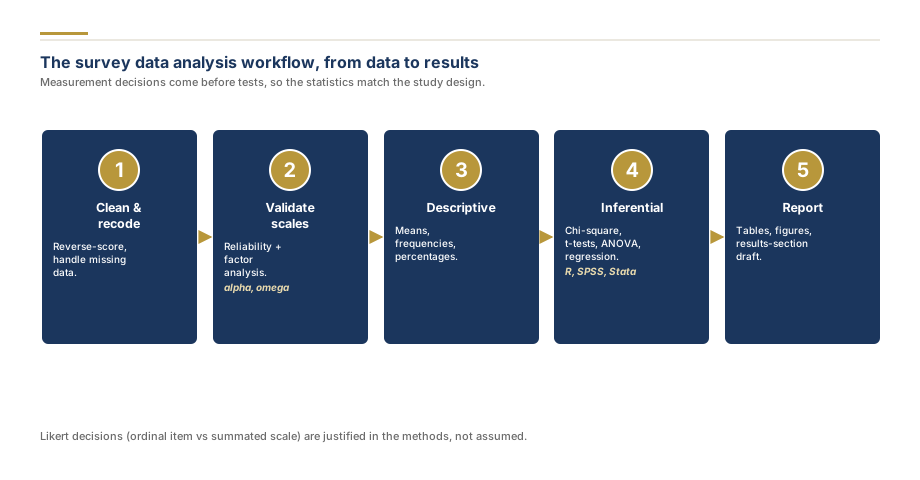
Our survey data analysis service covers the full path from raw responses to a written results section:
Data cleaning and recoding, including reverse-scoring and handling of missing data
Reliability analysis (Cronbach's alpha for internal consistency reliability (Cronbach, 1951), McDonald's omega) for every multi-item scale, depending on your scale structure
Exploratory and confirmatory factor analysis where you use validated instruments, following best practices in exploratory factor analysis (Costello and Osborne, 2005) and COSMIN guidance for measurement properties (Mokkink et al., 2010)
Inferential analysis: chi-square, correlation, t-tests, ANOVA, and regression
Publication-ready tables and figures formatted to your style guide, including the APA Publication Manual, 7th edition (American Psychological Association, 2020), with charts prepared by our data visualization team
A results-section draft written in the conventions of your field
Reproducible R, SPSS, or Stata syntax so your analysis can be re-run and defended
When your survey also has open-ended responses, our qualitative data analysis support codes the free-text answers so the quantitative and qualitative findings sit together in one mixed-methods write-up.
Ready to start? A PhD methodologist will quote your project within a few hours.
Free re-run and re-write if reviewers question the analysis or scales.
Likert scale analysis is where most survey projects stumble. A single Likert item (for example, strongly disagree to strongly agree) is ordinal, and treating it as continuous is hard to defend. A summated scale built from several Likert items, however, can often be analyzed with parametric methods once its reliability is established. We make that decision explicitly, depending on your scale structure: we test the internal consistency of each scale, justify whether items are summed or analyzed individually, and choose parametric or non-parametric tests accordingly. That justification is written into your methods so reviewers see the reasoning, not just the result.
Where scale validation fits before any test
The step most rushed survey analyses skip is scale validation, and it is the one reviewers ask about first. Before a single group comparison or regression runs, we establish whether each multi-item scale is measuring what it claims: internal consistency through reliability analysis, and, where you use a validated instrument, exploratory or confirmatory factor analysis to confirm the structure holds in your sample. Only once the measurement is sound do we move to the inferential tests. That order matters because a significant result on an unreliable scale is not a finding, it is an artefact, and writing the validation into your methods is what lets an examiner or a reviewer trust everything that follows.
Who We Help With Survey Data
Our survey statistics clients span health sciences, nursing, psychology, education, social sciences, and beyond: PhD and master's students analyzing dissertation surveys, academics running questionnaire studies under publication deadlines, and applied teams who need defensible numbers from staff or patient surveys. Every project is matched with a PhD methodologist published in your field, so the reporting conventions fit your discipline. In each case the deliverable is the same: clean output, honest interpretation, and a write-up you can defend in a viva or in peer review. You can review ask about our published survey and measurement work to confirm the standard of the deliverables.
For clinical studies and registries that need the database built and validated first, our study data management team handles collection, cleaning, and lock before analysis.
Ready to move? Get a free quote with a short note about your survey and sample size, or explore the full list of research services to combine analysis with writing, editing, or visualization.
Frequently Asked Questions
6
It depends on your sample size, the number of scales and outcomes, and how much of the results section you need written. A short questionnaire with a couple of validated scales is a smaller job than a large instrument needing confirmatory factor analysis and structural equation modeling. We review your questionnaire and dataset and return one fixed fee, agreed before any work begins and the same for every client worldwide, so you see an itemized quote before committing.
Yes, that is the most common case. You send the responses you have already collected in whatever state they are in, and we clean and recode them, run the analysis, and write the results section. If your survey also has open-ended answers, we can code the free-text strand so the quantitative and qualitative findings sit together in one mixed-methods write-up.
We decide explicitly rather than by default. A single Likert item is ordinal, so treating it as continuous is hard to defend. A summated scale built from several items can often take parametric tests once its reliability is established. We test each scale, justify whether items are summed or analyzed individually, and write that reasoning into your methods so reviewers see the logic behind the choice.
Yes. For every multi-item scale we report internal consistency reliability, typically Cronbach's alpha and McDonald's omega, and where you use a validated instrument we run exploratory or confirmatory factor analysis to confirm the structure holds in your sample. The validation is documented in the methods, not just assumed.
ChatGPT can suggest which test might fit and help draft narrative text, but it cannot reliably run validated statistics on your actual dataset, check assumptions, or ensure the output is correct and reproducible. Survey errors like treating an ordinal Likert item as continuous without justification are easy to make and hard to catch. We use proper statistical software and a PhD statistician verifies every result.
Yes. Every engagement includes annotated, reproducible syntax in SPSS, R, or Stata alongside the cleaned dataset, so you, a supervisor, or a reviewer can re-run any analysis and verify the numbers. Your data is handled confidentially, never published or reused, and returned to you in full at handoff.
Already collected your data? Send us your dataset and we will return clean output, tables, and a written results section.