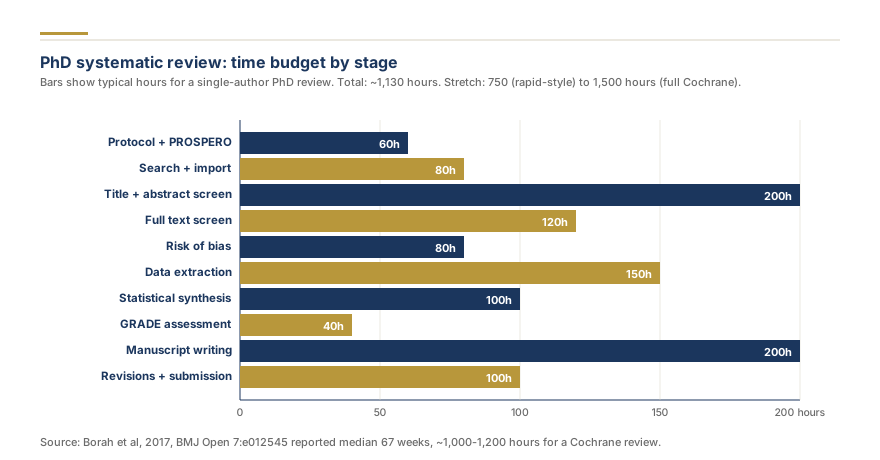
A systematic review for PhD students is one of the most demanding, and most rewarding, pieces of research you will produce during your doctoral journey. Whether it forms a standalone chapter, a published paper, or the methodological backbone of your entire thesis, the systematic review demonstrates your ability to identify, appraise, and synthesize evidence using Cochrane-standard methodology. Getting it right matters: your committee, examiners, and eventual peer reviewers will scrutinize every methodological decision you make.
A systematic review for PhD is a structured evidence synthesis methodology chapter or publishable paper within a doctoral thesis. It follows the same Cochrane Handbook methodology (Higgins et al., 2023) and PRISMA 2020 compliant reporting standards (Page et al., 2021) as any systematic review, requiring a pre-registered protocol, comprehensive multi-database search, dual reviewer screening, risk of bias assessment, and transparent reporting.
We've supported dozens of PhD students through their systematic review chapter work, the most common regret is starting too late and underestimating the screening phase. This guide covers exactly what your committee expects, the step-by-step process, the mistakes that cost PhD students months of rework, and when professional systematic review support makes sense. For a broader walkthrough of methodology, see the full systematic review process.
Why PhD Students Do Systematic Reviews
Systematic reviews have become a core requirement across doctoral programs in health sciences, education, social work, psychology, and business. A PhD systematic review serves one of three structural roles within your thesis, depending on your program's format and your research design.
As a standalone thesis chapter. The most common approach is to include a systematic review as Chapter 2 of a traditional thesis. In this format, the systematic review replaces the conventional literature review with a rigorous, protocol-driven evidence synthesis that maps the current state of knowledge on your topic. Committees increasingly prefer this structure because it demonstrates methodological competency and produces a replicable, transparent evidence base for the remaining chapters.
As a published paper within a PhD by publication. In a PhD by publication (also called a PhD by portfolio or thesis by compilation), each chapter is a standalone manuscript. A systematic review is an ideal first paper because it establishes the evidence gap your subsequent empirical studies will address. Many students publish the systematic review before their data collection chapters, generating an early publication and strengthening the rationale for the entire thesis.
As the entire thesis framework. Some doctoral programs, particularly in nursing, allied health, and evidence-based policy, accept a comprehensive systematic review as the entire thesis. In this format, the systematic review is the primary contribution, often including a meta-analysis and extended discussion of implications for practice and policy.
Disciplines that routinely require or encourage systematic reviews in doctoral work include medicine, nursing, public health, physiotherapy, occupational therapy, psychology, education, social work, and management. If your program does not explicitly require a systematic review, proposing one as your Chapter 2 will almost always strengthen your candidature by demonstrating methodological rigor and producing a publishable output.
What Your Committee Expects from a PhD Systematic Review
Your committee expects the same methodological standards as a peer-reviewed journal submission. The bar for a systematic review dissertation chapter is not lower because you are a student, it is the same bar, and in some cases higher, because your examiners will probe your understanding of every methodological choice during your viva or defense.
PRISMA 2020 compliance. The PRISMA 2020 statement (Page et al., 2021) provides a 27-item checklist and a standardized flow diagram for reporting systematic reviews. Your committee will expect you to follow this checklist. PRISMA 2020 is not optional guidance, it is the reporting standard that journals and thesis examiners use to evaluate whether your review is complete and transparent. Items include a structured abstract, explicit eligibility criteria, documented search strategy, a flow diagram showing study selection at each stage, and pre-specified methods for assessing risk of bias and synthesizing results.
PROSPERO protocol registration. PROSPERO protocol registration is the process of publicly registering your systematic review protocol before you begin screening. PROSPERO, maintained by the Centre for Reviews and Dissemination at the University of York, is the international prospective register for systematic reviews with health-related outcomes. Registration locks your methodology, prevents post-hoc changes to eligibility criteria or outcomes, and signals methodological credibility. Many PhD committees now expect PROSPERO registration as a minimum standard (CRD, University of York). Retrospective registrations, submitted after screening has begun, are flagged, weakening the review's methodological credibility.
Dual-reviewer screening. Cochrane Handbook methodology requires at least two independent reviewers for study screening, even for student-led systematic reviews (Higgins et al., 2023, Chapter 4). Dual reviewer screening means that two people independently assess titles, abstracts, and full texts against your eligibility criteria, then resolve disagreements through discussion or a third reviewer. Solo screening is a methodological weakness that examiners will challenge. Your supervisor is not a substitute for a second reviewer, independence means neither screener influences the other's decisions during the initial assessment.
PICO framework. Your research question PICO structure is the foundation of your entire review. The PICO framework (Population, Intervention, Comparison, Outcome) structures your research question into searchable, operationalizable components. Examiners will ask why you chose each element and how it maps to your eligibility criteria. For qualitative or non-intervention reviews, the PEO (Population, Exposure, Outcome) or PICo (Population, Interest, Context) variants apply. Use our try our pico framework generator to refine your question before your committee meeting.
Risk of bias assessment. Every included study must be assessed for risk of bias using a validated tool. The choice of tool depends on your study designs: RoB 2 (Revised Cochrane risk-of-bias tool) for randomized controlled trials, ROBINS-I (Risk Of Bias In Non-randomized Studies of Interventions) for non-randomized studies, and the Newcastle-Ottawa Scale (NOS) for observational studies. Your committee will expect you to justify your choice of tool, present results in a summary table or traffic-light plot, and discuss how bias across studies affects confidence in your findings.
Step-by-Step Systematic Review Process for PhD Students
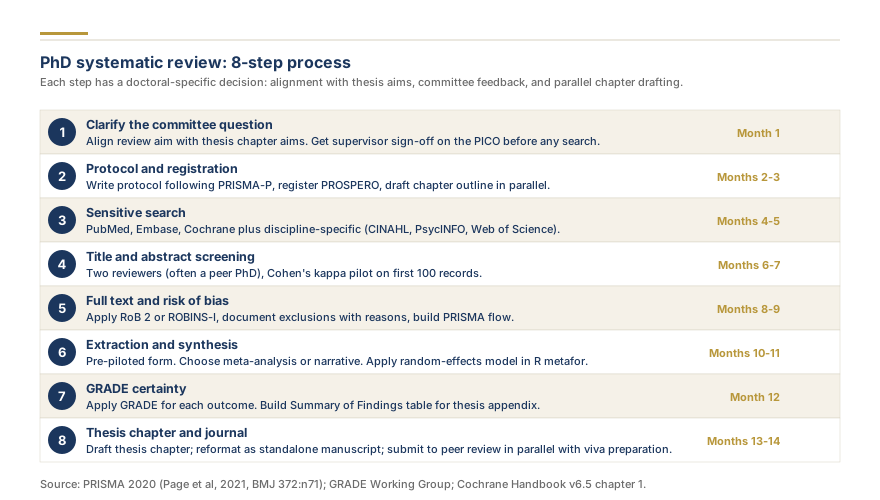
The systematic review process follows the same sequence regardless of whether you are a PhD student or a senior researcher. The difference is that as a student, you are learning the methodology while executing it, which is why each step takes longer and why clear documentation of your decisions is critical for your viva.
Define Your Research Question Using PICO
Start with a focused, answerable research question structured using the PICO framework. A well-defined PICO determines your eligibility criteria, search terms, and the scope of your review. The most common PhD mistake at this stage is defining the question too broadly. A question like "What is the effectiveness of physiotherapy?" cannot be answered by a single systematic review. A focused alternative, "What is the effectiveness of manual therapy compared to exercise therapy for chronic low back pain in adults?", specifies each PICO element and produces a manageable, searchable scope.
Draft your PICO elements, discuss them with your supervisor, and refine based on preliminary scoping searches. A scoping search of 30–60 minutes in PubMed or Google Scholar will reveal whether your question yields too many studies (narrow the population or outcome), too few (broaden the intervention or comparison), or overlaps with an existing recent review (differentiate your focus). To test that last point quickly, the research gap checker reports how many systematic reviews already exist on your question and how many trials have been published since the most recent one.
Register Your Protocol on PROSPERO
Once your PICO is finalized and your committee has approved your review question, register your protocol on PROSPERO. The registration form requires you to specify your review title, research question, eligibility criteria, databases to be searched, screening process, data extraction plan, risk of bias tool, and synthesis method. Registration typically takes 2–4 weeks for approval.
Register before you begin screening. This timing is critical. A protocol registered after screening has begun is flagged as retrospective, which undermines the primary purpose of registration: preventing data-driven changes to your methodology. Your PROSPERO registration number (e.g., CRD42026XXXXXX) should appear in your thesis chapter, any published manuscript, and your PRISMA flow diagram.
Build Your Search Strategy
A comprehensive, reproducible search strategy is the backbone of your systematic review. You must search a minimum of two databases (Cochrane Handbook recommendation), though most PhD systematic reviews search four to six: PubMed/MEDLINE, Embase, CINAHL, PsycINFO, Cochrane Library, and one or more discipline-specific databases. Each database requires a tailored search string using controlled vocabulary (MeSH terms, Emtree terms) and free-text keywords combined with Boolean operators.
University librarians are your most underused resource at this stage. Most academic libraries offer systematic review search support at no cost. A librarian will help you identify relevant databases, construct Boolean search strings, select MeSH terms, and peer-review your strategy for completeness. The PRESS checklist (Peer Review of Electronic Search Strategies) provides a framework for evaluating search quality.
Document your full search strategy for every database. PRISMA 2020 requires that the complete search strategy for at least one database is reported in the manuscript or supplementary materials. For your thesis, include all strategies.
Screen with a Co-Reviewer
Import your search results into a reference manager (Endnote, Zotero) or a systematic review platform (Covidence, Rayyan) and remove duplicates. If you have not settled on a manager yet, start with our comparison of Zotero and Mendeley. Screening proceeds in two stages: title-and-abstract screening, followed by full-text screening of potentially eligible studies. For a free option with relevance ranking and agreement scoring, use our title and abstract screening with kappa scoring.
Both stages require dual reviewer screening. You and your co-reviewer independently apply the eligibility criteria, then compare decisions. Disagreements are resolved by discussion or, if consensus cannot be reached, by a third reviewer. Record your inter-rater agreement (Cohen's kappa) at both stages, examiners frequently ask for this metric as evidence of screening rigor.
Recruit your co-reviewer early. A fellow PhD student in your program is ideal: you can screen for each other's reviews, which is faster and more cost-effective than hiring an external screener. If no colleague is available, a professional systematic review support service can provide independent screening.
Extract Data and Assess Quality
Design a data extraction form before you begin. The form should capture study characteristics (author, year, country, design, sample size), participant characteristics (age, sex, condition), intervention and comparison details, outcomes (primary and secondary), and results (effect estimates, confidence intervals, p-values). Pilot the form on two or three studies and refine it before extracting the full set.
Data extraction should also be performed by two independent reviewers, with discrepancies resolved by discussion. In practice, many PhD students extract data independently and have a second reviewer verify a random sample (e.g., 20–30% of studies). This approach is acceptable if documented and justified in your methods.
Assess each included study for risk of bias using your pre-specified tool (RoB 2, ROBINS-I, or the Newcastle-Ottawa Scale). Present results in a risk-of-bias summary figure (traffic-light plot) and a summary table showing domain-level judgments for each study.
Synthesize and Write Up
Your synthesis approach depends on the heterogeneity of your included studies. If studies are sufficiently homogeneous in population, intervention, comparison, and outcome, a meta-analysis is appropriate. If clinical or methodological heterogeneity is too great, a narrative synthesis structured around your PICO elements is the correct approach. Both are valid, do not force a meta-analysis when heterogeneity makes pooling inappropriate.
For narrative synthesis, use the Synthesis Without Meta-analysis (SWiM) reporting guideline (Campbell et al., 2020). For meta-analysis, follow the Cochrane Handbook guidance on model selection (random-effects vs. fixed-effect), heterogeneity assessment (I-squared, tau-squared), and sensitivity analysis.
Write your chapter following the PRISMA 2020 structure: rationale, objectives, protocol and registration, eligibility criteria, information sources, search strategy, selection process, data collection, risk-of-bias assessment, synthesis methods, results (study selection flow diagram, study characteristics, risk-of-bias results, synthesis results), discussion, and conclusions. Include the PRISMA flow diagram showing the number of records at each stage. For guidance on how this chapter fits into a broader thesis, see delegating your systematic review project for common workflows.
5 Mistakes PhD Students Make with Systematic Reviews
These five errors account for the majority of systematic review rework, examiner criticism, and journal rejections among PhD students. Each is avoidable with proper planning.
1. Defining the research question too broadly. Scope creep is the most common PhD-specific pitfall. A question that is too broad produces thousands of search results, makes screening unmanageable, and forces you to either narrow retrospectively (undermining your protocol) or spend months on a review that cannot be completed within your candidature. Use the PICO framework to constrain each element. If a scoping search returns more than 3,000 records after deduplication, your question is likely too broad.
2. Screening alone. Solo screening is a methodological weakness that examiners and peer reviewers will identify immediately. Cochrane Handbook methodology requires at least two independent reviewers for study screening (Higgins et al., 2023, Chapter 4). Screening alone introduces selection bias and removes the inter-rater reliability check that validates your eligibility criteria. Recruit a colleague, use a professional screening service, or at minimum have a second reviewer independently screen a random sample and report agreement statistics.
3. Not registering on PROSPERO. Skipping PROSPERO protocol registration saves a few hours in the short term but costs credibility at every subsequent stage. Without a registered protocol, you cannot demonstrate that your eligibility criteria, outcomes, and analysis plan were pre-specified. Examiners will question whether your methods were influenced by the results. Registration takes 30–60 minutes to complete and 2–4 weeks for approval, a trivial investment relative to the multi-year timeline of a PhD.
4. Using the wrong risk-of-bias tool. RoB 2 is designed for randomized controlled trials. ROBINS-I is designed for non-randomized studies of interventions. The Newcastle-Ottawa Scale is designed for observational studies (cohort and case-control). Using the wrong tool produces invalid quality assessments. Check the Cochrane Handbook (Chapter 8) for guidance on tool selection, and justify your choice in your methods section. If your review includes mixed study designs, you may need more than one tool.
5. Treating the systematic review as a literature review. A systematic review is not a narrative summary of what you have read. It is a structured, protocol-driven evidence synthesis methodology with explicit eligibility criteria, a reproducible search strategy, independent dual screening, standardized data extraction, risk-of-bias assessment, and transparent reporting. PhD students who approach a systematic review as though it were a traditional literature review produce work that fails to meet PRISMA 2020 standards and is not publishable. If you need to understand the distinction in detail, see our comparison of the full systematic review process.