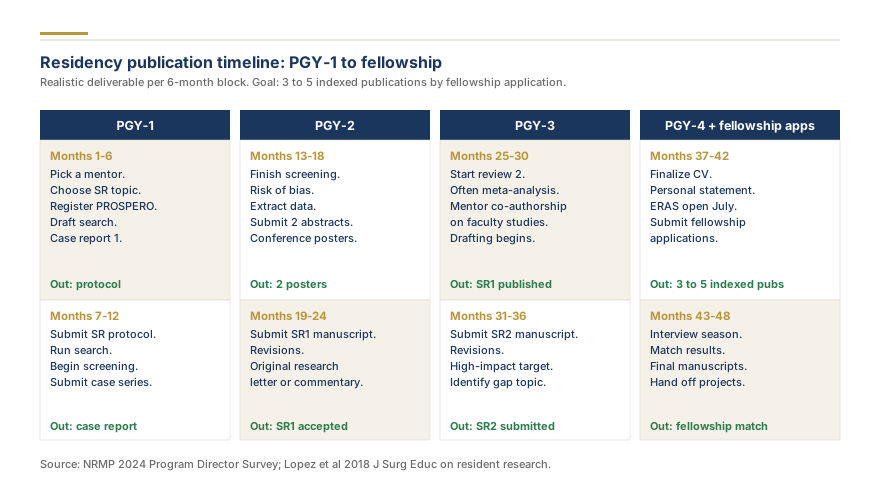
A publication strategy for residency is the single most controllable factor that separates competitive fellowship applicants from the rest of the field. The National Resident Matching Program (NRMP) Charting Outcomes data consistently shows that matched applicants in competitive specialties average 10 to 20 peer-reviewed publications, while unmatched applicants average 3 to 7. The difference is not talent or intelligence. It is planning. Residents who treat publications as a multi-year pipeline, rather than a last-minute scramble before ERAS submission, produce more papers, target better journals, and accumulate the research metrics that fellowship program directors actively screen for. This guide provides a concrete, year-by-year plan from PGY-1 through PGY-5 and beyond, with realistic timelines, journal selection strategy, and specific tactics for managing multiple manuscripts simultaneously while carrying a full clinical workload.
Building Your Research Infrastructure in PGY-1
Your intern year is not the year to publish five papers. It is the year to build the systems that will produce those papers over the next three to four years. Residents who skip this foundation phase spend PGY-2 and PGY-3 catching up on basics that should have been settled during orientation month.
Identify two to three research mentors within your first 60 days. One should be a clinician-scientist in your target fellowship subspecialty. Another should be a senior resident or junior faculty member who has recently navigated the publication process successfully. The third, if available, should be someone outside your department who can offer collaboration opportunities and a different methodological perspective.
Create your digital research identity during the first month. Register for an ORCID identifier, set up a Google Scholar profile, and create a PubMed My Bibliography account. These three profiles will track your citations, make your work discoverable, and serve as a living CV supplement when program directors search your name online. Linking your ORCID to journal submission systems also prevents attribution errors across institutions.
Start a manuscript tracking spreadsheet that logs every project with its current stage (data collection, analysis, drafting, submitted, in revision, accepted, published), target journal, co-authors, and next action item. This spreadsheet becomes the command center for your entire publication pipeline over the next several years.
During PGY-1, aim for one to two case reports or brief communications submitted by the end of the academic year. Case reports require minimal protected research time, teach you the full submission-revision-publication cycle, and produce indexed publications that count on your CV. Journals like BMJ Case Reports, Cureus, and specialty-specific case report journals have acceptance rates of 40 to 60 percent and turnaround times of 4 to 8 weeks, making them ideal training grounds.
Begin collecting data for a larger project that will become your PGY-2 or PGY-3 manuscript. Prospective data collection during intern year, even 15 minutes per day of chart review or database entry, creates a dataset that pays dividends in later years when you have slightly more bandwidth for analysis and writing.
Scaling Output in PGY-2: From Case Reports to Original Research
PGY-2 is the transition year where your publication strategy shifts from learning the process to producing substantive work. You now understand the clinical workflow, have identified your research niche, and should have at least one published or accepted case report from intern year.
Target two to four manuscript submissions during PGY-2. At least one should be an original research article (retrospective cohort, cross-sectional study, or quality improvement project). Original research carries significantly more weight than case reports on fellowship applications, and NRMP Charting Outcomes data from the Accreditation Council for Graduate Medical Education (ACGME) tracked specialties confirms that fellowship programs value original contributions.
Launch a systematic review project in PGY-2. Systematic reviews and meta-analyses are among the highest-cited study types in medicine, and they require no IRB approval, no patient enrollment, and no prospective data collection. A well-executed full-service systematic review with a meta-analysis can be completed in 3 to 6 months and published in a mid-tier to high-tier journal. The key is starting with a focused clinical question, registering your protocol after understanding what PROSPERO is, and using validated tools like the PRISMA diagram builder to ensure methodological rigor from day one. For a detailed walkthrough, see our guide on how to write a systematic review step by step.
Submit your first conference abstract at the PGY-2 stage. National specialty conferences (AHA Scientific Sessions, ASCO Annual Meeting, ACG, AAD) accept abstract submissions 6 to 9 months before the conference date. A poster or oral presentation at a national meeting adds a distinct line item to your CV and demonstrates to fellowship programs that your work has been peer-vetted at the national level.
Learn to pipeline manuscripts. The most productive resident-researchers never work on just one project at a time. They maintain two to three projects at different stages: one in data collection, one in analysis or drafting, and one in submission or revision. When you submit a manuscript and enter the 4 to 12 week review waiting period, you immediately shift your writing time to the next project in the pipeline. This approach transforms dead time into productive time and doubles or triples your annual output without requiring additional hours.
PGY-3: Peak Productivity and Strategic Journal Selection
PGY-3 is your highest-output year. You have enough clinical competence that the learning curve no longer consumes your entire cognitive bandwidth. You have datasets maturing from PGY-1 and PGY-2 data collection. And you have 12 to 18 months before ERAS opens, which creates urgency without panic.
Aim for four to six submissions during PGY-3, with at least two original research articles and one systematic review or meta-analysis. If you started your systematic review in PGY-2, it should be submitted or published by mid-PGY-3, giving it time to appear on PubMed before your fellowship application.
Journal selection becomes strategic at this stage. The two variables that matter most for a resident's publication strategy are impact factor and acceptance rate, and they pull in opposite directions. High-impact journals (impact factor above 5) carry prestige but have acceptance rates of 5 to 15 percent and review timelines of 3 to 6 months. Mid-tier specialty journals (impact factor 2 to 5) accept 20 to 35 percent of submissions and typically return decisions within 6 to 10 weeks. For residents on a fellowship application timeline, the math often favors targeting mid-tier journals where a faster acceptance timeline means the paper is indexed and citable before your application deadline.
The 70/30 rule works well for residents: submit 70 percent of your manuscripts to journals where you realistically expect acceptance within one to two submission cycles, and 30 percent to reach journals where acceptance would be a significant CV achievement. This prevents the common trap of repeatedly submitting to top-tier journals, collecting rejections for 6 to 12 months, and arriving at ERAS season with manuscripts "in preparation" rather than published.
Use the impact factor strategically, not emotionally. A paper published in a journal with an impact factor of 2.5 counts on your CV and is indexed on PubMed. A paper rejected three times from journals with impact factors above 10 and still sitting on your desk counts as nothing. Fellowship program directors reviewing 300 to 500 applications care about your total publication count, the quality of journals (are they indexed and peer-reviewed?), and whether you have first-author or senior-author contributions. They are not comparing the difference between an impact factor of 3.1 and 4.2.
Track your H-index on Google Scholar starting in PGY-3. While a resident's H-index will be modest (typically 1 to 5), watching it grow provides concrete evidence that your work is being cited, which signals genuine impact beyond simple publication counts. Some fellowship programs in cardiology, gastroenterology, and pulmonary/critical care now list H-index expectations in their selection criteria.
Conference Strategy and Abstract Pipeline
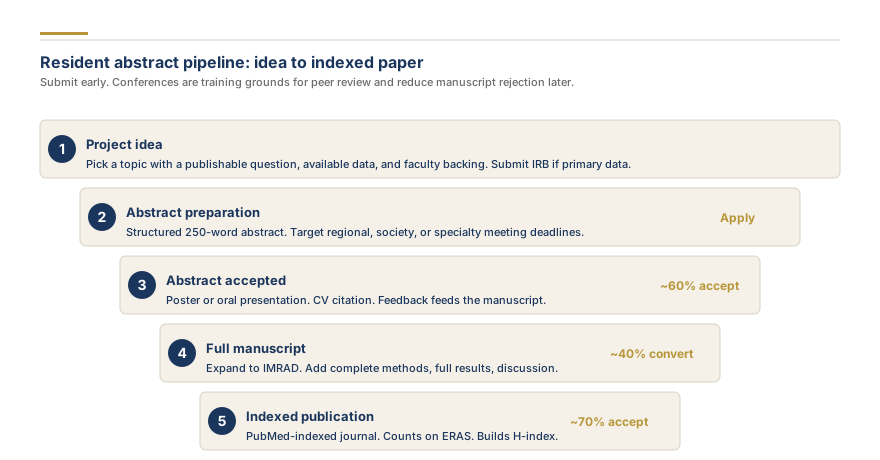
Conference presentations serve a dual purpose in your publication strategy: they add separate line items to your CV, and they generate feedback that improves your manuscripts before journal submission.
Build a conference calendar at the start of each academic year. Map every relevant national and regional conference with its abstract submission deadline, notification date, and presentation date. Most specialty conferences accept abstracts 6 to 9 months in advance. Working backward from these deadlines, you can plan which datasets will be ready for abstract submission and which need more time.
Submit abstracts from works in progress, not only completed studies. Conference abstracts can present preliminary data, pilot results, or interim analyses. A poster presentation of preliminary findings from your PGY-2 dataset generates early feedback and adds a CV entry, even if the full manuscript will not be submitted for another 6 months.
Convert every conference presentation into a manuscript. The data already exists, the analysis is done, and you have received peer feedback during the presentation. The marginal effort to convert a poster abstract into a brief communication or original article is far less than starting from scratch. Residents who present at conferences without subsequently publishing the full work leave significant CV value on the table.
Target two to four conference abstracts per year starting in PGY-2. National meetings carry the most weight, but regional and state-level conferences have higher acceptance rates (often 50 to 70 percent) and shorter turnaround times, making them valuable for building momentum early in training.
Managing Revisions While on Clinical Service
Receiving a "revise and resubmit" decision from a journal is excellent news. It means the editors see value in your work and are offering you a path to publication. But for a resident juggling 60 to 80 hour clinical weeks, a revision request with a 30 to 60 day deadline can feel impossible. Your publication strategy must include a revision management plan.
Respond to every revision within three weeks of receiving the decision letter, regardless of your clinical schedule. This is the single most important habit for maintaining your publication pipeline. Journals that offer revise-and-resubmit decisions expect timely responses, and delays beyond 60 days risk the paper being treated as a new submission, losing your original reviewers, or being withdrawn. Understanding how to respond to peer reviewers effectively is a skill that directly accelerates your publication rate.
Block revision time immediately. When a revision decision arrives, open your calendar and block two to three 90-minute sessions within the next two weeks. Do not wait for a "less busy" rotation. That rotation rarely comes, and the revision deadline will arrive while you are still waiting.
Use the point-by-point response format. Copy every reviewer comment into a response document, number each point, and write your response directly below it. This structured approach makes the revision process manageable in short sessions because you can address two to three reviewer points per sitting rather than trying to conceptualize the entire revision at once.
Delegate statistical revisions strategically. When reviewers request additional subgroup analyses, sensitivity analyses, or alternative statistical models, this is where professional meta-analysis services and medical writing support become force multipliers. A resident spending 20 hours teaching themselves how to run a forest plot with subgroup analysis could invest that same time writing the next manuscript and outsource the technical statistical work to someone who can deliver it in a fraction of the time.
Planning a multi-year publication strategy and need help with the statistical heavy lifting? Research Gold provides professional outsourced systematic review and meta-analysis services that handle everything from protocol registration through publication-ready results. Residents get a complete deliverable, including PRISMA documentation, forest plots, risk of bias assessment, and a methods section ready for journal submission, so you can focus your limited time on clinical training and writing. tell us about your project to see how we can support your research pipeline.