A systematic review as a medical student is one of the most realistic paths to a peer-reviewed publication before residency applications. Unlike clinical trials or bench research, systematic reviews do not require IRB approval, patient recruitment, lab access, or funding. You need a laptop, database access through your medical school library, and a structured methodology. The ACGME recognizes scholarly activity as a core competency, and the NRMP Charting Outcomes data consistently shows that matched applicants in competitive specialties average three to five research experiences on their ERAS applications. A well-executed systematic review, particularly one that includes a meta-analysis, demonstrates the ability to critically appraise literature, synthesize evidence, and contribute original findings to your field. This guide walks you through every stage of the process, from selecting a topic to submitting your manuscript, with honest timelines and practical advice for students who have never published before.
Why Systematic Reviews Are the Best First Publication for Medical Students
Medical students face a unique research challenge: they need publishable research for residency applications, but they have limited time, no independent funding, and often no established lab affiliation. Systematic reviews solve all three problems simultaneously.
No IRB approval required. Because systematic reviews analyze previously published data, they do not involve human subjects and therefore do not require institutional review board approval. This eliminates weeks or months of protocol development and ethics review that would delay a clinical study. You can start working on day one.
No patient recruitment or data collection. Clinical studies stall when enrollment is slow. Systematic reviews use data that already exists in published literature. Your "data collection" is searching databases and extracting information from published papers, which you can do from anywhere with an internet connection.
Flexible scheduling. You can work on a systematic review during any block of free time. Preclinical students can dedicate focused weeks during breaks. Clinical students can chip away at screening and data extraction between rotations. The work is modular and can be paused and resumed without losing progress.
High citation potential. Systematic reviews and meta-analyses sit at the top of the evidence hierarchy. They are cited more frequently than individual studies because clinicians, guideline developers, and other researchers rely on them to summarize entire bodies of evidence. A single well-placed systematic review can generate dozens of citations within two to three years of publication.
Transferable skills. The process of conducting a systematic review teaches critical appraisal, literature searching, data extraction, risk of bias assessment, and evidence synthesis. These are skills you will use throughout residency, fellowship, and your clinical career, regardless of specialty.
The NRMP Program Director Survey consistently ranks research experience among the top factors in residency selection. For competitive specialties like dermatology, orthopedic surgery, plastic surgery, and otolaryngology, publications are not optional. A systematic review gives you a realistic path to one or more publications within the timeline of medical school.
What the Match Data Actually Shows About Research
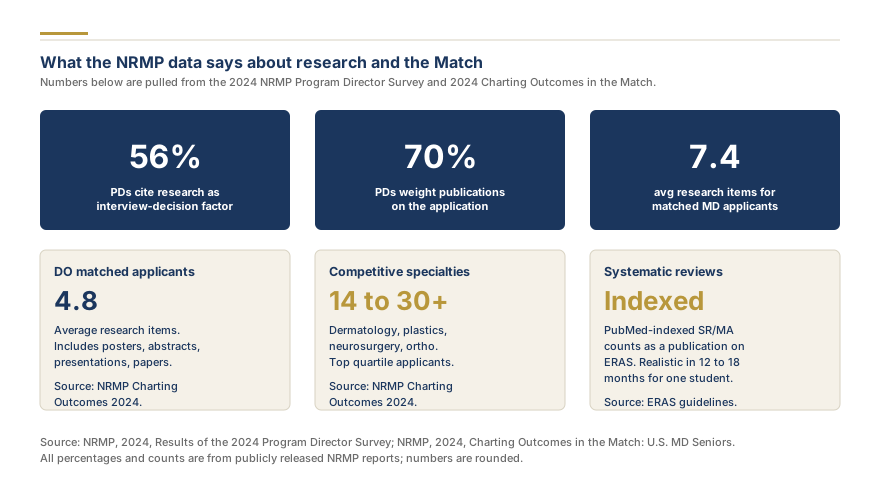
Understanding how research factors into the match helps you set realistic goals and prioritize your time effectively.
The NRMP Charting Outcomes in the Match report provides specialty-specific data on the research profiles of matched and unmatched applicants. In the most competitive specialties, the numbers are stark. Matched dermatology applicants average 17.4 research experiences and 6.1 peer-reviewed publications. Matched plastic surgery applicants average 15.9 research experiences. Even in less competitive fields, matched applicants consistently have more research than unmatched applicants.
Quality matters more than quantity for most specialties. Outside the top five most competitive specialties, program directors value demonstrated scholarly ability over sheer publication count. One thoughtful, well-conducted systematic review with a meta-analysis demonstrates more research competence than three poster abstracts from projects where your contribution was minimal.
ERAS allows you to categorize research by type. When you list a systematic review on your ERAS application, reviewers immediately understand the scope of the project. They know you formulated a research question, conducted a comprehensive literature search, screened hundreds of articles, extracted data, assessed quality, and synthesized findings. That is a complete research experience, and it carries more weight than a case report or a conference abstract.
The ACGME requires scholarly activity during residency across all specialties. Starting a systematic review during medical school not only strengthens your ERAS application but also prepares you for the research expectations you will face as a resident. Programs want applicants who can hit the ground running with research, and having completed a systematic review demonstrates exactly that.
Realistic Timelines: Preclinical vs. Clinical Years
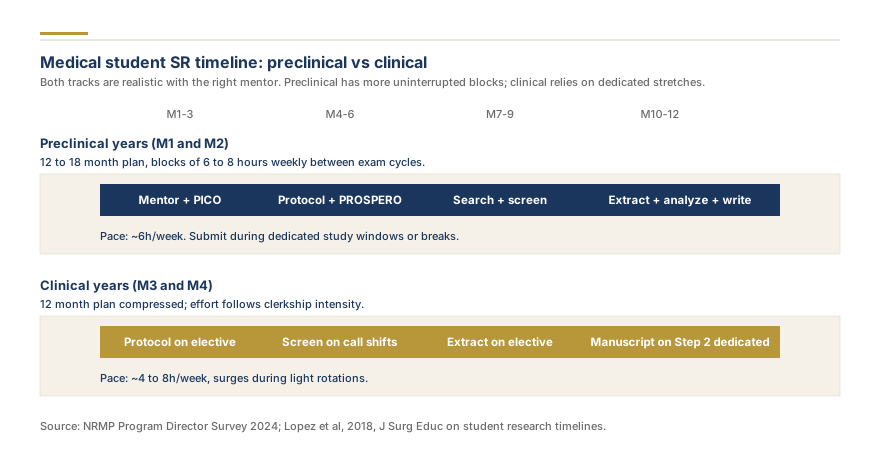
One of the biggest mistakes medical students make is underestimating how long a systematic review takes. Setting realistic expectations at the start prevents frustration and abandonment midway through the project.
Preclinical years (M1 and M2). If you start during your preclinical years, you have the advantage of more predictable schedules and longer breaks. A realistic timeline for a preclinical medical student is six to nine months from protocol registration to manuscript submission. During the academic year, plan to dedicate five to ten hours per week. During breaks, you can accelerate to 20 to 30 hours per week for screening and data extraction phases.
Clinical years (M3 and M4). Clinical rotations make sustained research work harder but not impossible. The key is choosing rotations strategically. Many schools offer research electives or lighter rotations (some M4 electives, certain community rotations) that create windows for concentrated work. A realistic timeline for a clinical student is nine to twelve months. The work happens in bursts rather than steady weekly commitments.
Dedicated research year. Some students take a gap year for research, and this is the ideal scenario for completing a systematic review with a meta-analysis. With full-time dedication, you can complete the entire project in three to four months and spend the remaining time on manuscript revision and submission.
Here is a realistic breakdown by project phase:
| Phase | Estimated Hours | Preclinical Timeline | Clinical Timeline |
|---|---|---|---|
| Topic selection and protocol | 15 to 25 hours | 2 to 3 weeks | 3 to 4 weeks |
| Literature search | 10 to 15 hours | 1 to 2 weeks | 2 to 3 weeks |
| Title and abstract screening | 20 to 40 hours | 2 to 4 weeks | 4 to 6 weeks |
| Full-text screening | 15 to 25 hours | 1 to 2 weeks | 2 to 4 weeks |
| Data extraction | 25 to 50 hours | 2 to 4 weeks | 4 to 6 weeks |
| Risk of bias assessment | 10 to 20 hours | 1 to 2 weeks | 2 to 3 weeks |
| Analysis and synthesis | 15 to 30 hours | 1 to 3 weeks | 2 to 4 weeks |
| Manuscript writing | 30 to 50 hours | 3 to 4 weeks | 4 to 6 weeks |
| Total | 140 to 255 hours | 6 to 9 months | 9 to 12 months |
These numbers assume you are working with one co-reviewer for screening and extraction, which is the minimum required by PRISMA 2020 guidelines (Page et al., 2021). If you are working alone on screening (which some journals will question), reduce the hours but add time for a senior reviewer to resolve disagreements.
Finding a Faculty Mentor and Building Your Team
A systematic review requires at least two reviewers for screening and data extraction, a methodologist or statistician for the analysis, and a faculty mentor who will serve as senior author. Finding the right mentor is the single most important step in the process.
Where to find a mentor. Start with faculty in your area of clinical interest. Look for professors who have published systematic reviews or meta-analyses themselves, as they understand the methodology and can provide meaningful guidance. Check PubMed for faculty publications and filter by review type. Your school's research office or department of medical education may maintain a list of faculty willing to mentor student research.
What to look for in a mentor. The ideal mentor has published at least one systematic review, responds to emails within 48 hours, and is willing to meet biweekly (not weekly, as you will not have enough progress to justify weekly meetings in most phases). Avoid faculty who are enthusiastic about the topic but have never conducted a systematic review. Methodology matters, and a mentor unfamiliar with PRISMA 2020 reporting standards, Cochrane methods, or risk of bias tools will not catch errors that could sink your manuscript during peer review.
Building your reviewer team. You need at least one co-reviewer for dual screening and extraction. Another medical student in your class is the easiest option, but be realistic about their commitment level. Establish clear expectations upfront: how many hours per week each person will contribute, who handles which tasks, and what authorship order will look like. Put this in writing before you start.
The role of a librarian. Medical school librarians are underutilized experts in systematic review methodology. Most academic medical centers have a health sciences librarian who can help design and execute your search strategy, translate it across databases (PubMed, Embase, CINAHL, Cochrane Library), and document the process for reproducibility. Some librarians are willing to be co-authors if their contribution is substantial. Involve the librarian early, as a poor search strategy is the most common reason systematic reviews are rejected during peer review.
Choosing a Topic That Will Actually Get Published
Topic selection determines whether your systematic review takes six months or two years, and whether it gets published in a good journal or sits on your hard drive forever.
Check for existing reviews first. Before committing to a topic, search the Cochrane Library, PROSPERO (the international prospective register of systematic reviews), and PubMed for existing systematic reviews on your question. If a high-quality Cochrane review was published in the last two years on your exact question, choose a different topic. If the last review is three or more years old, or if it was poorly conducted, an updated or improved review is justified.
Use the PICO framework to structure your question. Every systematic review starts with a well-defined research question. The PICO framework (Population, Intervention, Comparison, Outcome) provides the structure. A vague question like "does exercise help depression?" is unsearchable. A PICO-structured question like "In adults with major depressive disorder (P), does aerobic exercise (I) compared to pharmacotherapy alone (C) reduce depression severity scores (O)?" is precise enough to build a search strategy around. Use Research Gold's free free PICO question generator to structure your question before meeting with your mentor.
Choose a topic with 15 to 40 eligible studies. This is the sweet spot. Fewer than 10 studies and you may not have enough data for a meaningful synthesis (and definitely not enough for a meta-analysis). More than 50 studies and the screening and extraction workload becomes unmanageable for a student team. Check the approximate number of potentially eligible studies by running a quick PubMed search with your main terms before committing.
Target a gap in the literature. The most publishable systematic reviews address questions where multiple primary studies exist but no one has systematically synthesized them. Look for topics where clinical practice varies because the evidence has not been aggregated, where recent trials have changed the landscape since the last review, or where existing reviews are methodologically weak. Your faculty mentor can help you identify these gaps within their specialty.
Register your protocol on PROSPERO. Once your team agrees on the research question, register your protocol on PROSPERO before starting the search. Registration is free, takes about an hour, and serves two purposes: it prevents duplication (other teams can see your planned review) and it demonstrates methodological rigor to journal editors and peer reviewers. Many journals now require PROSPERO registration for systematic review submissions.