Genome Sequencing Analysis: Variant Calling to Interpretation
Genome sequencing analysis turns raw DNA reads into a catalogue of variants and a biological interpretation. This guide explains the whole genome sequencing pipeline, from alignment and variant calling to annotation, and covers bacterial WGS, phylogenetics, and the questions genome analysis can answer.
Research Gold Team
June 2, 2026
Have whole genome sequencing data and no pipeline to run it through? Get a free quote and a PhD bioinformatician will reply within a few hours with scope and timeline.
Key Takeaways
Genome sequencing analysis turns raw DNA reads into a filtered, annotated catalogue of variants, then interprets what those variants mean.
The core human or eukaryotic pipeline is alignment to a reference, variant calling with GATK, then variant filtering and annotation.
Bacterial whole genome sequencing follows a different path: reference mapping or de novo assembly feeding strain typing, resistance gene detection, and phylogenetics.
Variant calling is only as trustworthy as its filtering; raw calls are full of artifacts, and the filtering and quality thresholds must be reported.
Read depth, reference build, and annotation database versions all change the result, so a defensible analysis pins and documents every one of them.
The GATK best-practices germline pipeline aligns with BWA-MEM, marks duplicates, recalibrates base qualities, calls per-sample GVCFs with HaplotypeCaller, and joint-genotypes; use variant quality score recalibration for large cohorts and documented hard filters for small or single samples
Single-nucleotide variants and indels are only one layer: structural variants need split-read and assembly callers such as Manta, DELLY, or GRIDSS, copy number comes from read depth, and somatic mutations require tumor-normal paired calling with a panel of normals
Roughly 30x coverage suits germline whole genome sequencing while somatic and low-frequency detection needs far greater depth, and long-read platforms resolve large structural variants and repetitive regions that short reads cannot
Interpret variants with VEP or SnpEff, filter against gnomAD, and weigh ACMG criteria with scores such as CADD or REVEL; for bacteria, type strains and resistance genes, then build a core-genome maximum-likelihood tree only after removing recombination with Gubbins or ClonalFrameML
Genome sequencing analysis turns the raw DNA reads from a sequencer into a filtered, annotated catalogue of variants and a biological interpretation of what they mean. The instrument produces billions of DNA letters in FASTQ files; whole genome sequencing analysis is everything that follows, from aligning those reads to a reference through calling and filtering variants to annotating their effect. This guide walks the pipeline for both eukaryotic and bacterial genomes and explains where the decisions that determine a trustworthy result actually sit.
If you have whole genome sequencing data and need variants called and annotated, or a set of bacterial isolates turned into a phylogenetic tree, this guide shows what a complete DNA sequencing analysis involves and how to keep it reproducible and defensible.
What Genome Analysis Is Trying to Find
A genome is mostly identical between any two individuals of a species; the interesting biology lives in the differences. Genome sequence analysis is therefore largely the business of finding and interpreting those differences, the variants: single-base substitutions, small insertions and deletions, and larger structural changes. For a human study, that means cataloguing how a sample's genome departs from the reference and predicting which of those departures matter. For a set of bacterial isolates, it means comparing genomes to each other to reconstruct how strains are related and what resistance or virulence genes they carry.
Because the reference build and annotation databases define the coordinate system and the meaning of every variant, a variant call is only interpretable alongside the exact versions used. Pinning and documenting them is not bureaucratic; it is what makes the result reproducible at all.
The Whole Genome Sequencing Pipeline
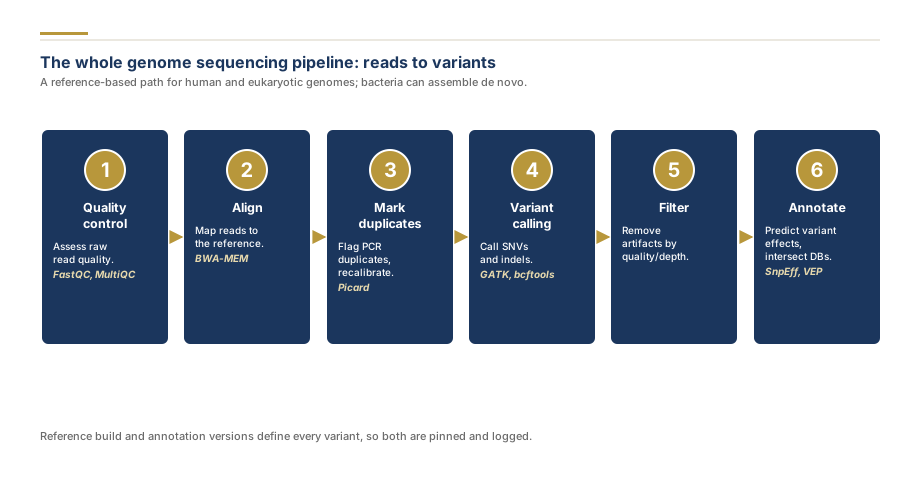
The reference-based pipeline for human and other eukaryotic genomes is well established and runs through these stages.
Stage
Purpose
Common tools
Quality control
Assess raw read quality
FastQC, MultiQC
Trimming
Remove adapters and poor bases
fastp, Trimmomatic
Alignment
Map reads to the reference
BWA-MEM
Duplicate marking
Flag PCR duplicates
Picard, samtools
Variant calling
Identify variants
GATK, bcftools
Filtering
Remove artifacts
GATK, hard filters
Annotation
Predict variant effect
SnpEff, VEP
Quality control and trimming. Assess every FASTQ file with FastQC and MultiQC, then trim adapters and low-quality bases.
Alignment. Map reads to the reference genome with BWA-MEM, producing a sorted, indexed BAM file.
Preprocessing. Mark duplicate reads and, where appropriate, recalibrate base qualities so the variant caller is not misled by systematic errors.
Variant calling. Call single-nucleotide variants and small insertions and deletions with GATK or bcftools.
Filtering. Apply quality and depth filters, because raw variant calls are full of artifacts and an unfiltered call set is not a result.
Annotation. Predict the functional consequences of each variant with SnpEff or VEP and intersect with relevant databases.
Coverage matters throughout: roughly 30x is standard for germline whole genome sequencing, while somatic or low-frequency variant detection needs substantially more depth. For the statistical side of association testing or cohort comparison, our biostatistics support handles the modeling that sits on top of a called variant set.
Bacterial WGS, Assembly, and Phylogenetics
Bacterial whole genome sequencing analysis follows a different path from the human pipeline. Genomes are small, and the questions are usually comparative: how are these isolates related, which carry resistance genes, and where did an outbreak spread. The analysis can run through reference mapping and variant detection or through de novo genome assembly, which reconstructs each genome from its reads without leaning on a reference, the better choice for novel or highly divergent strains.
From there, the comparative workflow typically maps reads and detects variants across all isolates, removes recombinant regions (recombination violates the assumptions of standard phylogenetic models and must be filtered before tree-building), builds a maximum-likelihood phylogeny, and annotates the tree. Strain typing and resistance or virulence gene detection round out the picture. This full bacterial pipeline, version-pinned and delivered with the command log, is part of our omics analysis service.
Need your own sequencing data analysed?
We run the full pipeline from raw reads to differential expression, enrichment analysis, and publication-ready figures.
DNA, RNA, and Choosing the Right Sequencing Question
Genome sequencing answers questions about the DNA itself: what variants are present and how genomes relate. When the question is instead which genes are active, the corresponding workflow is expression-based. Our guide to RNA sequencing analysis covers measuring gene expression, single-cell RNA-seq analysis resolves it to individual cells, and transcriptomics analysis covers the broader expression methods and their interpretation. Choosing DNA versus RNA sequencing is the first design decision, and it follows directly from whether your question is about sequence or about activity.
Variant Calling Done Properly: GATK Best Practices
A trustworthy germline call set follows a sequence of steps whose order is not arbitrary. After BWA-MEM alignment you mark duplicates so that the same PCR fragment is not counted as independent evidence, then run base quality score recalibration (BQSR) against a known-sites resource to correct the systematic miscalibration of the sequencer's per-base quality estimates. Calling itself uses GATK HaplotypeCaller, which performs a local de novo assembly of candidate haplotypes in each active region rather than judging one position at a time; this is what gives it a real advantage on insertions and deletions, where position-based callers stumble. For more than one sample, call each into a per-sample GVCF and then joint-genotype the cohort together with GenotypeGVCFs, which scales to large studies and sharpens calls at rare sites by sharing information across samples.
Filtering is not optional, because a raw VCF is dominated by artifacts. For large cohorts, variant quality score recalibration (VQSR) fits a Gaussian mixture model to annotations such as QD, MQ, FS, and ReadPosRankSum and assigns each variant a tranche-based probability of being real; for a single sample or a small project where VQSR cannot be trained, documented hard filters on those same annotations are the accepted substitute. Coverage governs what is even detectable: roughly 30x is standard for germline whole genome sequencing, whereas somatic and low-frequency detection needs far greater depth.
Beyond SNVs: Structural Variants, Copy Number, and Somatic Calling
Single-nucleotide variants and small indels are only one layer of genome variation. Structural variants, the deletions, duplications, inversions, and translocations that often carry the largest phenotypic effect, are detected from split reads, discordant read pairs, and local assembly by callers such as Manta, DELLY, or GRIDSS, while copy-number changes are inferred from read depth with tools like CNVkit. Cancer genomics adds a further distinction: separating somatic mutations acquired by the tumor from the germline variants present in every cell requires a paired tumor-normal design analysed with a somatic caller such as Mutect2, supported by a panel of normals to filter recurrent artifacts and by attention to tumor purity and the variant allele fraction that signals clonal versus subclonal mutations. Where short reads cannot resolve large rearrangements or repetitive and low-complexity regions, long-read platforms (PacBio HiFi, Oxford Nanopore) recover structural variants and enable haplotype phasing.
Annotation, Interpretation, and Bacterial Typing
A called variant is meaningless until it is placed in context. VEP or SnpEff predict the functional consequence, population databases such as gnomAD filter out common variants unlikely to drive a rare phenotype, and clinical interpretation weighs the ACMG criteria together with in-silico scores such as CADD or REVEL and curated evidence from ClinVar. Bacterial work reframes the whole problem as comparison rather than reference deviation: assess assembly quality with metrics like N50 and completeness checks (BUSCO or CheckM), type strains by multilocus sequence typing, and detect resistance and virulence genes with AMRFinderPlus, ResFinder, or the CARD database. For phylogenetics, build a core-genome alignment and then remove recombinant regions with Gubbins or ClonalFrameML before tree-building, because recombination violates the assumptions of standard phylogenetic models and distorts both branch lengths and topology; only then fit a maximum-likelihood tree with RAxML or IQ-TREE, optionally dated for transmission inference.
What a Genome Analysis Project Delivers
A complete genome sequencing analysis ships as a package: a quality-control report, the reproducible pipeline with every tool and reference build pinned, the aligned data, a filtered and annotated variant set (or an assembly and phylogenetic tree for bacterial work), downstream tables for your specific question, and methods text ready for your manuscript. When the result needs to become a figure, an annotated tree, a variant landscape, or a coverage plot, our research figure service produces final, publication-compliant graphics.
When you are ready, get a free quote with a short description of your organism, sample number, and design, or explore the full list of research services to combine genome analysis with statistics, visualization, or manuscript support.
Match your coverage to your goal: roughly 30x is standard for germline whole genome sequencing, while somatic and low-frequency variant detection needs substantially more depth.
Pro Tip
Always record the exact reference genome build and annotation versions; a variant's coordinates and interpretation are meaningless without them.
Pro Tip
For bacterial phylogenetics, remove recombinant regions before building the tree, because recombination violates the assumptions of standard phylogenetic models.
Pro Tip
Filter variants to the question, never trust a raw call set
A raw VCF is full of artifacts. Use variant quality score recalibration on large cohorts or documented hard filters on small samples, then filter by population frequency against gnomAD and weigh pathogenicity with ACMG criteria and scores such as CADD or REVEL before calling any variant meaningful.
Pro Tip
Remove recombination before building a bacterial tree
Recombinant regions violate the assumptions of standard phylogenetic models and distort branch lengths and topology. Detect and mask them with Gubbins or ClonalFrameML on the core-genome alignment before running a maximum-likelihood method such as RAxML or IQ-TREE.
Frequently Asked Questions
5
Genome sequence analysis is the computational process of interpreting the DNA sequence read from an organism's genome. It starts with raw sequencing reads and aligns them to a reference genome (or assembles them de novo), then identifies how the sequence differs from the reference, the variants, and annotates those differences to predict their effect. For larger projects it extends to comparing genomes across samples, detecting structural changes, and building phylogenetic relationships. The goal is to turn billions of DNA letters into a defensible answer about what the genome contains and what it means.
Whole genome sequencing data is analysed through a pipeline. Reads undergo quality control and trimming, then are aligned to a reference genome with an aligner such as BWA-MEM. Duplicate reads are marked and base qualities recalibrated, after which variants are called with a tool such as GATK or bcftools. The raw variants are then filtered to remove artifacts and annotated to predict their functional consequences. For bacterial genomes the path can instead run through de novo assembly and downstream typing and phylogenetics. Every tool, version, and threshold is documented for reproducibility.
In a research context, DNA and whole genome sequencing are used to study the genetic basis of a very wide range of conditions, including inherited disorders caused by single-gene mutations, many cancers driven by somatic mutations, and complex diseases with many contributing variants. Sequencing can identify the specific variants associated with a condition, characterize tumor mutation profiles, and detect chromosomal and structural changes. Any clinical or diagnostic use, however, requires accredited clinical pipelines and oversight; the analysis described here is for research use.
The computational analysis of a whole genome, from raw reads to an annotated variant set, typically takes from a day to several days of work depending on genome size, sequencing depth, and whether the project is a single sample or a large cohort. Bacterial genomes are small and fast; human whole genomes are far larger and the variant-calling and filtering steps take longer. The wet-lab sequencing itself is separate and usually adds one to several weeks at a sequencing facility.
Variant calling compares your reads against an existing reference genome and records the differences, which is efficient when a good reference exists, as for humans or well-studied species. Genome assembly instead reconstructs the genome sequence from the reads themselves without relying on a reference, which is necessary for novel organisms, highly divergent strains, or studying structural rearrangements that a reference-based approach can miss. Many bacterial projects use de novo assembly, while most human studies use reference-based variant calling.
Share
Found this useful? Share it with your colleagues.
Need your own sequencing data analysed?
We run the full pipeline from raw reads to differential expression, enrichment analysis, and publication-ready figures.
Sequencing Data Waiting? Our Bioinformaticians Run the Pipeline.
Quality control, alignment, normalization, differential expression, and pathway analysis, with reproducible code and figures ready for your manuscript.
Our promise: Free pipeline re-run and figure revisions if reviewers push back.
4.9 / 5Quote within a few hoursReproducible Bioconda or Nextflow pipelinesPhD methodologistConfidential by default
Research Gold Team is our group of PhD methodologists and statisticians who deliver our systematic review, meta-analysis and statistical analysis work. The same team writes and checks the guides and tools on this site.
From raw reads to an annotated variant set or an annotated tree, we run the whole genome sequencing pipeline with full methods and code. Get a free quote or browse the full list of research services.
Sequencing Data Waiting? Our Bioinformaticians Run the Pipeline.
Quality control, alignment, normalization, differential expression, and pathway analysis, with reproducible code and figures ready for your manuscript.
RNA sequencing analysis turns raw RNA-seq reads into a list of genes that change between conditions, with the statistics to back it up. This guide walks through the full pipeline, from quality control and alignment to differential expression and pathway analysis, and explains how to interpret and report the results.
Transcriptomics analysis is the study of the complete set of RNA transcripts in a cell or tissue to understand which genes are active and how they are regulated. This guide explains the methods, from microarrays to RNA sequencing, the analysis workflow, and the diseases and questions transcriptomics is used to answer.
Single-cell RNA-seq analysis resolves gene expression one cell at a time, revealing the cell types and states hidden inside a tissue. This guide explains the scRNA-seq pipeline, from quality control and normalization through clustering and UMAP to cell-type annotation, and how to interpret the result.