Bioinformatics Analysis Service for Sequencing and Omics Data
Bioinformatics analysis services turn your raw sequencing data into validated, publication-ready results. At Research Gold, PhD bioinformaticians run reproducible RNA-seq, whole genome, single-cell, and metagenomics pipelines, then deliver the differential expression tables, volcano plots, heatmaps, pathway enrichment, and version-pinned methods text your manuscript or thesis needs.
Reproducible Bioconda or Nextflow pipelinePhD BioinformaticiansRaw data to publication figures
Short answer
Bioinformatics analysis services turn your raw sequencing data into validated, publication-ready results. At Research Gold, PhD bioinformaticians run reproducible RNA-seq, whole genome, single-cell, and metagenomics pipelines, then deliver the differential expression tables, volcano plots, heatmaps, pathway enrichment, and version-pinned methods text your manuscript or thesis needs.
Free written quote
Scope, timeline, and price before you commit
Quote within a few hours
WhatsApp or email
Bioconda + Nextflow
Reproducible pipeline and code
PhD bioinformaticians
RNA-seq, WGS, single-cell, metagenomics
Have sequencing data and no pipeline to run it through? Get a free quote and a PhD bioinformatician will reply within a few hours with scope and timeline.
A bioinformatics analysis service takes your raw sequencing data and turns it into validated, publication-ready results. At Research Gold, PhD bioinformaticians run reproducible Bioconda and Nextflow pipelines across RNA sequencing, whole genome sequencing, single-cell, and metagenomics data, then deliver the figures, statistics, and full methods text, including the exact tools and versions, that your manuscript or thesis needs.
If you have FASTQ files sitting on a drive and no pipeline to run them through, or a reviewer has asked for an analysis your lab cannot do in-house, this page explains what our bioinformatics services cover, the data types we handle, the pipeline we follow, and how we keep every analysis reproducible.
The Analytical Decisions That Decide Whether a Result Holds Up
The reads coming off a sequencer are not the answer; they are raw material. Turning them into biology is a chain of decisions, and each one moves the final number: which reference genome and annotation to use, how to handle low-quality bases and adapter contamination, which aligner and quantifier suit the assay, how to model the experimental design statistically, and how to control for batch effects and multiple testing. Get one of those wrong and the differential expression results, the fold changes, and the enrichment story all shift.
A good bioinformatics analysis service makes those decisions explicitly and records them, so the analysis can be reproduced and defended. That is the difference between a result a reviewer trusts and a black-box number that collapses under scrutiny. Every project we run ships with a documented, version-pinned pipeline you can hand to a reviewer.
Sequencing Data We Analyze
We handle the full range of high-throughput sequencing and omics data. Each data type below links to a detailed guide on how its analysis works.
This page is the hub for our NGS data analysis service; the linked guides go deeper on each technique, and all of them feed into the same reproducible pipeline described below.
Ready to start? A PhD methodologist will quote your project within a few hours.
Free pipeline re-run and figure revisions if reviewers push back.
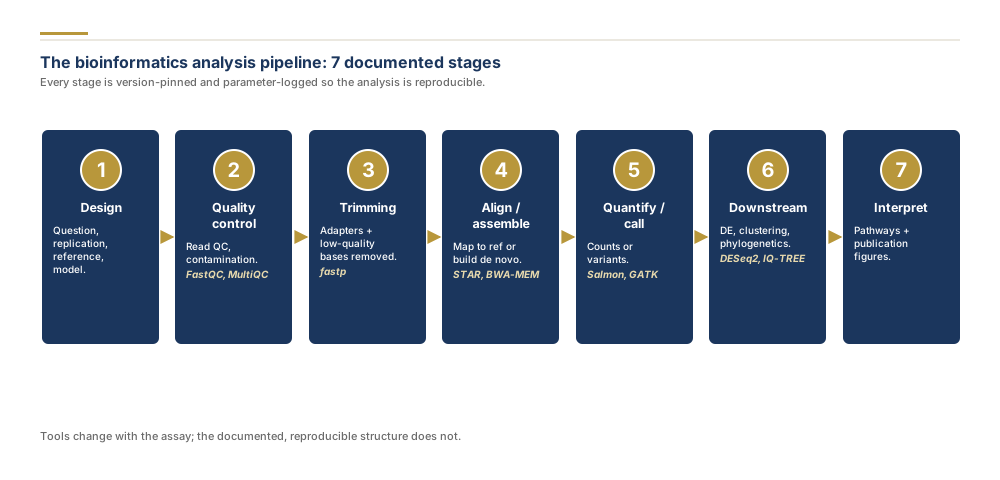
Every project, regardless of data type, runs through the same documented stages. The specific tools change with the assay, but the rigor does not.
Design review. We confirm the biological question, the experimental design, replication, the correct reference and annotation, and the statistical model before any compute runs.
Quality control. Raw reads are assessed with FastQC and MultiQC so contamination, adapter content, and low-quality cycles are caught up front.
Trimming and preprocessing. Adapters and low-quality bases are removed with tools such as fastp or Trimmomatic, and the effect is re-checked.
Alignment or assembly. Reads are aligned to a reference (for example with STAR, HISAT2, or BWA-MEM) or assembled de novo, depending on the project.
Quantification or variant calling. Gene counts are produced (Salmon, featureCounts) or variants are called and filtered (GATK, bcftools), as the assay requires.
Downstream analysis. Differential expression (DESeq2, edgeR, limma), clustering, variant annotation, or phylogenetics (IQ-TREE, RAxML-NG) is run with the appropriate statistics.
Interpretation and figures. Results are placed in biological context with pathway and enrichment analysis, and rendered as publication-ready figures.
For the statistics that sit on top of these pipelines, our statistical analysis service handles experimental design, mixed models, and downstream hypothesis testing when a project needs more than the standard omics workflow.
Tools and Reproducibility
We build pipelines from open, peer-reviewed, Bioconda-distributed tools and orchestrate them with Nextflow or Snakemake so the whole analysis runs as one versioned workflow. That choice matters for three reasons. It is transparent, because every tool and version is recorded and citable. It is reproducible, because the same workflow re-run on the same data returns the same result. And it is cost-effective, because there are no proprietary licence fees passed on to you.
For bacterial whole genome sequencing, for example, our standard stack runs read mapping and variant detection, recombination-aware filtering, maximum-likelihood phylogenetics, and tree annotation, all pinned to specific versions and delivered with the command log. Whatever the assay, you receive the bioinformatics pipeline itself, not just its output, so your results are auditable.
What You Receive
Every bioinformatics analysis project is delivered as a complete package:
A quality-control report for the raw and processed reads
The reproducible pipeline and code, with all tool versions pinned
Core results: count matrices, variant call files, assemblies, or trees
Downstream analysis tables and statistics for your specific question
Publication-ready figures (volcano plots, heatmaps, PCA, phylogenetic trees, and more)
Methods text with the exact tools, versions, and parameters, ready for your manuscript
Need the figures refined for a specific journal? Our data visualization service takes the analysis output and produces final, journal-compliant figures.
Who We Work With
Our bioinformatics consulting clients include PhD students who generated sequencing data but were never trained to analyze it, principal investigators clearing a backlog of datasets, wet-lab groups without a computational member, and core facilities that need overflow capacity. Reviewers also send authors to us when a revision asks for an analysis the original team could not perform. In each case we provide the computational expertise and accountability, and you keep authorship and biological ownership of the work.
When you are ready, get a free quote with a short description of your data and design, or explore the full list of research services to combine bioinformatics with statistics, visualization, or manuscript support.
Omics assays we analyse
Beyond bulk and single-cell RNA-seq, our bioinformatics team delivers proteomics analysis (mass-spectrometry data processing, differential abundance, and pathway enrichment), metabolomics analysis, microbiome analysis (16S and shotgun metagenomics, with taxonomic profiling and diversity metrics), and spatial transcriptomics. Each service returns a reproducible pipeline, publication-ready figures, and a methods section listing the exact tools and versions, so the analysis withstands peer review.
Frequently Asked Questions
6
Yes. We run the full RNA sequencing workflow from raw FASTQ files: quality control, trimming, alignment or pseudo-alignment, quantification, and differential expression with DESeq2, edgeR, or limma. You receive the count matrix, the differential expression tables, volcano plots, heatmaps, and pathway enrichment, plus the code that produced them.
You receive the reproducible pipeline itself, with every tool and version pinned, alongside the results. That means the analysis can be re-run on the same data to return the same output, and a reviewer or collaborator can audit exactly what was done. The deliverable is auditable, not a black box.
Yes, revision-driven analyses are one of the most common reasons researchers come to us. Send the reviewer comment and your data, and we scope the specific analysis needed, such as a re-analysis, a new comparison, an added enrichment, or a corrected batch model. You keep authorship and biological ownership of the work.
We handle bulk and single-cell RNA sequencing, whole genome and bacterial sequencing, metagenomics and microbiome, proteomics, metabolomics, and spatial transcriptomics. Each runs through a reproducible, version-pinned pipeline matched to the assay. If your data type is not listed, describe it in your quote request and we will confirm whether it is in scope.
Yes. Every project ships with methods text listing the exact tools, versions, and parameters used, written so it drops straight into your manuscript or thesis and withstands peer review. If you also need the figures refined to a journal's specifications, our data visualization service prepares final, journal-compliant figures.
Your project is run by a PhD bioinformatician who is accountable for the result, not an automated black box. We use modern tooling, including validated machine-learning methods where appropriate, but the design choices, quality checks, and biological interpretation are made and signed off by a named specialist.
From raw FASTQ to publication figures, we run the whole pipeline. Send us your dataset for a scoped quote.