How to Choose a Target Journal for Publication: A Researcher's Decision Framework
How to choose a target journal for publication using 8 selection criteria, a step-by-step decision process, systematic review recommendations, open access vs subscription considerations, and pre-submission inquiry tips.
Research Gold Team
February 27, 2026
Need help preparing your manuscript for the right journal? Our team handles journal selection and formatting.
Key Takeaways
Journal selection affects visibility, citation potential, and time-to-publication, worth strategic thought
Start with scope, read aims and scope, check recent publications
Impact factor is one metric among many: consider CiteScore, h-index, acceptance rate, audience
Open access APCs range from $0 (diamond OA) to $11,000+ (Nature)
Pre-submission inquiry saves months, editors confirm scope before you format
How to choose target journal is one of the most consequential decisions in the publication process. The journal you select determines who reads your work, how it is cited, how long you wait for a decision, and whether your manuscript even reaches peer review. Yet most researchers treat journal selection as an afterthought, finishing a manuscript and then scrambling to find a home for it.
When we help clients submit systematic reviews, journal selection is always our first conversation. Choosing the right journal before you write, or at minimum before you format, saves months of wasted effort, avoids desk rejection, and positions your research in front of the audience most likely to cite it. This guide walks through the eight criteria that matter most, a step-by-step selection process, and specific considerations for systematic reviews and meta-analyses.
Why Choosing the Right Journal Matters
Journal selection is not a cosmetic decision. It shapes the trajectory of your research in measurable ways. A well-matched journal amplifies your findings. A poorly matched journal buries them, or worse, leads to months of wasted review time followed by rejection.
Visibility and citation potential depend on whether the journal's readership aligns with your topic. Publishing a niche pharmacoeconomics study in a broad medical journal may earn prestige but few citations. Publishing it in a specialty journal with an engaged readership may generate more meaningful impact. Impact Factor measures journal influence at the aggregate level, but your individual paper's reach depends on audience fit.
Time-to-publication varies dramatically. Some journals return initial decisions within 3 weeks. Others take 6-12 months. If your research is time-sensitive, a pandemic response, a policy-relevant systematic review, a methodological advance that others are racing to publish, the journal's review timeline is not a minor consideration. It can determine whether your work is first or forgotten.
Desk rejection rates at top-tier journals range from 40% to 70%. Submitting to a journal where your manuscript has a realistic chance of review is not aiming low, it is being strategic. The time spent formatting, writing cover letters, and waiting for rejection at an unrealistic target journal is time you could have spent getting published at the right one.
The relationship between journal selection and publication success is well-documented. Researchers who invest 2-3 hours in systematic journal evaluation before formatting report fewer rejections, shorter time-to-acceptance, and higher satisfaction with where their work ultimately appears. For a deeper look at what goes wrong when journal selection is neglected, see our analysis of why manuscripts get rejected.
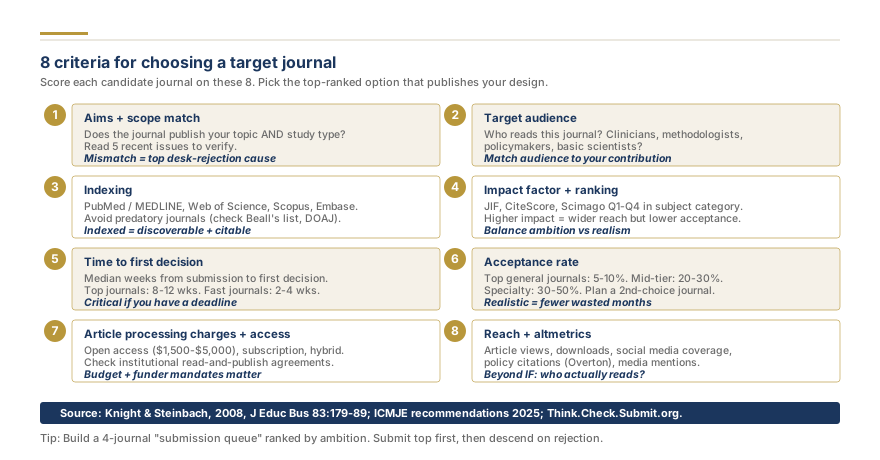
8 Criteria for Choosing a Target Journal
Score every candidate journal on these 8. Source: Knight & Steinbach, 2008; ICMJE 2025.
Selecting a journal requires evaluating multiple dimensions simultaneously. No single criterion should dominate the decision. The following eight factors, taken together, form a comprehensive journal selection criteria framework.
1. Scope and Aims Alignment
This is the non-negotiable first filter. Every journal publishes a detailed "Aims and Scope" statement on its website. Read it carefully. Then go further: browse the last 12 months of published articles. Does your topic appear? Are there papers with similar methodology, population, or research question?
A journal may list "public health" in its scope but publish almost exclusively epidemiological cohort studies. If your manuscript is a qualitative evidence synthesis, that journal is a poor fit regardless of scope language. Actual publication history matters more than stated scope.
2. Impact Factor and CiteScore
Impact Factor (from Clarivate's Journal Citation Reports, or JCR) and CiteScore (from Scopus) are the two most widely used journal-level metrics. Impact Factor calculates the average number of citations received by articles published in the journal over the previous two years. CiteScore uses a four-year window and includes more document types.
Neither metric tells you whether your specific paper will be cited. But they serve as proxies for journal prestige, which influences how your CV is evaluated by hiring committees, grant panels, and promotion boards. When choosing between journals with similar scope, a higher Impact Factor gives your work a credibility advantage, but only if the scope match is genuine.
Metric
Source
Citation Window
Document Types
Update Frequency
Impact Factor
Clarivate JCR
2 years
Articles, reviews
Annual (June)
CiteScore
Scopus
4 years
All indexed types
Annual
h-index
Various
Lifetime
All indexed types
Continuous
SJR
Scopus
3 years
Articles, reviews
Annual
3. Audience and Readership
Who reads this journal? Clinicians, methodologists, policy-makers, basic scientists? Your manuscript should speak to the journal's primary audience. A systematic review of surgical techniques belongs in a surgical journal, not a general methods journal, unless the methodological innovation is the contribution, not the clinical finding.
Check the journal's editorial board composition. If the board is dominated by clinicians, a purely methodological paper may not resonate. If the board is methodologists, a clinical paper without novel methods may be deprioritized.
4. Peer Review Timeline
Most journals publish their average time from submission to first decision. Some report it on their website; others include it in Clarivate JCR or Scopus profiles. Typical ranges:
Rapid review journals: 2-4 weeks to first decision
Standard medical journals: 6-12 weeks
Specialty and social science journals: 3-6 months
Some humanities and niche journals: 6-12 months
If your systematic review addresses an evolving evidence base, a journal with a 9-month review cycle may mean your search is outdated by the time the paper appears. Factor timeline into your decision.
5. Acceptance Rate
Acceptance rates range from under 5% (Nature, The Lancet, NEJM) to 40-60% for mid-tier specialty journals. An acceptance rate is not a quality indicator on its own, it reflects selectivity, volume of submissions, and scope breadth. But it helps you calibrate expectations.
A realistic strategy targets journals where your work has a 15-40% chance of acceptance based on the journal's rate and your manuscript's strength. Spending 6 months on a journal with a 5% acceptance rate is a rational choice only if your manuscript is genuinely competitive at that level.
6. Open Access Options
Open Access publishing has transformed the landscape. Understanding your options is essential for both visibility and budgeting.
Gold OA: Pay an article processing charge (APC) and the paper is freely accessible immediately. APCs range from $0 (diamond OA journals like some MDPI titles) to over $11,000 (Nature).
Green OA: Publish in a subscription journal but self-archive a preprint or accepted manuscript in a repository (e.g., PubMed Central, institutional repository).
Hybrid OA: Subscription journal that offers an OA option for individual articles, usually at a premium APC ($2,000-$5,000).
Diamond OA: No APC, no subscription fee. Funded by institutions or societies. Increasingly common in certain disciplines.
Funders such as the NIH, Wellcome Trust, UKRI, and Plan S coalition require open access. Check your funder's policy before selecting a journal.
7. Article Processing Charges (APCs)
APCs are a practical consideration that researchers often discover too late. Budgeting for publication costs should happen during grant writing, not after acceptance.
Journal Tier
Typical APC (Gold OA)
Examples
Top-tier general
$5,000-$11,500
Nature, The Lancet, NEJM
High-impact specialty
$2,500-$5,000
BMJ Open, PLOS Medicine
Mid-tier specialty
$1,000-$2,500
BMC Systematic Reviews, PLOS ONE
Diamond OA
$0
Various society journals
Subscription (no OA)
$0
Many specialty journals
APC waivers and discounts are available from most publishers for researchers in low- and middle-income countries. Always ask.
8. Indexing and Database Coverage
Is the journal indexed in PubMed, Scopus, Web of Science, or your discipline's key databases? Indexing determines discoverability. A journal not indexed in PubMed is effectively invisible to most medical researchers. A journal absent from Scopus will not have a CiteScore.
Check indexing status before submitting. Some newer journals are "pending indexing", this means your article may not appear in database searches for months or years after publication.
Want your manuscript written or revised?
Our PhD medical writers draft, restructure, or revise your paper and prepare it for submission to your target journal.
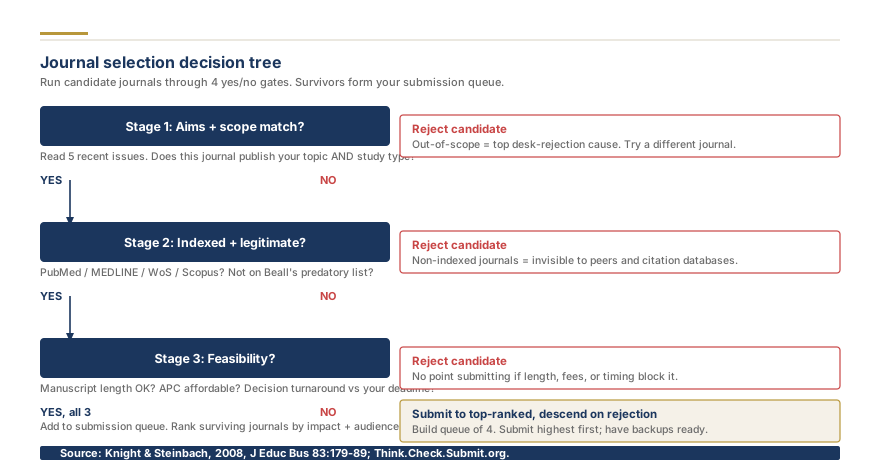
Run candidates through 4 yes/no gates. Source: Knight & Steinbach, 2008; Think.Check.Submit.org.
A structured approach to target journal selection prevents the common mistake of choosing based on prestige alone. Follow these five steps to identify your best-fit journal.
Step 1: Analyze your reference list. The journals you cited most frequently are natural candidates. If you cited 8 papers from the Journal of Clinical Epidemiology, that journal's audience is already engaged with your topic. List the top 5 journals by citation frequency in your manuscript.
Step 2: Search journal databases. Use tools like JCR (Clarivate), Scopus Sources, Elsevier's Journal Finder, Springer's Journal Suggester, or Jane (Journal/Author Name Estimator). Paste your abstract and review the suggested journals. Cross-reference suggestions against your citation-based shortlist.
Step 3: Evaluate scope alignment. For each candidate journal, read the Aims and Scope statement. Then review the last 12 months of published content. Check whether your methodology, population, and topic are represented. Eliminate journals where scope alignment is uncertain.
Step 4: Compare metrics and logistics. For remaining candidates, compile a comparison table:
Criterion
Journal A
Journal B
Journal C
Scope match
Strong
Moderate
Strong
Impact Factor / CiteScore
4.2 / 7.1
6.8 / 10.3
2.9 / 5.2
Acceptance rate
25%
12%
38%
Review timeline
6 weeks
12 weeks
4 weeks
APC
$2,200
$3,500
$0
Indexed in PubMed
Yes
Yes
Yes
Step 5: Rank and plan. Rank your top 3 journals. Journal 1 is your primary target. Journals 2 and 3 are your backup plan. Before formatting for Journal 1, consider sending a pre-submission inquiry (discussed below). If the editor confirms interest, format and submit. If not, move to Journal 2 without losing time.
This systematic approach ensures that target journal publication decisions are evidence-based rather than aspirational. For help structuring your research question before journal selection, use our PICO/PECO/SPIDER tool.
Need help selecting the right journal and preparing your manuscript? Our publication support team identifies high-impact target journals, formats manuscripts to journal specifications, and manages the submission process. get a no-obligation project quote, or explore our medical writing services.
How to Choose a Journal for Systematic Reviews
Systematic reviews and meta-analyses have specific journal selection considerations that generic guidance often overlooks. The methodology-heavy nature of evidence synthesis means that not every clinical journal welcomes systematic reviews, and specialized systematic review journals may not reach your target clinical audience.
Dedicated systematic review journals include Cochrane Database of Systematic Reviews, Systematic Reviews (BMC), Campbell Systematic Reviews, and the systematic review sections of journals like the Journal of Clinical Epidemiology. These journals have reviewers trained in systematic review methodology, your PRISMA 2020 flow diagram, search strategy, and risk of bias assessment will receive expert scrutiny, which is both a challenge and an advantage.
Clinical specialty journals that publish systematic reviews require careful evaluation. Check whether the journal has published systematic reviews in the past 12 months. Some clinical journals accept systematic reviews but assign them to reviewers unfamiliar with systematic review methodology, leading to frustrating review processes where reviewers ask questions that reveal a lack of familiarity with PRISMA 2020 reporting standards or Cochrane methods.
Reporting requirements vary. Many journals now require PRISMA 2020 checklists at submission. Some require protocol registration in PROSPERO. Others mandate data availability statements. Knowing these requirements before you submit prevents delays and formatting rework.
Cochrane vs. non-Cochrane is a strategic decision. Cochrane reviews follow a rigid protocol and are published in the Cochrane Library. Non-Cochrane systematic reviews have more flexibility in scope and methods but must still meet reporting standards. If your review does not follow Cochrane protocol, target non-Cochrane journals.
When we help clients navigate journal selection for systematic reviews, we evaluate the journal's track record with systematic review methodology, review timeline, and whether the journal's audience aligns with the clinical question being addressed. For guidance on structuring your systematic review manuscript, see our IMRAD writing guide.
The open access vs. subscription decision involves visibility, cost, funder compliance, and career strategy. Neither option is universally better, the right choice depends on your circumstances.
Visibility advantage of OA. Studies consistently show that open access articles receive more downloads and, in many fields, more citations than paywalled equivalents. If your systematic review addresses a global health issue, OA ensures that researchers in low-resource settings can read and cite your work. Open access enables universal access to research findings, which is both an ethical and strategic consideration.
APC budgeting. If your grant includes publication funds, OA is straightforward. If it does not, APCs of $2,000-$5,000 represent a meaningful expense. Many institutions offer OA funds or Read and Publish agreements with major publishers, check with your library before assuming you must pay out of pocket.
Funder mandates. NIH requires that peer-reviewed manuscripts resulting from funded research be deposited in PubMed Central within 12 months. UKRI and Plan S require immediate OA. Wellcome Trust requires immediate OA with a CC-BY license. Non-compliance can affect future funding eligibility.
Hybrid journal caution. Hybrid journals charge APCs comparable to fully OA journals ($2,500-$5,000) but may not provide the same visibility benefits because most of the journal's content remains behind a paywall. Some funders (Plan S) do not recognize hybrid OA as compliant. Evaluate carefully.
Career considerations. In some fields and institutions, the prestige of the journal matters more than its OA status. A subscription-only specialty journal with high prestige may serve your career better than a gold OA journal with lower name recognition. This calculus varies by discipline, career stage, and geography.
Factor
Gold OA
Green OA
Subscription
Immediate public access
Yes
After embargo (6-12 mo)
No
APC cost
$0-$11,000+
$0
$0
Funder compliance (Plan S)
Usually yes
Depends on embargo
Usually no
Citation advantage
Moderate
Minimal
Baseline
Journal prestige range
Broad
Broad
Broad
Once you have a journal target, our Enago systematic review breakdown explains how Enago's editing service fits before submission and what synthesis work it does not handle.
Common Journal Selection Mistakes
Even experienced researchers make predictable errors when choosing a journal. Recognizing these patterns helps you avoid months of wasted effort.
Targeting prestige over fit. Submitting to The Lancet because it would look impressive on your CV, when your study is a single-center observational analysis with 80 participants, is not ambitious, it is inefficient. High rejection rates at mismatched journals cost time without building your publication record. Match your manuscript's scope and rigor to the journal's realistic expectations.
Ignoring the audience. A beautifully executed meta-analysis of physiotherapy interventions published in a general internal medicine journal may receive fewer citations than the same paper in a physiotherapy-specific journal. The audience matters more than the Impact Factor for your paper's real-world impact.
Neglecting to check recent publications. A journal's scope statement may be broad, but its recent publication history reveals what editors actually accept. If the journal has not published a systematic review in two years, your systematic review is likely a poor fit, regardless of what the Aims and Scope say.
Formatting before selecting. Each journal has unique formatting requirements: reference style, word limits, figure specifications, abstract structure. Formatting a manuscript for Journal A, getting rejected, and then reformatting for Journal B wastes days of effort per cycle. Select your target journal (and backups) before you format.
Overlooking predatory journals. The proliferation of predatory journals, outlets that charge APCs without providing legitimate peer review, is a genuine threat to researchers, particularly early-career scholars and those unfamiliar with a new field's journal landscape. Use the Directory of Open Access Journals (DOAJ) to verify legitimate OA journals. Consult Beall's List (or its successors) for known predatory publishers. Red flags include: guaranteed acceptance, unsolicited email invitations to submit, unverifiable editorial boards, and unrealistically fast review promises.
Skipping the pre-submission inquiry. A pre-submission inquiry is a brief email (100-150 words) sent to the journal editor before formal submission. You describe your study type, main finding, and relevance to the journal, and ask whether the editor considers it suitable for review. A positive response signals scope alignment and editorial interest. A negative response saves you weeks of formatting and months of waiting.
The pre-submission inquiry is underused because researchers assume it is presumptuous or unnecessary. In reality, editors appreciate it. It helps them manage submission volume, and it helps you avoid desk rejection. The inquiry takes 15 minutes to write and can save 3-6 months. Pre-submission inquiry should be part of every journal selection process.
Not having backup journals. Rejection is statistically likely at most journals. Having a ranked list of 3 journals, primary, secondary, and tertiary, means you can move to Journal 2 within days of a rejection rather than starting the selection process from scratch. For guidance on strengthening your manuscript for resubmission, see our medical writing services guide.
Journal selection is a research skill, not a guessing game. The researchers who publish efficiently and in high-impact venues are not necessarily producing better science, they are making better strategic decisions about where to submit. Investing a few hours in systematic target journal selection pays dividends in faster publication, better audience reach, and fewer rejection cycles. Whether you are submitting a randomized controlled trial, a systematic review following PRISMA 2020 reporting guidelines, or a methodological paper, the framework above applies.
For researchers who want professional support with journal selection, manuscript formatting, or the full publication process, Research Gold's medical writing services include journal matching as a standard part of our workflow. We evaluate your manuscript against candidate journals, draft pre-submission inquiries, and format your paper to the target journal's specifications, so you can focus on the research itself. Our overview of publication support services for researchers maps each stage from completed data to published paper.
Two related decisions deserve their own attention. The first is how to read a journal's standing without overrating a single number, which our guide on the journal impact factor explained unpacks. The second is how to screen out predatory journals before you submit, since a deceptive outlet can undo months of work.
Pro Tip
Start with your reference list
Journals you cited most are likely the best fit.
Pro Tip
Send a pre-submission inquiry
A 100-word email can save 3-6 months.
Pro Tip
Have a Plan B and Plan C
Identify 2 backup journals before submitting to your first choice.
Frequently Asked Questions
5
Not necessarily. Best journal = scope alignment + right audience + reasonable acceptance rate.
Use Beall's List or DOAJ. Red flags: guaranteed acceptance, unsolicited invitations, unverifiable editorial board.
No. Simultaneous submission is prohibited. Submit one at a time.
Brief email to the editor asking if your topic is suitable. Saves months.
2-4 weeks (rapid) to 6-12 months (some specialties). Check the journal's stated timeline.
Share
Found this useful? Share it with your colleagues.
Want your manuscript written or revised?
Our PhD medical writers draft, restructure, or revise your paper and prepare it for submission to your target journal.
Getting a Paper Out? Our PhD Medical Writers Draft It With You.
From IMRAD structure to the discussion, figures, and cover letter, we write journal-ready manuscripts that follow ICMJE and EQUATOR reporting guidelines.
Our promise: Free revisions until the manuscript matches the journal's standard.
4.9 / 5Quote within a few hoursICMJE + EQUATOR Network guidelinesPhD methodologistConfidential by default
Research Gold Team is our group of PhD methodologists and statisticians who deliver our systematic review, meta-analysis and statistical analysis work. The same team writes and checks the guides and tools on this site.
Journal fit decides whether peer review goes smoothly. Our medical writers align your manuscript to your target journal's structure, scope, and reviewer expectations before submission. Review the medical writing service or get a free quote.
Getting a Paper Out? Our PhD Medical Writers Draft It With You.
From IMRAD structure to the discussion, figures, and cover letter, we write journal-ready manuscripts that follow ICMJE and EQUATOR reporting guidelines.
The journal impact factor measures the average citations to a journal's recent articles. This guide explains the calculation, its well-known limitations, and the alternative metrics worth knowing.
A practical decision framework for choosing the right statistical test. Covers t-test, ANOVA, chi-square, Mann-Whitney, regression, and more, with assumption checks, flowcharts, and common mistakes to avoid.
Human-written, AI-assisted, AI-screened: the labels have stopped being descriptive. Here is the single threshold journals actually use, what you must disclose, and where Research Gold draws the line.