IMRAD manuscript writing is the foundation of biomedical research communication. Every original research article published in a peer-reviewed medical journal follows the same core architecture: Introduction, Methods, Results, and Discussion. This structure, standardized by the ICMJE (International Committee of Medical Journal Editors) and adopted by over 5,000 biomedical journals worldwide, ensures that research findings are presented in a consistent, reproducible, and evaluable format. Whether you are drafting your first clinical study report or preparing a multi-site trial for submission, mastering the IMRAD format determines whether your manuscript reaches peer review or lands in the desk rejection pile.
This section-by-section guide walks you through every component of how to write a medical manuscript using the IMRAD structure. You will learn what each section must contain, how long each section should be, which reporting checklists to use for your study design, and which mistakes trigger immediate rejection. The goal is a publication-ready manuscript that satisfies editors, survives peer review, and communicates your findings with precision.
The Question Each IMRAD Section Answers
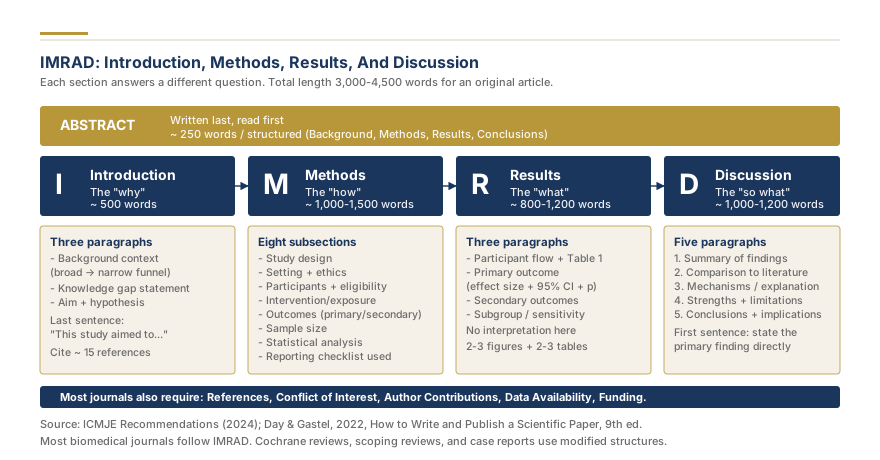
The IMRAD framework structures medical manuscripts by assigning each section a specific communicative function. The Introduction answers "why was this study done?" The Methods section answers "how was it done?" Results answers "what was found?" And the Discussion answers "what does it mean?" This separation is not arbitrary. It allows peer reviewers to evaluate methodological rigor independently of the authors' interpretation. It allows readers to jump directly to the section most relevant to their needs. And it provides editors with a predictable format that accelerates the review process.
The history of IMRAD traces back to the mid-20th century, but its dominance was cemented when the ICMJE formally adopted it in the 1970s. Today, the EQUATOR Network (Enhancing the QUAlity and Transparency Of health Research) builds on IMRAD by providing study-design-specific reporting checklists that specify what content must appear within each IMRAD section. IMRAD is the skeleton; reporting checklists are the muscles and organs.
Understanding IMRAD format explained at this structural level is the first step toward writing a manuscript that editors take seriously. The sections that follow break down each component in detail, with word targets, content requirements, and the specific mistakes that lead to rejection.
Before You Write -- Pre-Writing Preparation
Successful journal manuscript preparation begins before you type a single word of the manuscript. Pre-writing preparation determines whether your manuscript hits its target on the first submission or cycles through months of reformatting and resubmission. Three preparatory steps are non-negotiable: selecting your target journal, identifying the correct reporting checklist, and organizing your data and author contributions.
Select your target journal first. The journal you choose dictates word count limits, reference style, figure requirements, abstract format, and even which IMRAD subsections are required. Writing a manuscript without a target journal is like building a house without a blueprint -- you will inevitably tear parts down and rebuild. Read the journal's author guidelines before you outline. Check the aims and scope statement to confirm the journal publishes your study type. Review two or three recent articles in the same journal to understand the expected depth and tone. For detailed guidance, see our journal selection guide.
Identify the correct reporting checklist. The EQUATOR Network maintains reporting guidelines for every major study design. The four most commonly used are:
| Study Design | Reporting Checklist | Items |
|---|---|---|
| Randomized controlled trial | CONSORT 2010 | 25 items |
| Observational study (cohort, case-control, cross-sectional) | STROBE Statement | 22 items |
| Systematic review | PRISMA 2020 | 27 items |
| Meta-analysis of observational studies | MOOSE | 35 items |
Each checklist specifies exactly what information must appear in each IMRAD section for that study design. The CONSORT statement tells you what to include in the Methods section of a randomized trial. The STROBE checklist does the same for observational studies. PRISMA 2020 governs systematic reviews and meta-analyses of interventional studies. These checklists are not optional supplements -- most journals require a completed checklist at submission, and reviewers use them to evaluate your manuscript. Download your checklist before you start writing and use it as a structural blueprint.
Organize your data and clarify author contributions. Compile all statistical outputs, tables, and figures before drafting. Confirm that every co-author meets the four ICMJE authorship criteria: (1) substantial contribution to conception/design or data acquisition/analysis, (2) drafting or critical revision, (3) final approval, and (4) accountability for the work. Authorship disputes that surface mid-submission delay publication by months.
Establish your writing order. Most experienced medical writers recommend drafting in this sequence: Methods first (most concrete), then Results (data-driven), then Discussion (interpretation), then Introduction (framing), and finally the Abstract (summary). This order follows the logic of the research process rather than the reading order, and it prevents you from writing an Introduction that promises findings you cannot deliver.
Introduction -- Establishing the "Why"
The Introduction answers one question: why was this study necessary? It uses a funnel structure that moves from broad context to a specific knowledge gap to a precise research objective. A well-written Introduction is three to four paragraphs long -- roughly 400 to 600 words -- and ends with a clear statement of the study's aim or hypothesis.
Paragraph 1: Broad context. Open with the clinical or scientific problem your study addresses. Establish the topic's importance using epidemiological data, clinical burden, or public health significance. Cite foundational references but do not write a literature review. Two to three sentences are sufficient.
Paragraph 2: What is known. Summarize the current state of evidence. What have previous studies shown? What interventions, exposures, or approaches have been tested? Cite the most relevant and recent studies -- typically three to six references. This paragraph demonstrates that you understand the existing literature and positions your study within it.
Paragraph 3: The gap. Identify what remains unknown, unresolved, or inadequately studied. This is the most important paragraph in the Introduction because it justifies your study's existence. Be specific. "More research is needed" is not a gap statement. "No randomized trial has compared intervention X to intervention Y in population Z" is a gap statement. The gap must logically lead to your research question.
Paragraph 4: Objective and hypothesis. State the study's aim in one or two sentences. Use language that mirrors the study design: "We aimed to determine..." for hypothesis-testing studies, "We aimed to explore..." for exploratory studies. If your study has a formal hypothesis, state it here. This paragraph should also briefly mention the study design (e.g., "We conducted a randomized, double-blind, placebo-controlled trial...") to orient the reader before they enter the Methods section.
The Introduction must not include results, methods, or conclusions. It must not exceed four paragraphs in most journals. And it must cite the specific knowledge gap that your study fills -- vague justifications are a hallmark of weak manuscripts and a common trigger for desk rejection reasons. Medical manuscript follows ICMJE guidelines from the very first section: the ICMJE Recommendations (2023) explicitly state that the Introduction should "provide context but not review the subject extensively."
Methods -- Detailing the "How"
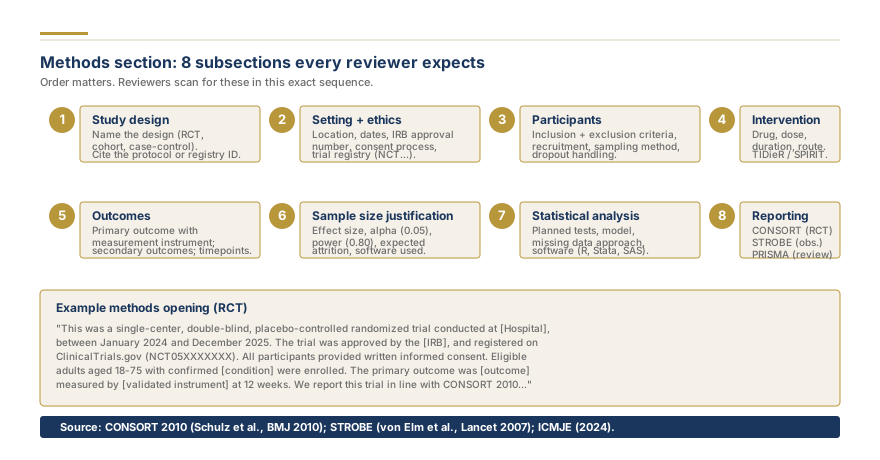
The Methods section is the most scrutinized section during peer review. In our experience preparing manuscripts for submission, the Methods section receives the most peer reviewer scrutiny -- and insufficient methodological detail is the single most common reason for desk rejection. ICMJE Recommendations require that Methods be described "in sufficient detail to allow others to replicate the work" (ICMJE, 2023). This section must be written in the past tense and organized under clear subheadings.
Study Design
State the study design in the first sentence (e.g., "This was a prospective, single-center, randomized controlled trial..."). Name the specific reporting checklist you followed. For an RCT, write: "This trial is reported in accordance with the CONSORT 2010 Statement." For a systematic review, reference PRISMA 2020. The study design declaration tells reviewers which checklist to use when evaluating your manuscript and demonstrates methodological awareness. CONSORT reports randomized controlled trials according to a standardized 25-item framework that specifies what belongs in each Methods subsection.
Participants
Describe eligibility criteria (inclusion and exclusion), recruitment setting, recruitment period, and how participants were identified. Report the sample size calculation, including the expected effect size, alpha level, power, and the statistical test used to determine the required n. A missing sample size calculation is a red flag that reviewers consistently identify.
Intervention or Exposure
For trials, describe the intervention and comparator in enough detail for replication -- dosing, frequency, duration, mode of delivery, and who delivered it. For observational studies, define the exposure variable, its measurement, and any categorization used. If the intervention is complex, consider referencing a published protocol or supplementary materials.
Outcome Measures
Define the primary outcome measure and all secondary outcomes. Specify how each outcome was measured, who measured it, and at what time points. Validated measurement instruments should be cited. If composite outcomes were used, define the individual components. Clear outcome specification prevents post-hoc outcome switching -- a form of reporting bias that peer reviewers are trained to detect.
Statistical Analysis
Describe every statistical test used, the software and version, the significance threshold, and how missing data were handled. Report whether intention-to-treat or per-protocol analysis was used (for trials). For regression models, list all covariates and the rationale for their inclusion. Statistical analysis details are where reviewers most often request additional information, so err on the side of completeness.
Ethical Approval
State that the study was approved by an IRB (Institutional Review Board) or ethics committee, including the approval number. Confirm that informed consent was obtained from all participants. For studies involving human subjects, ICMJE Recommendations (2023) require ethical approval documentation. State trial registration (if applicable) with the registry name and number.
The Methods section typically runs 800 to 1,200 words. Every reporting checklist item that applies to the Methods section of your study design must be addressed. If in doubt about whether a detail is necessary, include it -- reviewers can always ask you to trim, but they will reject a manuscript with missing methodological information.
Results -- Presenting the "What"
The Results section presents findings objectively, without interpretation. State your primary outcome in the first sentence. Do not bury the lead -- readers and reviewers want to know the main finding immediately, and everything else is context for that finding. The Results section typically runs 600 to 1,000 words, excluding tables and figures.
Report the primary outcome first. Begin with participant flow (how many were enrolled, randomized, analyzed) and then state the primary outcome with its effect size, 95% confidence interval, and p-value. For example: "The intervention group showed a 15% reduction in 30-day readmission rates compared to the control group (RR 0.85, 95% CI 0.74-0.97, p = 0.02)."
Use tables and figures strategically. Tables present exact values; figures show trends and comparisons. Every table and figure must have a descriptive caption that allows it to be understood without reading the main text. Number tables and figures in the order they are first mentioned. Do not duplicate data -- if a finding appears in a table, reference the table in the text rather than repeating the numbers. For systematic reviews, the Results section should include a PRISMA flow diagram showing study identification, screening, eligibility, and inclusion. You can create one using our free online prisma flow diagram generator.
Report secondary outcomes and subgroup analyses. After the primary outcome, present secondary outcomes in the order listed in the Methods section. Subgroup analyses should be clearly labeled as pre-specified or exploratory. Pre-specified subgroup analyses carry more weight than post-hoc explorations, and reviewers will check whether your reported subgroups match those described in Methods.
Present adverse events and missing data. For clinical trials, the CONSORT 2010 Statement requires reporting all adverse events by group, including serious adverse events. Report the amount of missing data and the method used to handle it (complete case analysis, multiple imputation, etc.). Transparency about missing data builds reviewer confidence.
What to avoid in Results. Do not interpret findings -- save interpretation for the Discussion. Do not use words like "significant" without specifying "statistically significant" and providing the test statistic. Do not selectively report favorable outcomes while omitting unfavorable ones -- this constitutes selective reporting and violates the ICMJE guidelines. Do not introduce methodological details that belong in Methods.
A clean Results section follows the order established in the Methods section, presents every pre-specified outcome, uses tables and figures to reduce text density, and maintains strict objectivity. Peer review evaluates manuscript quality most harshly when Results and Discussion bleed into each other.
Need professional medical manuscript writing support? Our medical writers draft IMRAD-structured manuscripts with journal-specific formatting, statistical reporting, and ICMJE-compliant documentation. request pricing for your research project, or see our medical writing assistance.
Discussion -- Interpreting the "So What"
The Discussion section interprets your findings, contextualizes them within the existing literature, acknowledges limitations, and states implications. It answers the question "so what?" and is typically the longest section at 1,000 to 1,500 words. The Discussion follows a predictable internal structure organized around five functions.
Key Findings
Open the Discussion by restating the primary finding in one to two sentences. Do not repeat the statistical values from Results -- summarize the finding in plain language. For example: "This trial demonstrated that the telehealth intervention significantly reduced 30-day readmission rates compared to usual care." This opening sentence anchors the entire Discussion and tells the reader what to expect.
Comparison with Existing Literature
Compare your findings with those of previous studies. Where do your results agree? Where do they diverge? If your findings contradict prior work, propose explanations -- differences in population, intervention, measurement, or analysis. Cite at least three to five relevant studies and engage with them substantively rather than simply listing them. This section demonstrates your command of the field and positions your contribution within the broader evidence base.
Strengths and Limitations
Every study has limitations. Reviewers expect you to identify them honestly. Common limitations include small sample size, single-center design, short follow-up, self-reported outcomes, and potential confounding. For each limitation, explain how it might affect the interpretation of your results. Then state the study's strengths -- rigorous design, validated measures, adequate power, long follow-up, or novel population. Presenting strengths and limitations together shows balanced scientific judgment.
Clinical and Research Implications
State what your findings mean for clinical practice, policy, or future research. Be specific and proportionate. A single randomized controlled trial rarely changes practice guidelines; it contributes evidence that may inform future guideline updates. Suggest specific next steps for research -- larger trials, different populations, longer follow-up, mechanistic studies. Avoid vague statements like "more research is needed" without specifying what kind of research and why.
Conclusion
End the Discussion with a concise conclusion (two to three sentences) that restates the main finding and its primary implication. Some journals require a separate Conclusion section; others embed it as the final paragraph of the Discussion. Check your target journal's guidelines.
Critical rules for the Discussion. Do not introduce new data or results that were not presented in the Results section. Do not overstate your findings -- language like "proves" or "demonstrates conclusively" is inappropriate for a single study. Do not repeat the Results section verbatim. Do not ignore findings that did not support your hypothesis.