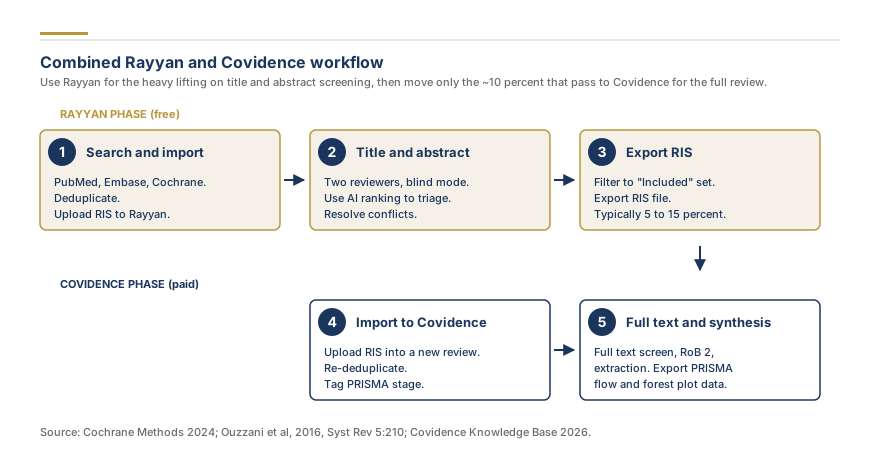
Covidence and Rayyan are the two most widely used screening tools for systematic reviews, but they serve different needs and excel in different areas. Covidence is a comprehensive end-to-end review management platform endorsed by Cochrane, while Rayyan is a focused screening tool with superior AI-assisted relevance prediction and a generous free tier. If cost or data-residency rules out both, our free Rayyan and Covidence alternative runs screening in your browser with no record cap. This comparison covers every feature, pricing detail, and use case to help you choose the right tool for your systematic review.
The short answer: if your institution provides Covidence access, use it for its complete workflow coverage. If you need the best free option or are working with a very large number of records, Rayyan's AI screening is hard to beat. Many experienced teams use both, leveraging Rayyan's screening strengths with Covidence's extraction and reporting capabilities.
Screen at no cost with free screening sheets for two reviewers.
Head-to-Head Feature Comparison
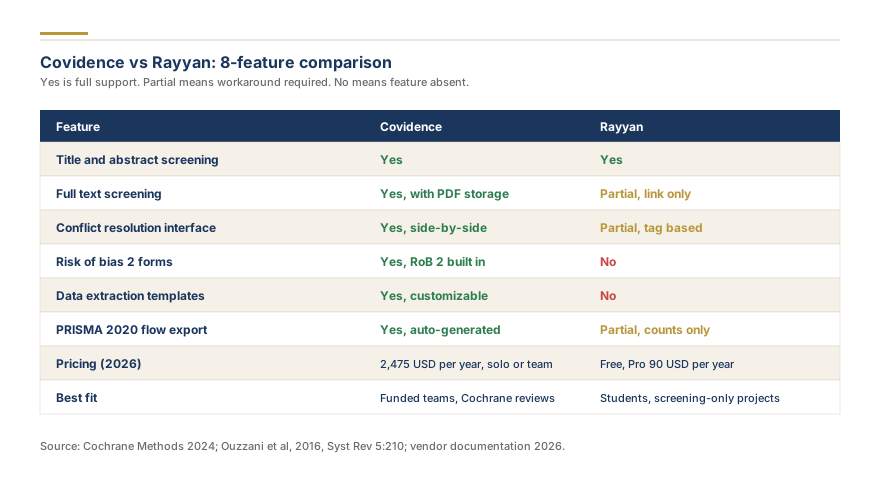
| Feature | Covidence | Rayyan |
|---|---|---|
| Title-abstract screening | Yes, dual-reviewer with conflict resolution | Yes, dual-reviewer with blind mode |
| Full-text screening | Yes, with PDF upload and annotation | Yes, basic |
| AI-assisted screening | Basic prioritization | Advanced active learning (50-70% time savings) |
| Data extraction | Yes, customizable forms with dual extraction | No |
| Quality assessment | Built-in templates (our guide to rob 2, our guide to robins-i, NOS) | No |
| De-duplication | Automatic with manual verification | Automatic detection; one-click auto-resolve on paid plans only |
| PRISMA flow diagram | Auto-generated, editable DOCX export | PRISMA 2020 diagram on paid plans only, not in the free tier |
| RevMan integration | Direct export for Cochrane reviews | No |
| Team collaboration | Unlimited collaborators on every plan, role permissions | Role-based; free reviewer invites capped by plan, 2 on the free tier |
| Reference import | RIS, EndNote XML, CSV, PubMed | RIS, BibTeX, CSV, PubMed XML |
| Exclusion reasons | Structured categories at full-text stage | Labels and notes |
| Mobile access | Web browser (responsive) | Dedicated mobile app |
Screening: Where Rayyan Wins
Rayyan's core advantage is its active learning AI model. After you screen approximately 50 to 100 records, Rayyan's algorithm begins predicting the relevance of unscreened records based on patterns in your include/exclude decisions. The model improves with every decision, eventually ranking the most likely relevant studies at the top of your screening queue.
This means you encounter relevant studies early in the process, and as you screen further into increasingly irrelevant records, you can apply stopping rules with confidence that you have found most or all relevant studies. Research has shown that Rayyan's AI can reduce the number of records you need to manually screen by 50 to 70 percent while maintaining sensitivity above 95 percent.
Covidence offers basic machine learning prioritization, but it does not provide the real-time active learning feedback loop that makes Rayyan's screening so efficient. For reviews with large numbers of records (5,000+), this difference translates into weeks of saved screening time.
Rayyan's blind review mode is another screening strength. In blind mode, reviewers cannot see each other's decisions until both have completed screening for a given batch. This ensures truly independent assessment, which is methodologically important for reducing bias in the screening process. Covidence also supports independent screening but does not have a dedicated blind mode interface.
Beyond Screening: Where Covidence Wins
Covidence covers the entire systematic review workflow after screening, which is where Rayyan stops. Once you have identified your included studies, Covidence provides:
Data Extraction
Covidence offers customizable systematic review data extraction process forms that support dual extraction with reconciliation. Two reviewers independently extract data from each included study, and Covidence highlights discrepancies for resolution. This eliminates the need for separate spreadsheets and reduces extraction errors.
Quality Assessment
Built-in templates for the most common risk of bias tools let you complete quality assessment within the same platform:
- learn about rob 2 for randomized controlled trials
- learn about robins-i for non-randomized studies
- Newcastle-Ottawa quality assessment guide for observational studies
- Custom templates for any other assessment framework
PRISMA Compliance
Covidence auto-generates a PRISMA flow diagram based on your screening and selection decisions, populating the number of records at each stage. This saves significant time compared to manually creating the flow diagram.
Cochrane Integration
For Cochrane review teams, Covidence's direct RevMan export is a major advantage. Extracted data transfers seamlessly into RevMan Web for our guide to meta-analysis, forest plot generation, and GRADE assessment.