The best systematic review software in 2026 depends on your budget and phase coverage: Research Gold for free screening with a published accuracy benchmark and self-serve AI from $12 per month, Covidence for end-to-end Cochrane-style review management at $339 per year per review as of mid 2026, Rayyan for free multi-project screening with a mobile app, DistillerSR for enterprise teams, RevMan and R for meta-analysis, and ASReview for open-source AI screening. The right choice automates deduplication, screening, and data extraction while preserving the methodological rigor journals expect. This guide compares all eight platforms on features, pricing, strengths, and limitations for each phase of the review process.
No single systematic review software package handles every phase perfectly. Most research teams combine two to three tools: one for reference management and de-duplication, one for screening, and one for meta-analysis and reporting. Understanding what each tool does well helps you build an efficient workflow without paying for features you do not need.
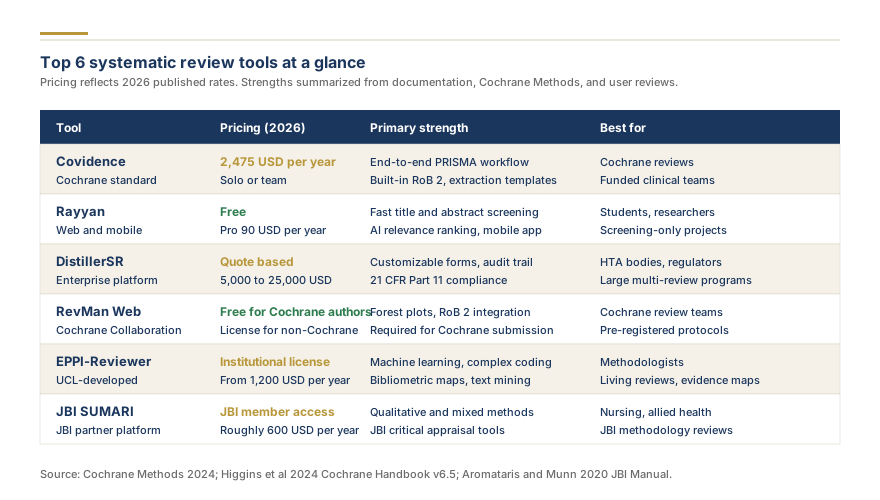
Systematic Review Software Compared at a Glance
| Tool | Best For | Price | Screening | Extraction | Meta-Analysis | AI Features |
|---|---|---|---|---|---|---|
| Research Gold | Free screening with published accuracy, scales to full platform | Free tier (Pro $12/mo or $99/yr) | Yes (2-reviewer) | Templates (paid: structured) | Calculators (paid: GRADE/RoB) | AI screening, published benchmark |
| Covidence | End-to-end management | $339/yr per review (as of mid 2026) | Yes | Yes | No | Basic |
| Rayyan | Free screening | Free (3 reviews); paid from $8.33/mo quarterly | Yes | Limited | No | Strong (AI institution-gated) |
| DistillerSR | Enterprise teams | Custom pricing | Yes | Yes | No | Advanced |
| RevMan Web | Cochrane reviews | Free (Cochrane) | No | Yes | Yes | No |
| ASReview | AI-prioritized screening | Free, open source | Yes | No | No | Strong |
| R (metafor) | Meta-analysis | Free, open source | No | No | Yes | No |
| EPPI-Reviewer | Mixed-methods reviews | Varies | Yes | Yes | No | Moderate |
Research Gold: Best Free Tool Suite for Systematic Reviews
Research Gold is the strongest free option for teams that want to run a methodologically sound review without a paid subscription, and it scales into a full hosted platform when a project grows. The free title and abstract screening tool ranks records by relevance, supports two independent reviewers, and scores their agreement with Cohen's kappa, all in the browser with a local-first mode. It is also the only platform in this comparison with a published accuracy benchmark: AI screening measured at 99.1 percent recall (229 of 231 relevant records) across five published benchmark datasets, with every decision human-confirmed, relevance ranking at roughly 78 percent work saved over sampling at 95 percent recall, and deduplication at 97.4 percent recall with zero wrong merges.
Key Features (Free)
- Free tier with real capacity. 3 projects of up to 5,000 records each, with the PRISMA flow diagram and deduplication included
- Two-reviewer screening. Relevance-ranked queue with active-learning recall estimation plus blind dual-reviewer mode with Cohen's kappa agreement scoring
- Database connectors. 7 free connectors (PubMed, Europe PMC, OpenAlex, Semantic Scholar, Crossref, DOAJ, ClinicalTrials.gov) plus citation chasing
- Reference de-duplication. Reference deduplication tool that removes duplicates across multiple database exports
- Data extraction. Extraction template builder that generates customizable forms for any review type
- PRISMA flow diagram. PRISMA flow diagram generator built directly from your screening numbers
- Analysis and visualization. Effect size calculator, forest plot generator, and risk of bias chart generator
Paid Platform Features
- Pro ($12/month or $99/year). Unlimited projects, self-serve AI screening with the published benchmark above, full-text PDF screening, structured data extraction, full audit trail, interactive PRISMA checklist, methods-section generator, custom RevMan and Cochrane exports, and automated retraction checks
- Team / Lab (from $390/year, five seats). Blinded dual screening, conflict dashboard with tiebreak adjudication, roles and permissions, inter-rater reliability analytics, risk of bias modules (RoB 2, ROBINS-I, NOS), and living-review updating
- Institution (from $3,000/year). GRADE certainty assessment, single sign-on (SSO/SAML/SCIM), admin console, and usage analytics
- Enterprise / Pharma (custom). 21 CFR Part 11 compliance with electronic signatures and validation documentation, data residency with BAA and SOC 2, a REST API with REDCap integration, and immutable audit logs
Pricing (2026)
- Free tier: 3 projects with 5,000 records each, PRISMA diagram and deduplication included
- Pro $12/month or $99/year with unlimited projects and self-serve AI screening; Team/Lab from $390/year, Institution from $3,000/year, Enterprise on a custom quote
Strengths
- Only tool here with a published, dataset-named accuracy benchmark for AI screening, ranking, and deduplication
- Free tier includes the PRISMA diagram and deduplication that Rayyan reserves for paid plans, at ten times Covidence's 500-record trial cap per project
- Only platform where an individual can buy AI-assisted screening self-serve, without an institutional sales cycle
- Paid tiers extend the same platform across the full review lifecycle, from database retrieval through full-text screening, extraction, risk of bias, GRADE, and regulatory-grade audit trails
Limitations
- No native mobile app (responsive web only)
- Younger platform with a smaller citation footprint in published methods sections than Covidence or Rayyan
Covidence: Best All-in-One Platform
Covidence is the most widely used systematic review management platform and the tool officially recommended by the Cochrane Collaboration. It covers the entire review workflow from title-abstract screening through data extraction and quality assessment.
Key Features
- Import and de-duplication. Upload references from multiple databases, and Covidence automatically detects and removes duplicates with high accuracy
- Dual-reviewer screening. Title-abstract and full-text screening with built-in conflict resolution. Reviewers work independently, and disagreements are flagged for resolution
- Data extraction. Customizable extraction forms with dual extraction and reconciliation support
- Quality assessment. Built-in templates for RoB 2, ROBINS-I, Newcastle-Ottawa, and custom tools
- PRISMA flow diagram. Automatic generation based on your screening decisions
- Export to RevMan. Direct export of extracted data for Cochrane reviews
Pricing (as of mid 2026)
- Free trial: 1 review, capped at 500 records
- Single: $339 USD per year for one review, unlimited collaborators, valid 12 months
- Package: $907 USD per year for up to 3 reviews, valid 12 months
- Institutional: contact sales (no price published); many universities provide access through library subscriptions
- No monthly billing option and, per Covidence's own pricing FAQ, no student discount
Strengths
- Most comprehensive single platform for systematic reviews
- Intuitive interface with minimal learning curve
- Strong audit trail and PRISMA compliance support
- Excellent for collaborative teams with dual-reviewer workflows
- Direct integration with Cochrane RevMan
Limitations
- No meta-analysis functionality (need separate software)
- AI screening features are basic compared to Rayyan or ASReview
- Cost can add up for individual researchers without institutional access
- Limited customization of extraction forms compared to DistillerSR
Rayyan: Best Free Screening Tool
Rayyan was developed by the Qatar Computing Research Institute and focuses specifically on screening efficiency. Its machine learning algorithm learns from your inclusion and exclusion decisions and predicts relevance for unscreened records, dramatically accelerating the screening phase.
Key Features
- AI-assisted screening. Rayyan's algorithm learns from your screening decisions and ranks remaining records by predicted relevance. After training on 50 to 100 decisions, it can prioritize the most likely relevant studies, reducing screening time by 50 to 70 percent
- Dual-reviewer screening. Blind mode ensures independent screening. Conflicts are visible only after both reviewers complete their assessments
- De-duplication. Automatic and manual duplicate detection
- Labeling and filtering. Custom labels, reasons for exclusion, and advanced filtering by year, journal, or keywords
- PRISMA export. Screening statistics for your PRISMA flow diagram
Pricing (as of mid 2026)
- Free: up to 3 active reviews, 2 free reviewer invitations, no PRISMA diagram, no automatic duplicate resolution, 100 mobile app decisions
- Essential: $8.33/month billed quarterly, or $4.99 per seat per month billed annually (adds PRISMA diagrams and auto duplicate resolution)
- Advanced: $13.33/month billed quarterly, or $8.33 per seat per month billed annually
- Business/Academic and Enterprise: custom pricing with a 5-license minimum; ResearchPilot AI is available only on these institutional plans per Rayyan's help center
- No monthly billing option; the smallest commitment is quarterly
Strengths
- Free tier handles 3 concurrent reviews at no cost, forever
- Strong relevance prediction plus the best native mobile app in the category (offline screening with sync)
- Excellent for large-volume screening (handles 10,000+ records efficiently)
- Blind review mode prevents reviewer bias, and the newer risk of bias workspace covers RoB 2, ROBINS-I, QUADAS-2, Newcastle-Ottawa, JBI, and AMSTAR 2
Limitations
- The free tier excludes the PRISMA flow diagram and automatic duplicate resolution, and caps the mobile app at 100 decisions
- The flagship ResearchPilot AI (AI Reviewer, auto extraction) is restricted to institutional plans with a 5-license minimum, so individuals cannot buy it
- No published accuracy numbers (recall, precision, or work-saved benchmarks) for any AI feature
- The AI model needs 50 to 100 training examples before predictions become reliable