The NIH R01 is the National Institutes of Health's flagship Research Project Grant, supporting health-related research with project periods of up to five years and budgets that commonly reach 250,000 to 500,000 dollars per year in direct costs. R01 is the activity code that funds the bulk of independent investigator research at NIH, and an R01 award is widely treated as the inflection point in a biomedical research career. This guide covers what an R01 actually is, who can apply, how peer review works at the Center for Scientific Review, the structure of a competitive application, the five scored criteria, the resubmission cycle, and the practical preparation steps that distinguish funded applications from declined ones.
R01 has anchored NIH extramural funding since 1948. It is the longest-running activity code at the agency and the mechanism through which most independent biomedical scientists conduct their hypothesis-driven research. Roughly half of NIH's competing research project grants in any given fiscal year are R01s, and many investigators measure their independent career by R01 awards rather than by any other metric. That weight is why the application process is so deeply structured and why the conventions, page limits, scoring criteria, and resubmission rules are worth understanding before drafting a single page.
R01 Eligibility, Investigator Profile, and Career Trajectory
R01 eligibility hinges on three factors: institutional registration, investigator status, and the science itself. The institution must be registered with eRA Commons, SAM.gov, and Grants.gov before any R01 can be submitted. Most United States academic medical centers and research universities are already registered; international institutions and small independent research organizations sometimes are not, and the registration alone can take several weeks to complete.
Investigator status is broader than many applicants assume. R01 applicants can be assistant, associate, or full professors; non-tenure-track research faculty; clinician-investigators with appointed research time; staff scientists with institutional independence; and senior postdoctoral fellows in institutions that formally grant them principal investigator status. The defining requirement is that the principal investigator must have institutional commitment to lead the proposed research, not specific titles or seniority. Multiple principal investigator applications, in which two or more investigators share leadership, are permitted under a written leadership plan submitted with the application.
Career trajectory matters because review study sections weigh investigator track record under the Investigators criterion. Reviewers look for evidence that the principal investigator has the methodological, conceptual, and administrative capacity to deliver the proposed work: publications relevant to the topic, prior funded grants (R03, R21, K-series, foundation grants, institutional pilot awards), graduate trainees and postdocs supervised, and collaborator letters establishing complementary expertise. First-time R01 applicants, sometimes called Early Stage Investigators or New Investigators, receive somewhat preferential consideration at funding institutes (decisions vary by institute), but they still must demonstrate competence on the five scored criteria.
The Parent Funding Opportunity Announcement and Program-Specific Announcements
R01 applications are submitted to a Funding Opportunity Announcement (FOA), not directly to NIH. The Parent FOA, currently PA-25-303, is an open, ongoing, multi-institute announcement that accepts R01 applications from across NIH. Most investigator-initiated R01s submit under the Parent FOA. The Parent FOA has no specific scientific scope; the science is matched to a funding institute after submission.
Program-specific announcements are issued by individual NIH institutes for targeted research priorities. Examples include Requests for Applications (RFA), Program Announcements (PA), and Program Announcements with Special Receipt, Referral, or Review (PAS). Requests for Applications frequently have a single receipt date, a set-aside budget, and an institute-specific review panel. Investigators who target a specific institute should search the NIH Guide for Grants and Contracts at grants.nih.gov for open announcements aligned with their research, and consider using NIH RePORTER for grant intelligence to see what the institute has funded recently.
The choice between Parent FOA and a targeted announcement is consequential. Parent FOA review draws from generalist study sections at the Center for Scientific Review, where panels combine investigators across diverse topics. Targeted announcements can use special emphasis panels with reviewers specifically convened for that announcement, sometimes producing different scoring patterns. For investigators in an area with active special funding, a targeted announcement can be the more efficient path.
R01 Submission Cycles and Receipt Dates
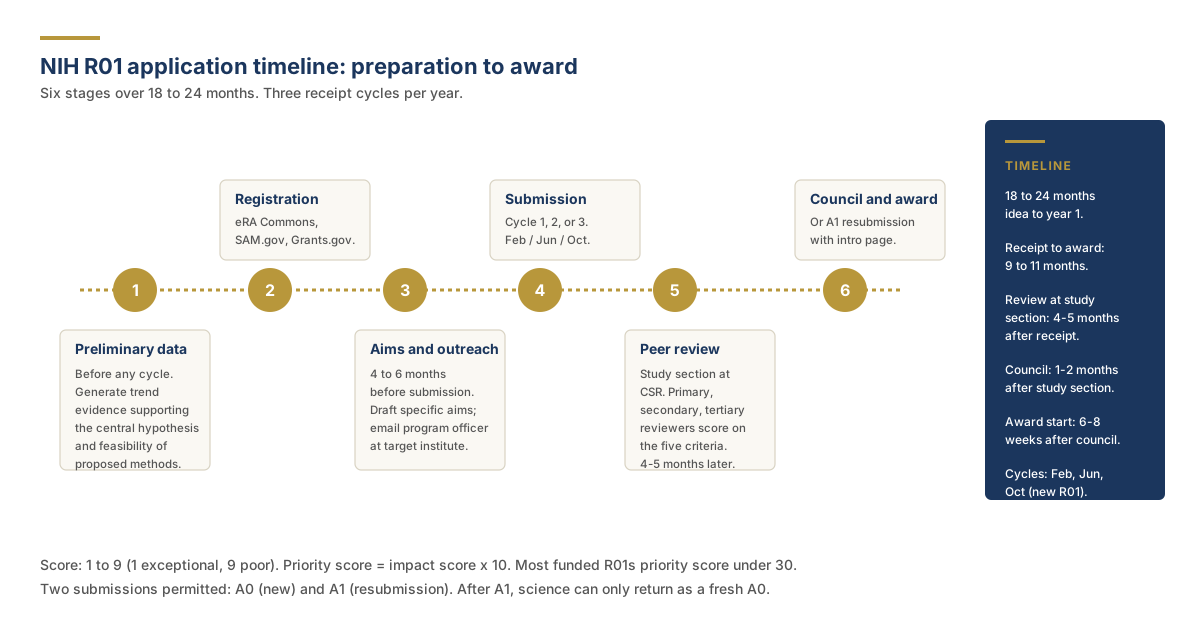
R01 applications follow three standard cycles per year. Cycle 1 receipt dates fall in early February (new) and early March (renewal, revision, resubmission). Cycle 2 receipt dates fall in early June (new) and early July (renewal). Cycle 3 receipt dates fall in early October (new) and early November (renewal). AIDS-related R01 applications have shifted deadlines that fall later in each cycle: typically January, May, and September.
The cycle from receipt to first-year funding is roughly 9 to 11 months. After submission, NIH performs validation and referral; the Center for Scientific Review assigns the application to a study section and the application is matched to a primary and a secondary funding institute. Study section review occurs 4 to 5 months after the receipt date. Advisory council review at the institute occurs 1 to 2 months after study section. Awards begin within 6 to 8 weeks of council. The full timeline from idea to funding for a successful first submission is therefore commonly 18 to 24 months, including preparatory time for preliminary data, specific aims drafting, and stakeholder engagement.
This long horizon means strategic application timing matters. Junior investigators with a finite institutional startup runway should submit as early in their independent career as preliminary data allows, accepting that the first submission may be declined and a resubmission will be needed. Senior investigators rolling over from a prior R01 should target a submission cycle that allows for a resubmission cycle within the no-cost-extension window of the existing award.
Required Sections in an R01 Application
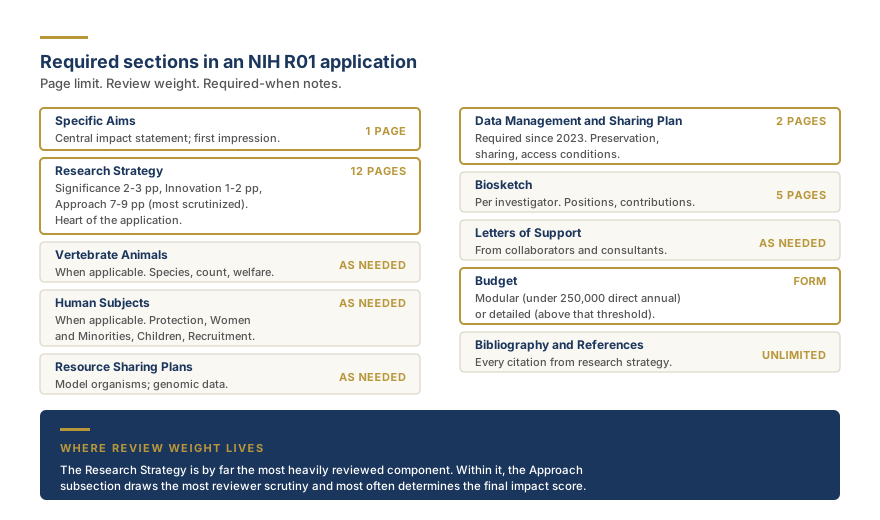
A submission package has many components. The Research Strategy is the central document, with a strict 12-page limit. Inside that 12 pages, the application is conventionally organized into three subsections: Significance (typically 2 to 3 pages), Innovation (1 to 2 pages), and Approach (7 to 9 pages, the longest and most heavily scrutinized).
Specific Aims is a separate one-page document that opens the application; reviewers read it first and many reviewers form their initial impression here. The aims page summarizes the central hypothesis, the specific aims (typically 2 to 4 numerical aims), and the expected impact. The page is consequential enough that experienced applicants invest substantial revision effort here. The writing a fundable specific aims page walkthrough drills into the structure most reviewers expect.
Vertebrate Animals, when applicable, is a separate document describing the species, number of animals, justification, and welfare procedures (housing, anesthesia, euthanasia). Human Subjects, when applicable, includes the Protection of Human Subjects, Inclusion of Women and Minorities, Inclusion of Children, and Recruitment and Retention sections. Resource Sharing Plans describe model organism sharing and genomic data sharing where applicable. The Data Management and Sharing Plan, required since 2023, describes how generated data will be preserved and shared, where, and under what access conditions.
The Biosketch is a five-page document per investigator describing positions, contributions to science, and current and pending support. Letters of Support from collaborators and consultants establish key expertise gaps. The Budget, in modular or detailed form, is the financial commitment of the proposed work. The Bibliography and References Cited is unlimited and lists every citation made in the research strategy.
Modular Versus Detailed Budgets
R01 applicants choose between modular and detailed budget formats. Modular budgets are permitted when the requested direct costs are 250,000 dollars per year or less. The budget is requested in 25,000-dollar modules (up to 10 modules per year), with a brief justification of personnel effort and consortium arrangements but without itemized supplies, travel, or equipment lines. Modular budgets simplify the application and shift the review focus from line-item scrutiny to scientific scope.
Detailed budgets are required when direct costs exceed 250,000 dollars per year, including consortium subaward direct costs as part of the total. Detailed budgets list every personnel position with calendar months of effort, salary and fringe benefits, fully itemized supplies and equipment, travel by purpose, and consortium subaward details. Detailed budgets require closer interaction with the institutional research office and more granular justification of every line.
The choice depends on the project scope. Mechanistic single-laboratory projects typically fit within modular limits. Multi-site clinical projects, animal model platforms requiring expensive purchase or per-diem costs, large equipment-intensive studies, and projects with multiple consortium subawards typically require detailed budgets. For analytic and design support specific to budget justification, biostatistics support for sample size and analysis plans often shapes the personnel line for the statistician position.
How Study Sections Review R01 Applications
After receipt, the Center for Scientific Review assigns the application to a study section within an Integrated Review Group. The Center for Scientific Review has roughly 20 Integrated Review Groups organized by broad scientific area (for example, AIDS and AIDS-Related Research; Behavioral, Social, and Population Sciences; Bioengineering Sciences and Technologies; Cell Biology; and so on). Each Integrated Review Group contains 8 to 20 study sections, each of which is a panel of approximately 20 scientific experts who meet three times per year to review applications.
Each application is assigned to a primary reviewer, a secondary reviewer, and a tertiary discussant. Sometimes ad hoc reviewers are recruited specifically because they bring expertise not represented on the standing panel. Primary and secondary reviewers read the entire application and write written critiques scored on each of the five criteria. The discussant reads the application and contributes during the meeting discussion.
At the meeting, applications are organized into a streamlined review track or discussed track. Streamlined applications fall in approximately the bottom half of the panel's preliminary scoring and are not discussed at the meeting; the written critiques are released without further panel input. Discussed applications, comprising the top half by preliminary score, are presented at the meeting by the assigned reviewers, then discussed by the full panel, and then scored by each panel member in a private overall impact score. Streamlining is a major cause of low scores: applications that fall below the discussion line rarely have the opportunity to recover from a single reviewer's misreading.
The Five Scored Criteria and Overall Impact Score
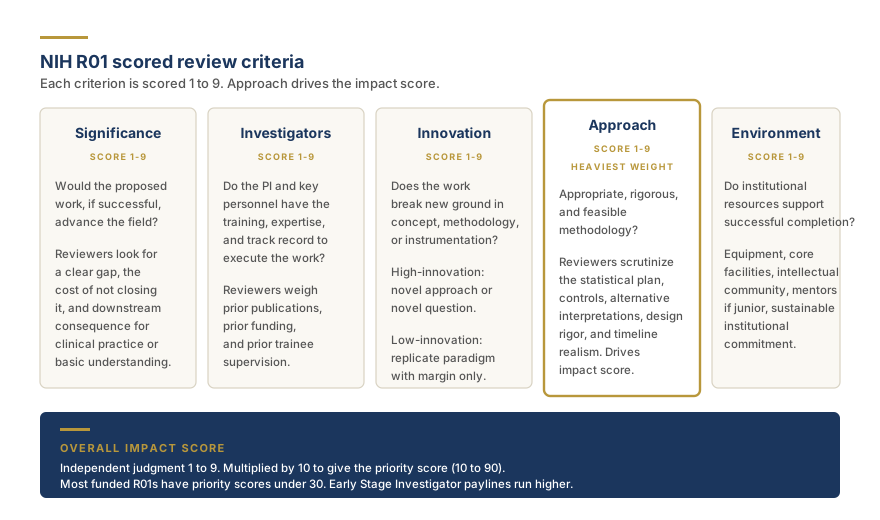
R01 applications are scored on five criteria: Significance, Investigators, Innovation, Approach, and Environment. Each criterion is scored on a 1 to 9 scale (1 is exceptional, 9 is poor). The criteria scores are documented in the written critique but are not directly summed; the overall impact score, also 1 to 9, is an independent judgment by each panelist of the overall scientific and technical merit of the application.
Significance asks whether the proposed research, if successful, would advance the field. Reviewers look for clear articulation of the gap, the importance of closing the gap, and the consequence of the proposed work for clinical practice, basic understanding, or downstream research.
Investigators asks whether the principal investigator and key personnel have the training, expertise, and track record to execute the proposed work. Reviewers weigh prior publications, prior funding, and prior trainee supervision.
Innovation asks whether the proposed work breaks new ground in concept, methodology, or instrumentation. High-innovation applications use novel approaches or address novel questions; low-innovation applications often replicate existing paradigms with marginal extensions.
Approach asks whether the proposed methodology is appropriate, rigorous, and feasible. Reviewers scrutinize the statistical analysis plan, the controls, the alternative interpretations, the rigor of the experimental design, and the realism of the timeline. Approach is the single most consequential criterion in determining the final impact score: weak Approach drags down otherwise strong applications more often than any other factor.
Environment asks whether the institution and the local resources support successful completion. Reviewers look for evidence of the resources, equipment, and intellectual community needed for the work.
The overall impact score is multiplied by 10 to produce a priority score (10 to 90). Most funded R01s have priority scores under 30 at the standard payline, although institutes adjust paylines, fund out-of-order priorities, and weight Early Stage Investigator applications differently.