Specific Aims Page: Structure, Reviewer View, Worked Example
Specific aims page structure for NIH grants: five-paragraph anatomy, reviewer perspective, two- versus three-aim layouts, worked example, common mistakes.
Dr. Sarah Mitchell
May 14, 2026
Key Takeaways
The specific aims page is the one-page executive summary that opens an NIH application; two-thirds of reviewers score primarily from it.
Use the five-paragraph anatomy: hook, gap statement, central hypothesis, aims block, payoff.
Two or three independent aims is the funded norm. Dependent aims compound risk and reliably lower scores.
Every aim needs three elements: imperative statement, aim-specific hypothesis, one-sentence approach naming model design outcome and analytic method.
Expect 12 to 40 rewrites of the aims page across mentor reads, pre-submission drafts, and final submission.
The specific aims page is the one-page summary that opens an NIH grant application, stating the research problem in context, the gap in current knowledge, the central hypothesis, two or three measurable aims, and the expected payoff for the field. Reviewers read it first, often before the rest of the application, and many seasoned program officers say a strong specific aims page is the single most important predictor of whether a proposal will be funded.
This guide unpacks the five-paragraph structure that experienced grant writers use, explains how primary, secondary, and tertiary reviewers actually consume the page, walks through an annotated worked example, and lists the recurring mistakes that send otherwise strong science to the bottom of the pile. By the end you should be able to draft a specific aims page that survives both a study section and a deadline weekend.
Anatomy of a Specific Aims Page That Reviewers Actually Like
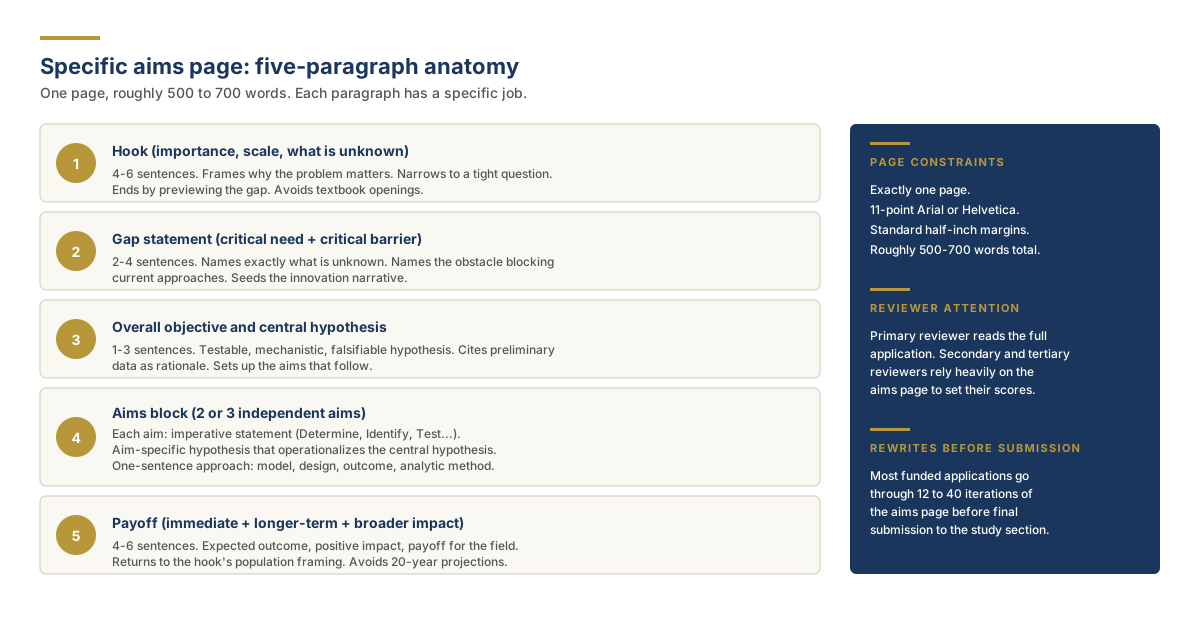
A specific aims page is almost always exactly one page in eleven-point Arial or Helvetica with standard half-inch margins, which works out to roughly 500 to 700 words of prose. The page is not free-form. Across thousands of funded R01 and R21 applications a remarkably consistent five-paragraph structure has emerged, and reviewers expect it. Departing from the structure does not automatically tank a score, but it does cost the applicant something more valuable than space: it costs reviewer attention.
The five paragraphs are: the hook, the gap statement, the central hypothesis and overall objective, the aims, and the payoff. The hook frames why the problem matters. The gap states what is unknown and why current approaches cannot answer the question. The central hypothesis is the testable claim that the entire application defends. The aims are the two or three concrete experiments that test the hypothesis. The payoff explains what the field gains if the aims succeed.
Below each paragraph has its own section so you can see what reviewers expect, what common drafts get wrong, and what stronger language looks like. The page is best drafted last, after the R01 grant structure or R21 exploratory mechanism and the research strategy are settled, because the aims page is a compression of decisions made elsewhere.
The Hook Paragraph: Importance, Scale, and What Is Unknown
The first paragraph has three jobs and roughly four to six sentences to accomplish them. It must establish that the problem is clinically or scientifically important, that the problem is large in scale, and that something specific about the problem is not yet understood. The hook is not a textbook introduction. It is not a place to explain what a disease is. It is the place where you stake the claim that this proposal matters.
A weak hook reads like a Wikipedia article. It opens with a definitional sentence, walks through epidemiology in general terms, and closes with a vague gesture toward needing more research. A strong hook opens with a striking fact or trend, narrows quickly to a tightly framed scientific question, and ends by previewing the gap.
A useful test: read the hook aloud and ask whether a smart non-specialist could repeat the central problem in their own words. If they cannot, the hook is too jargon-heavy. If the problem they repeat is too broad to be solved in five years with one laboratory's resources, the hook is not narrow enough. Reviewers reading dozens of applications in a sitting reward early specificity.
The Gap Statement: What Is Missing in Current Knowledge
The second paragraph names the gap. It tells reviewers, in two to four sentences, exactly what current science does not know and why current approaches cannot fill the gap. A clean gap statement contains a critical-need sentence and a critical-barrier sentence: critical need names the question the field cannot yet answer, and critical barrier names the technical, conceptual, or methodological obstacle that has prevented an answer.
Common failure modes in this paragraph include listing every gap in the literature, citing recent papers that already partially answer the question, and framing the gap as a knowledge gap when it is really a translational gap or vice versa. Reviewers track gaps tightly. If the gap stated in paragraph two does not match the experiments proposed later, the application loses credibility.
A strong gap statement also seeds the innovation narrative. If the gap exists because the field has lacked a particular technology, dataset, or analytic method, and your application introduces that technology, dataset, or method, the innovation criterion is already half written before the research strategy begins. The same logic applies to early-stage projects designed for the R21 exploratory mechanism, where the gap typically motivates a proof-of-concept rather than a fully powered trial.
The Central Hypothesis and Overall Objective
The third paragraph contains two of the most important sentences in the entire application: the overall objective of the proposal and the central hypothesis the proposal will test. The overall objective is a one-sentence statement of what the project as a whole will accomplish. The central hypothesis is a one-sentence claim that is specific, mechanistic, and testable.
Reviewers look for hypotheses they can falsify. A hypothesis stated as "we will investigate the role of X in Y" is not a hypothesis, it is a goal. A hypothesis stated as "X drives Y by activating pathway Z, leading to outcome W" is testable: each of the three claims can be checked by an aim. The classical structure is "Our central hypothesis is that <mechanism> drives <outcome> through <pathway or mediator>, and we will test this by <brief description of approach>."
A second sentence in this paragraph usually states the rationale for the hypothesis, citing the preliminary data and key literature that justify it. The rationale is what keeps reviewers from concluding that the hypothesis is speculation. It points to the figures and tables in the research strategy where preliminary data live, without rehearsing them in detail.
Each aim has three elements: an aim statement in imperative voice, an aim-specific hypothesis that operationalizes the central hypothesis for that aim, and a one-sentence approach describing the experimental design. Each aim should occupy three to five lines of text. Reviewers should be able to glance at a finished aims page and identify the three elements in each aim without parsing dense prose.
Aim statements typically read "Aim 1. To determine whether..." or "Aim 2. To identify the..." or "Aim 3. To test the..." Verbs matter. "Determine," "identify," "characterize," "quantify," and "test" suggest an analytic plan and clear endpoints. "Investigate," "study," and "explore" sound vague and reviewers reliably note this. Each aim statement is followed by an aim hypothesis, which is a logical sub-claim of the central hypothesis, and then by an approach sentence naming the model system, the design, the primary outcome, and the analytic method.
The aim hypotheses, taken together, should reconstruct the central hypothesis. If a reader could remove an aim and still believe the central hypothesis is fully tested, the aim is poorly integrated. If a reader could remove an aim and the central hypothesis collapses, the aim is essential. The latter is what reviewers reward.
Two-Aim Versus Three-Aim Layouts
Both two-aim and three-aim layouts are funded routinely. Two-aim applications are common in computational and population science, where each aim may itself encompass several large experiments or analyses. Three-aim applications are common in basic, translational, and clinical investigations where each aim corresponds to a distinct experimental system or patient cohort. Four aims is uncommon and risky because the page cannot hold a coherent narrative for four independent threads, and study sections often interpret four aims as evidence that the project is unfocused.
The single most important constraint on aim count is independence. Aims must be logically independent: if Aim 2 succeeds only when Aim 1 succeeds first, the application has effectively one aim with two phases, and the reviewer's risk calculation rises sharply. Project officers and reviewers explicitly call this out. Dependent aims compound risk, and the application fails if the first aim fails. Independent aims diversify risk, and partial success of the application is still a meaningful scientific contribution.
The cleanest layout has each aim addressing a different facet of the central hypothesis. For instance, Aim 1 may establish a mechanism in a cell or animal model, Aim 2 may verify the mechanism in human samples, and Aim 3 may demonstrate that perturbing the mechanism alters a clinically meaningful endpoint. Each aim can stand alone, each contributes to the central claim, and the failure of one does not destroy the application.
Need professional help with your research?
Our PhD methodologists deliver complete systematic reviews and meta-analyses, from protocol to manuscript.
There are three patterns reviewers regularly criticize, and seasoned applicants now avoid them by default. The first is the dependent aim, already discussed: aims that read "Aim 2 will be performed if Aim 1 succeeds" almost always score worse than independent equivalents. Programs and review groups have explicit guidance on avoiding fishing expedition aims and conditional aims.
The second pattern is the purely descriptive aim that lacks an analytic plan or testable claim. "Aim 2. To characterize the transcriptomic profile of <tissue> in <condition>" without specifying analytic comparisons, hypotheses about regulators or pathways, or links to function reads as descriptive and unmotivated. Strong descriptive aims always anchor to a hypothesis: the description exists to test something, not for its own sake. The same caution applies in clinical and population work: an aim that simply "describes" prevalence or trends without a hypothesis about predictors or mechanisms reads as weak.
The third pattern is the method development aim disguised as a science aim. An aim that reads "Aim 3. To develop a novel platform for measuring X" is appropriate for a tool-focused mechanism such as the R21 in tool development or a research methodology development project, but it is rarely appropriate as a third aim on a hypothesis-driven R01. Method development aims tend to score worse because reviewers cannot judge feasibility of the method and the science using the method in the same paragraph. If a method needs to be developed, it usually belongs in Aim 1 with a contingency plan, not as a standalone aim.
The Payoff Paragraph: Short, Long, and Immediate Impact
The final paragraph closes the page with the expected payoff, sometimes called the impact paragraph or the significance close. Most strong examples use a three-tier impact structure: the immediate scientific contribution if the aims succeed, the longer-term translational or applied consequence, and the broader payoff for the field.
A typical pattern: "The expected outcome of this work is mechanistic evidence that X regulates Y in Z. The positive impact of this work is twofold: it provides the first direct test of <mechanism>, and it identifies a tractable therapeutic target for <disease> for which no disease-modifying therapy exists." Reviewers like the explicit naming of positive impact because it ties back to the importance claim made in the hook. The page becomes circular: it starts with why this matters and ends with what we will have learned.
A weaker payoff paragraph confuses what the application will produce with what the field will eventually achieve in twenty years. Reviewers discount distant projections. A payoff stated as "this work will eventually cure cancer" is not credited. A payoff stated as "we will identify two candidate therapeutic targets and define the genetic backgrounds in which they should be tested" is credited because it can be verified by the experiments proposed.
Reviewer Perspective: How the Page Is Actually Used
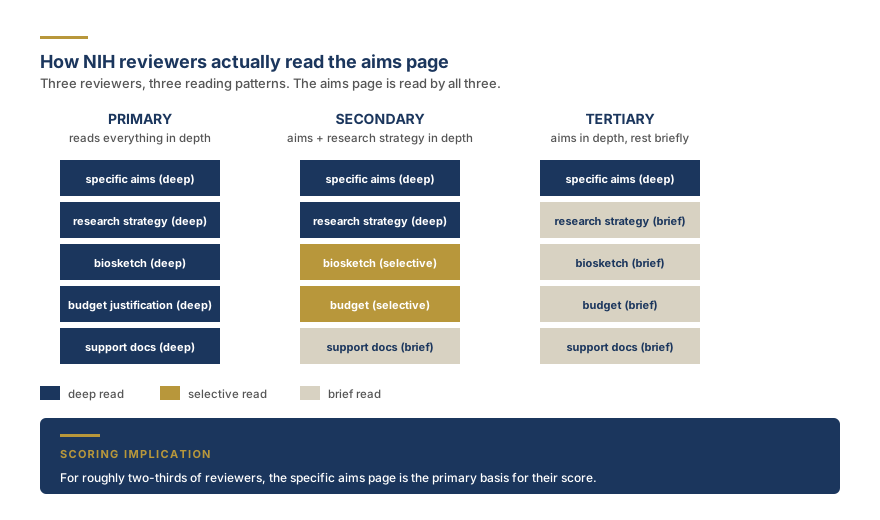
NIH study sections assign each application three reviewers: a primary, a secondary, and a tertiary. The primary reviewer reads the entire application in detail. The secondary reviewer reads the specific aims page and the research strategy in some depth and the rest selectively. The tertiary reviewer reads the specific aims page carefully and the rest of the application briefly. For roughly two-thirds of reviewers, the specific aims page is the primary basis for their score.
The page is also where other study section members form their first impression. Before the meeting most section members will at minimum scan the aims page of every application up for discussion. After triage, applications below the discussion line are not discussed at all, and the specific aims page is often the deciding document. Investigators reviewing for landscape can also use tools like NIH RePORTER for grant landscape analysis to spot-check related funded work before scoring.
This is why grant writers treat the page as the executive summary of the entire application. Every sentence is engineered to land a specific impression: the problem is important, the gap is real, the hypothesis is testable, the aims are independent, and the payoff is meaningful. Reviewers may forgive minor issues in the research strategy or budget, but they rarely forgive a confused or unfocused aims page.
Common Mistakes That Sink Otherwise Strong Science
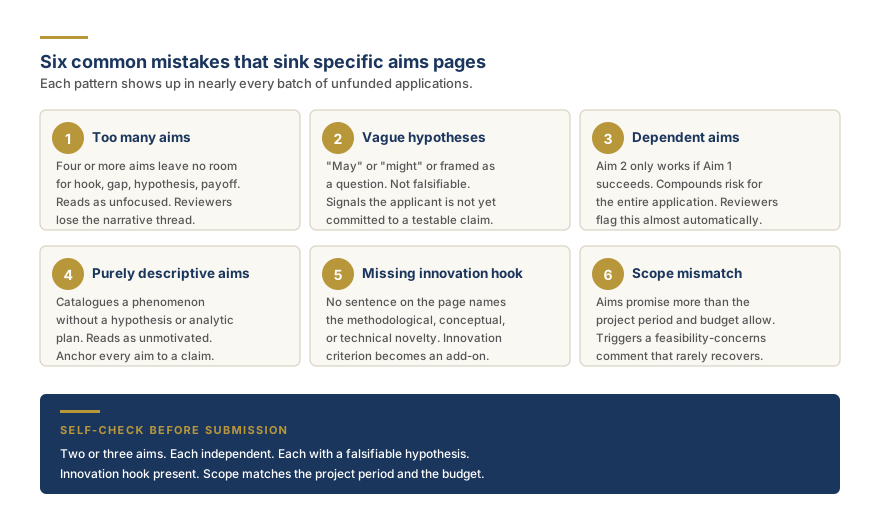
The most common mistakes appear in nearly every batch of unfunded applications. The first is too many aims: applicants pack four or even five aims into a single page, which leaves no room for the hook, gap, hypothesis, and payoff. Reviewers see a wall of aim text and lose the narrative.
The second mistake is vague hypotheses. Hypotheses that include the word "may" or "might" or are framed as questions rather than claims signal that the applicant is not yet committed to a testable position. Reviewers want a falsifiable claim and a plan to falsify it.
The third mistake is missing the innovation hook. The aims page is the most efficient place to plant the innovation flag. A single sentence in the gap or hypothesis paragraph that names the methodological, conceptual, or technical novelty pays dividends when the application reaches the innovation criterion. Without this hook the innovation criterion often reads as an add-on rather than a thread running through the science.
A fourth recurring mistake is mismatched scope: aims that promise more than can be done in the project period and budget. Reviewers read the aims with the project period in mind. Five-year R01 aims that read like ten-year aims invite the "feasibility concerns" comment, which costs scoring points and rarely recovers. The fifth is aims that double as methods aims when the project is supposed to be hypothesis-driven, as discussed earlier. The sixth is the missing approach sentence: aims that state a hypothesis but never describe the experimental approach leave reviewers unable to judge feasibility.
Annotated Example Walkthrough
The following annotated paragraph illustrates the structure for a hypothetical R01 in cardiometabolic genetics. The aim has been compressed to a single illustrative paragraph for space, but the structure mirrors what experienced reviewers expect on a real page.
"Heart failure with preserved ejection fraction affects more than three million adults in the United States, and no disease-modifying therapies exist. <Hook> Recent genome-wide studies implicate variants in the <pathway> locus, but the causal variant, the target cell type, and the mechanism remain unknown. <Gap> Our central hypothesis is that the <pathway> risk variant elevates heart-failure risk by altering <regulator> expression in <cell type>, dysregulating <process>. <Hypothesis> Aim 1. To map the <pathway> regulatory architecture using <method> in <model>. Hypothesis: the risk variant disrupts <regulator>. Approach: <design>. Aim 2. To test, using induced <cell type> from <cohort>, whether the variant alters <process>. Hypothesis: variant carriers show <effect>. Approach: <design>. Aim 3. To determine whether pharmacological restoration of <regulator> rescues <phenotype> in <model>. Hypothesis: rescue normalizes phenotype. Approach: <design>. <Aims> The expected outcome is a mechanism, a target, and a tractable preclinical pharmacology, with positive impact on the prioritization of new therapies for a disease with high mortality and no current options. <Payoff>"
Even abbreviated, the example makes the structure visible. Each paragraph has a job, each aim has a hypothesis and an approach, and the payoff returns to the population framing of the hook. Investigators preparing applications often have this overall structure reviewed alongside comprehensive grant writing support before submitting to a study section.
Aligning Specific Aims With Research Strategy, Biosketch, and Budget Justification
The specific aims page is not an isolated document. It sets up commitments that the rest of the application must honor. The research strategy must devote its significance, innovation, and approach sections to the same gap, hypothesis, and aims named on the aims page. If the research strategy expands beyond the aims page or omits material claimed on it, reviewers will note the inconsistency.
The biosketch should support the claims made on the aims page. If the aims page claims that the laboratory has a unique capability or has generated preliminary data critical to feasibility, the biosketch's contribution-to-science section should reflect that capability. Similarly, the biosketches of key personnel should align with the methods proposed in each aim. Reviewers cross-reference these documents routinely.
The budget justification must match the personnel, materials, and analytic workload implied by the aims. An aim that promises a hundred subject longitudinal cohort study but is budgeted for one part-time research coordinator and a single biostatistician triggers a "budget appears inadequate" comment that often becomes a scoring concern. This is one reason teams sometimes engage a methodology writing for grant proposals partner during the budget-and-aims integration phase: the aims and the budget must tell the same story.
When to Draft the Specific Aims Page
The specific aims page is usually drafted twice: once at the very beginning of the project, in rough form, to test whether the proposed work fits a fundable narrative, and once at the very end, in polished form, after the research strategy and budget are settled. The early draft is for the investigator's own clarity and for sharing with mentors, program officers, and collaborators. The late draft is for the study section.
Between these drafts the page is rewritten many times. Experienced grant writers report between twelve and forty iterations of the specific aims page for a single submission, with the largest changes coming in response to mentor or pre-submission reader feedback. Investigators new to the mechanism should expect to spend more time on the aims page than on any other single component of the application. Time invested in the aims page returns more score per hour than time invested in any other section.
Frequently Asked Questions
What is the specific aims page?
The specific aims page is the one-page summary that opens an NIH grant application. It frames the research problem, states the gap in knowledge, declares the central hypothesis, lists the two or three measurable aims, and explains the expected payoff. Reviewers treat the page as the executive summary of the entire application.
How long should a specific aims page be?
The specific aims page is exactly one page in eleven-point Arial or Helvetica with standard half-inch margins. That works out to roughly 500 to 700 words of prose. Going over one page is grounds for rejection at the NIH submission portal before the application is even reviewed.
How many aims should an NIH grant have?
Most funded NIH grants have two or three aims. Three is most common for R01 applications. Two is common in computational, population, and clinical science where each aim is large. Four aims is uncommon and usually weakens the application because the page becomes crowded and reviewers interpret four threads as a lack of focus.
Should specific aims have hypotheses?
Yes. Every aim should have an aim-specific hypothesis that operationalizes the central hypothesis for that aim. Hypotheses must be testable, mechanistic, and falsifiable. Aims framed as goals or as descriptive surveys without hypotheses score worse because reviewers cannot judge what would count as success or failure.
What does a good specific aims page look like?
A good specific aims page has a five-paragraph structure: a hook paragraph that frames importance and scope, a gap paragraph that names what is missing, a central hypothesis paragraph that states a testable claim, an aims paragraph or block with two or three independent aims each containing a statement and a hypothesis and an approach sentence, and a payoff paragraph that returns to impact.
When should I write the specific aims page?
Draft a rough version early, before writing the research strategy, to test whether the work fits a fundable narrative. Then revise heavily after the research strategy and budget are settled. Most experienced applicants rewrite the page twelve to forty times before final submission, with the largest revisions following pre-submission reads by mentors and collaborators.
Pro Tip
Draft the page twice: once at project start to test the narrative, once at the end after research strategy and budget are settled.
Pro Tip
Read the hook aloud and ask whether a smart non-specialist can repeat the central problem in their own words.
Pro Tip
Plant the innovation hook in the gap statement so the innovation criterion is already half written before the research strategy.
Pro Tip
Use verbs like determine, identify, characterize, quantify, test. Avoid investigate, study, explore.
Pro Tip
Cross-check the aims against the biosketch and budget so reviewers do not find inconsistencies.
Frequently Asked Questions
6
The specific aims page is the one-page summary that opens an NIH grant application. It frames the research problem, states the gap in knowledge, declares the central hypothesis, lists the two or three measurable aims, and explains the expected payoff. Reviewers treat the page as the executive summary of the entire application.
The specific aims page is exactly one page in eleven-point Arial or Helvetica with standard half-inch margins. That works out to roughly 500 to 700 words of prose. Going over one page is grounds for rejection at the NIH submission portal before the application is even reviewed.
Most funded NIH grants have two or three aims. Three is most common for R01 applications. Two is common in computational, population, and clinical science where each aim is large. Four aims is uncommon and usually weakens the application because the page becomes crowded and reviewers interpret four threads as a lack of focus.
Yes. Every aim should have an aim-specific hypothesis that operationalizes the central hypothesis for that aim. Hypotheses must be testable, mechanistic, and falsifiable. Aims framed as goals or as descriptive surveys without hypotheses score worse because reviewers cannot judge what would count as success or failure.
A good specific aims page has a five-paragraph structure: a hook paragraph that frames importance and scope, a gap paragraph that names what is missing, a central hypothesis paragraph that states a testable claim, an aims paragraph or block with two or three independent aims each containing a statement and a hypothesis and an approach sentence, and a payoff paragraph that returns to impact.
Draft a rough version early, before writing the research strategy, to test whether the work fits a fundable narrative. Then revise heavily after the research strategy and budget are settled. Most experienced applicants rewrite the page twelve to forty times before final submission, with the largest revisions following pre-submission reads by mentors and collaborators.
Share
Found this useful? Share it with your colleagues.
Need professional help with your research?
Our PhD methodologists deliver complete systematic reviews and meta-analyses, from protocol to manuscript.
From protocol to publication-ready manuscript. Our PhD-level methodologists handle systematic reviews, meta-analyses, scoping reviews, and more. Most projects deliver in under 2 weeks.
Our promise: Free rework on search, screening, or synthesis if reviewers push back.
4.9 / 5Quote within a few hoursPRISMA 2020 + Cochrane HandbookPhD methodologistConfidential by default
Dr. Sarah Mitchell holds a PhD in Biostatistics from Johns Hopkins Bloomberg School of Public Health and has over 15 years of experience in systematic review methodology and meta-analysis. She has authored or co-authored 40+ peer-reviewed publications in journals including the Journal of Clinical Epidemiology, BMC Medical Research Methodology, and Research Synthesis Methods. A former Cochrane Review Group statistician and current editorial board member of Systematic Reviews, Dr. Mitchell has supervised 200+ evidence synthesis projects across clinical medicine, public health, and social sciences.
From protocol to publication-ready manuscript. Our PhD-level methodologists handle systematic reviews, meta-analyses, scoping reviews, and more. Most projects deliver in under 2 weeks.
CHEERS 2022 checklist explained: all 28 items, what changed from CHEERS 2013, and how to report a cost-effectiveness analysis so payers and journals can use it.
SPIRIT 2025 checklist explained: all 34 items by section, what changed from SPIRIT 2013, and how the protocol lines up with CONSORT 2025 when you report the trial.
ARRIVE 2.0 guidelines explained: the Essential 10 and the Recommended Set, what changed from ARRIVE 2010, and the items journals check in animal research reports.