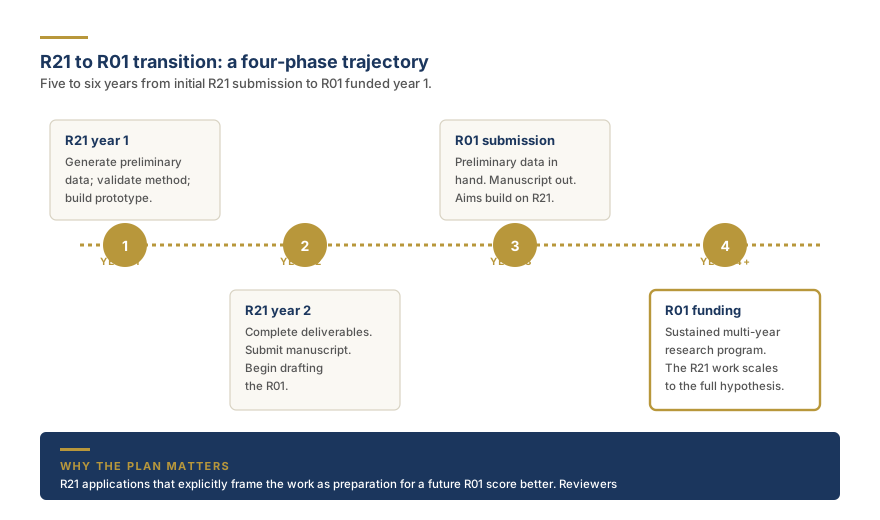
The NIH R21 is the Exploratory and Developmental Research Grant Award, designed for early-stage higher-risk projects with a combined cap of 275,000 dollars over two years and a maximum of 200,000 dollars in any single year. R21 sits at the early end of the NIH activity-code spectrum: shorter than an R01, smaller in budget, simpler to write, and explicitly intended to support work that does not yet have the preliminary data an R01 would need. The R21 is not a smaller R01, and treating it as one is the most common reason applications score poorly. This guide covers what R21 is for, how it differs from R01, when the mechanism is the right fit, and how to plan the transition from R21 to R01 in a multi-year research program.
R21 has existed since the early 1990s and was redesigned in the early 2000s to fund exploratory and developmental research that did not fit the R01 model. The fundamental design decision was to fund higher-risk, higher-novelty, smaller-scope projects: enough money for a focused two-year effort, not enough for a sustained multi-year program. The mechanism is widely used but also widely misused by investigators who write what is essentially an R01 with a smaller budget request.
How R21s Differ From R01s in Scope, Budget, and Review
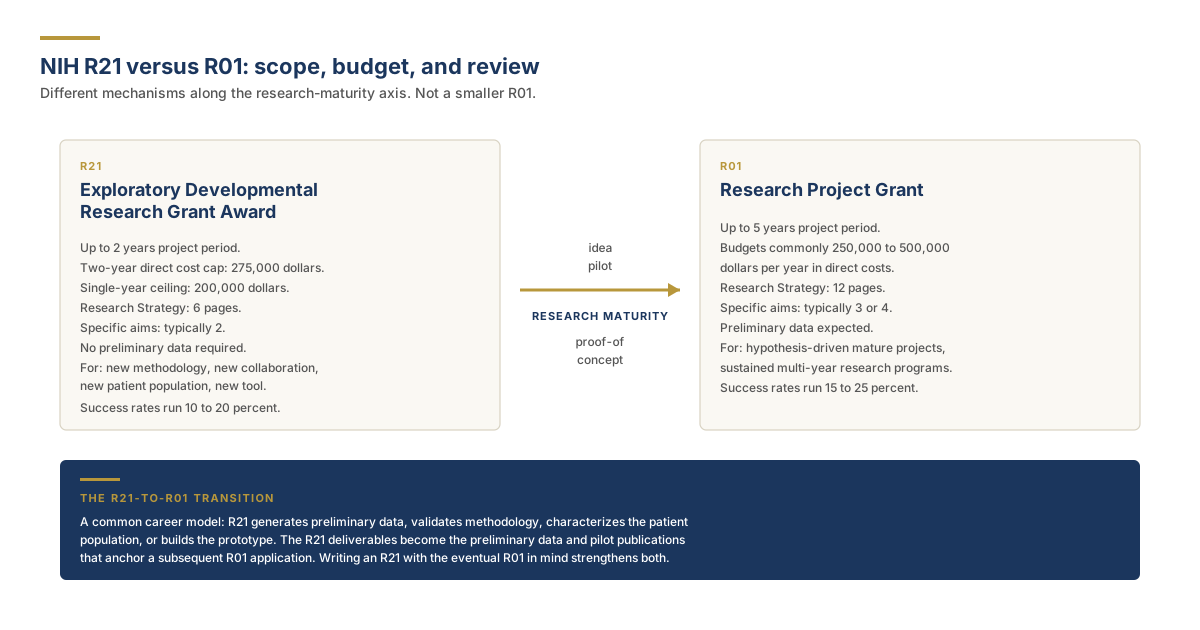
R21 differs from R01 along four dimensions: project duration, budget cap, page limit, and reviewer expectations. R21 funds up to two years of research; the budget total cannot exceed 275,000 dollars in direct costs across both years combined and no single year can exceed 200,000 dollars. The Research Strategy is six pages, half the R01 page limit. R21 review uses the same study section infrastructure as R01 but with a different rubric: reviewers explicitly assess whether the project is appropriate for an exploratory mechanism, not whether the work could be done in five years as an R01.
These constraints push the application toward a focused two-aim structure with a narrow scope. An R01 typically has three or four specific aims, each with multiple subaims. An R21 typically has two specific aims, each focused on a single concrete deliverable. Investigators who write an R21 with four aims, each of which is its own substantial project, are signaling to reviewers that they did not fit the work to the mechanism.
Budgets follow the scope. A modular R21 fits within the two-year cap by limiting personnel commitments, restricting equipment purchases to what is essential, and outsourcing services where appropriate. The most common budget breakdown is one or two key personnel at modest effort, supplies and reagents, core facility services, and software or computing. Large equipment, multiple postdoctoral salaries at full effort, and extensive consortium subawards push the budget past the cap and are signs of a project that belongs in an R01.
Which NIH Institutes Use R21 Most Heavily
Not all NIH institutes use R21 at the same intensity. The biggest users of R21 are NCI, NIAID, NIDA, NIMH, NIA, and NIDDK. Some institutes have specific R21 announcements with set-aside budgets; others accept R21 applications only through the Parent FOA. A small number of institutes do not accept R21 applications at all, or accept them only through specific announcements.
Before drafting, check the target institute's most recent funding announcements and the institute's R21 funding history. NIH RePORTER at reporter.nih.gov is the canonical source: filter by activity code R21, by funding institute, and by fiscal year to see the distribution of recent R21 awards. Use RePORTER for R21 landscape analysis to identify institutes with active R21 portfolios in your topic area and to read recently funded R21 abstracts that match your proposed work.
Program officer outreach matters more for R21 than for R01. Because R21 success depends on the institute treating the application as an exploratory-mechanism candidate, the program officer's view of whether the project genuinely fits R21 (versus belonging in R01) is consequential. A short pre-submission email to the program officer with the specific aims and a one-paragraph framing of why the work is exploratory rather than mature is the right level of contact.
R21 Budget Structure and the Two-Year Cap
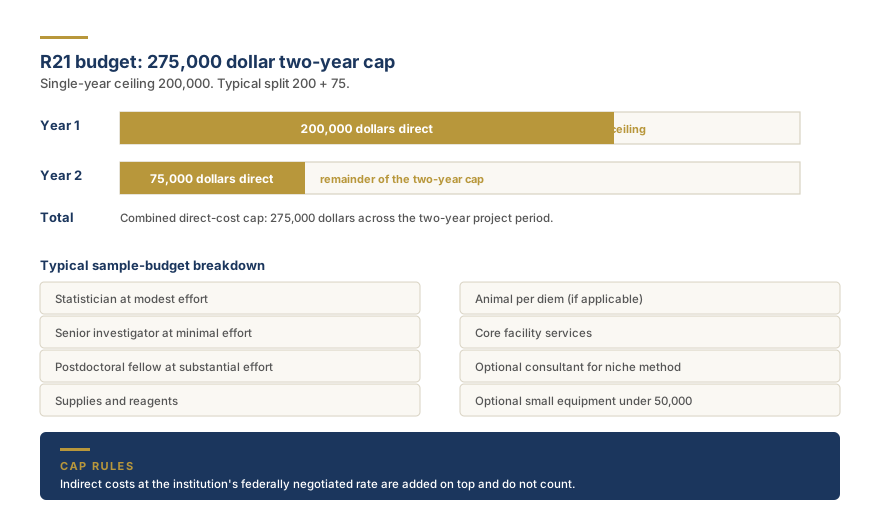
The R21 budget rules are strict. Total direct costs cannot exceed 275,000 dollars across the two-year project period. Within that total, no single year can request more than 200,000 dollars in direct costs. The two limits combine: the maximum split is 200,000 dollars in year 1 and 75,000 dollars in year 2 (or any other distribution that satisfies both rules). Indirect costs are added separately at the institution's federally negotiated rate and do not count against the cap.
Modular budget submission is permitted up to the cap. R21s with detailed budgets are uncommon because the cap is below the modular threshold; most applicants use modular budgets in 25,000-dollar modules. The justification is brief: personnel effort, consortium arrangements if any, and a note on consumables and core facility usage.
The budget shape signals project shape. A typical R21 budget covers one statistician at modest effort, one senior investigator at minimal effort, one postdoctoral fellow at substantial effort, supplies, animal per diem if applicable, and core facility services. Some R21s additionally include one consultant for niche methodology or one small piece of equipment under 50,000 dollars. Budgets that try to fit a full research program into the cap (multiple postdocs at full effort, multiple consortium subawards, extensive equipment) signal misalignment with the mechanism.
Page Limits and the Six-Page Research Strategy
R21 Research Strategy is six pages, exactly half the R01 limit. Within the six pages, the conventional subsection split is one page Significance, one page Innovation, four pages Approach. Some applications combine Significance and Innovation into a single subsection and dedicate up to five pages to Approach; the choice is the investigator's, but reviewers expect to see all three elements addressed.
The Specific Aims page (one page) is separate from the Research Strategy and is unchanged from R01 conventions: hypothesis, two specific aims, expected impact, and significance summary. The Bibliography is unlimited. The Biosketch is five pages per investigator. The Human Subjects, Vertebrate Animals, Data Management and Sharing Plan, Letters of Support, and Resource Sharing sections follow the standard NIH application package conventions.
The page constraint forces sharper writing. R21 Approach subsections cannot accommodate the depth of methodological discussion an R01 affords; each aim needs one or at most two paragraphs, with a tight statistical analysis plan and a brief rigor and reproducibility section. The writing strong specific aims walkthrough applies equally to R21, with the constraint that the R21 specific aims page must reflect the more focused two-aim structure.
The Preliminary Data Myth: Required Versus Welcomed
A widespread misunderstanding holds that R21 applications cannot include preliminary data. This is incorrect. The R21 mechanism does not require preliminary data, but it does not forbid including data that supports feasibility or motivates the proposed exploration. Reviewers respond to feasibility evidence even on R21 applications. The accurate statement is that R21 reviewers do not require preliminary data and do not penalize applications that lack it, but feasibility evidence (where it exists) is welcomed.
The practical implication is straightforward: include preliminary data if you have it, and clearly position it as preliminary rather than as mature evidence. Applications that include preliminary data but write it as if the central hypothesis is already supported invite reviewers to ask why the work belongs in R21 rather than R01. Applications that include no preliminary data are not penalized but should clearly describe why the methodology is feasible (prior literature, the laboratory's adjacent expertise, collaborator track record, or pilot data from related projects).
The corollary: applications proposing methodology the laboratory has never demonstrated, without literature evidence that the methodology is feasible, score poorly. R21 is for exploratory work, not for speculative work; reviewers need to believe the proposed two years of effort can plausibly produce the deliverables described in the aims.
Specific Aims for R21: Two Aims, Narrower Scope
R21 specific aims should articulate two focused aims that together accomplish a discrete deliverable: a new methodology demonstrated in a defined system, a new patient population characterized along specific dimensions, a new tool prototype validated against a defined benchmark, or a new collaboration's joint pilot project producing a defined output. Each aim should produce a result that can be written up as a manuscript at the end of the R21 period or that can serve as the preliminary data for a future R01 submission.
Anti-patterns to avoid:
Three or four aims. R21 is not big enough to fund this scope. Reviewers will note the misalignment.
Aims that are sequential and conditional. If Aim 2 cannot be done unless Aim 1 succeeds, the R21 carries the risk of zero deliverables if Aim 1 fails. Better: Aims that are parallel, each producing useful output, with explicit fallback positions if individual experiments fail.
Aims that mirror an R01 structure with smaller numbers. Reviewers can tell when an R01 outline has been compressed into the R21 page count. The mechanism asks for a different application shape, not a smaller version of the R01 application shape.
Aims without a clear deliverable. "Characterize X" or "Investigate Y" without a stated method, expected outcome, and use of the outcome are weak. Each R21 aim should answer the question "and then what?" with a concrete next step.