A systematic review during residency is one of the most achievable paths to a peer-reviewed publication for medical trainees working under strict time constraints. The Accreditation Council for Graduate Medical Education (ACGME) requires residents to demonstrate scholarly activity as a core competency, and a well-planned systematic review can satisfy that requirement within 4 to 8 months of focused, part-time effort. Unlike prospective clinical studies that demand IRB approval, patient enrollment, and months of data collection, a systematic review uses existing published evidence, which means you can make meaningful progress during research electives, weekend blocks, and those rare quiet call nights. This guide breaks down exactly how to complete one without derailing your clinical training.
Why a Systematic Review Is the Best Publication Strategy for Residents
Not all study designs are equally feasible during residency. Randomized controlled trials require funding, IRB approval, patient recruitment, and multi-year follow-up. Prospective cohort studies demand consistent data collection that conflicts with rotating schedules. Case reports are publishable but carry limited academic weight for fellowship applications. A systematic review, by contrast, offers three advantages that align perfectly with the constraints of residency training.
First, no IRB approval is needed. Systematic reviews synthesize existing published data, so most institutions classify them as exempt from institutional review board oversight. This eliminates weeks of paperwork and committee review that would consume time you do not have.
Second, the work is modular. Each phase of a systematic review, from protocol development to database searching to screening to data extraction to analysis, can be completed in discrete blocks of 2 to 4 hours. This modularity fits around 80-hour work weeks, night shifts, and unpredictable clinical schedules far better than any prospective study design.
Third, the methodology is standardized. The PRISMA 2020 guidelines (Page et al., 2021) provide a step-by-step framework that removes guesswork. You do not need to invent a novel methodology; you need to follow an established one rigorously. Cochrane Handbook for Systematic Reviews of Interventions (Higgins et al., 2023) provides the gold standard methodological reference, and tools like Covidence, Rayyan, and RevMan automate the most labor-intensive steps.
The ACGME scholarly activity requirement can be met through a systematic review published in a peer-reviewed journal, and program directors across specialties increasingly recognize systematic reviews as high-quality scholarly output. A 2022 survey published in the Journal of Graduate Medical Education found that programs with structured research curricula produced residents with significantly higher publication rates, and systematic reviews were the most common study type completed during training.
A Realistic Timeline: Fitting a Systematic Review Into Residency
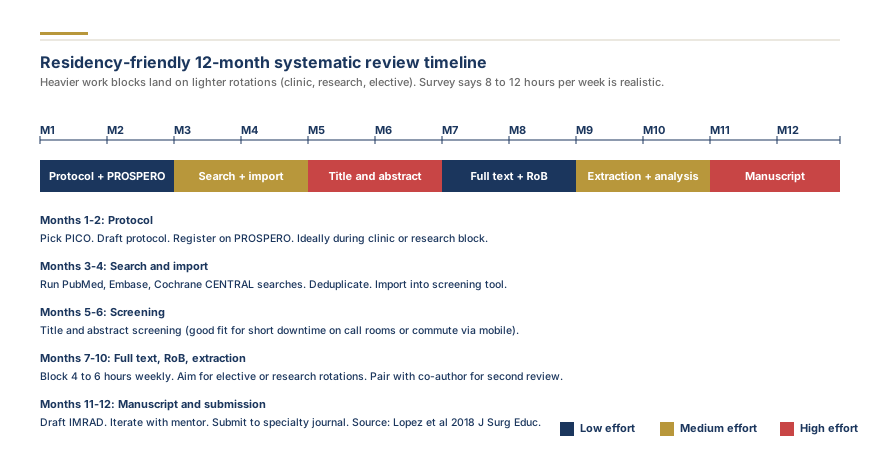
The biggest mistake residents make is underestimating how long a systematic review takes or overestimating how much time they have. A realistic plan accounts for the fact that you will have weeks where clinical duties leave zero time for research. Here is a 6-month timeline designed for residents who can commit an average of 5 to 8 hours per week, with more intensive work during research rotations.
Month 1: Topic selection and protocol registration. Choose a focused clinical question using the PICO framework (Population, Intervention, Comparison, Outcome). Register your protocol on PROSPERO, which takes about 2 to 3 hours to complete. PROSPERO registration is free and demonstrates methodological rigor to journals and reviewers. Read our how to register on PROSPERO for step-by-step instructions. During this month, you should also recruit at least one co-reviewer for dual screening, which is required by PRISMA and Cochrane standards.
Month 2: Search strategy development and execution. Build your search strategy across at least three databases: PubMed/MEDLINE, Embase, and the Cochrane Central Register of Controlled Trials. A medical librarian is your most underutilized resource here. Nearly every academic medical center employs librarians trained in systematic review search methodology, and most will co-author your paper in exchange for designing and running the search. Use our free PubMed search builder to structure your Boolean operators and MeSH terms before meeting with the librarian. For a deeper dive, read our literature search strategy guide.
Month 3: Screening and study selection. This is the most time-intensive phase. Import your search results into Rayyan (free) or Covidence (institutional license often available) for title and abstract screening, or use our free dual-reviewer screening tool, which ranks records by relevance and reports Cohen's kappa. Expect to screen 500 to 3,000 records depending on your topic. At a pace of 100 records per hour, this phase takes 5 to 30 hours. Full-text screening of the remaining 30 to 150 articles takes another 5 to 15 hours. Document your decisions using clear inclusion and exclusion criteria established during protocol development.
Month 4: Data extraction and quality assessment. Extract data from your included studies using a standardized form. Our free online extraction form builder generates a customizable spreadsheet that captures study characteristics, participant demographics, intervention details, outcomes, and results. Simultaneously assess risk of bias using the appropriate tool for your study designs: the Cochrane Risk of Bias tool (RoB 2) for randomized trials or the Newcastle-Ottawa Scale for observational studies. Our Cochrane RoB tool walks you through each domain.
Month 5: Analysis and synthesis. If you are conducting a meta-analysis, this is where you pool effect sizes, generate forest plots, test for heterogeneity using the I-squared statistic, and run sensitivity analyses. If a quantitative synthesis is not appropriate due to high clinical heterogeneity, a well-structured narrative synthesis matrix following the Synthesis Without Meta-analysis (SWiM) guidelines (Campbell et al., 2020) is equally publishable. RevMan, R with the metafor package (Viechtbauer, 2010), or Stata are the standard software options.
Month 6: Writing, PRISMA checklist, and submission. Write your manuscript following the PRISMA 2020 statement (Page et al., 2021). Complete the PRISMA checklist and flow diagram before submission. These are mandatory for most journals that publish systematic reviews, and submitting without them is a guaranteed desk rejection. Target journals that publish systematic reviews in your specialty; check the journal's scope and recent publications to confirm fit.
This timeline assumes steady part-time effort. If your program offers a dedicated research block or research elective, you can compress months 3 through 5 into 4 to 6 weeks of intensive work.
How to Choose a Topic You Can Actually Finish
Topic selection determines whether your systematic review gets published in 6 months or languishes as an incomplete project for 3 years. The right topic is narrow enough to be manageable, clinically relevant enough to attract journal interest, and novel enough that a similar review has not been published in the last 2 to 3 years.
Start with a clinical question from your rotations. The best systematic review topics come from genuine uncertainty you encounter during patient care. When an attending says "the evidence is mixed" or "we're not sure which approach is better," that is a potential systematic review question. These questions have built-in clinical relevance and a natural audience.
Check the existing literature before committing. Search PubMed, Cochrane Database of Systematic Reviews, and PROSPERO for existing reviews on your topic. If a high-quality Cochrane Review was published in the last 2 years on the exact same question, you need a different angle. If the most recent review is 5 or more years old, an updated review is both needed and publishable.
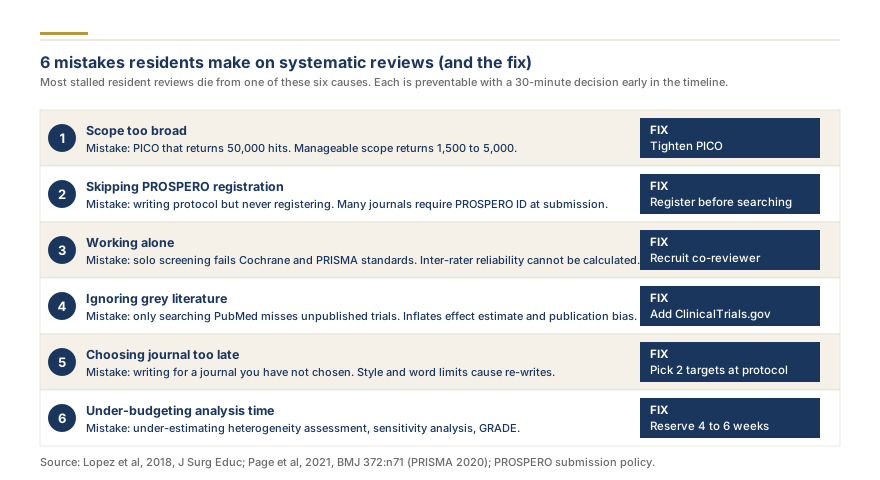
Limit your scope aggressively. Residents who fail to publish almost always chose a topic that was too broad. "The effectiveness of physical therapy after ACL reconstruction" will return 4,000 search results. "The effectiveness of blood flow restriction training on quadriceps strength after ACL reconstruction in adults: a systematic review and meta-analysis" will return 40. The narrower topic is more manageable, more novel, and paradoxically more publishable because it answers a specific clinical question.
Avoid topics with low-quality evidence. If your preliminary search reveals that most studies on your topic are case reports or case series with fewer than 20 participants, you will struggle to produce a meaningful synthesis. Look for topics where at least 8 to 15 randomized controlled trials or well-designed cohort studies exist.
Discuss feasibility with a mentor before starting. A faculty member who has published systematic reviews can assess your topic's viability in 10 minutes. They will spot pitfalls you will not see, suggest scope adjustments, and often agree to serve as a senior author, which adds credibility and accountability to the project.
Shortcuts That Save Time Without Sacrificing Quality
Efficiency matters when you are balancing research with clinical duties that leave you exhausted. These strategies reduce the time investment without compromising methodological rigor.
Use Rayyan's AI-assisted screening. The Rayyan platform includes a machine learning feature that learns from your initial screening decisions and prioritizes records likely to meet your inclusion criteria. Studies have shown this can reduce screening time by 30 to 40 percent compared to purely manual screening (Ouzzani et al., 2016). It does not replace human judgment, but it reorders the queue so you screen the most relevant records first.
Leverage your medical librarian for the search. Do not spend 20 hours learning Boolean operators and database-specific syntax from scratch. A medical librarian will design a more sensitive, more specific search strategy in 2 to 3 hours than you would build in 20. Most are happy to be included as a co-author, and their involvement strengthens your methods section because peer reviewers explicitly look for librarian involvement.
Extract data directly into a structured template. Free-form note-taking during data extraction wastes time and creates inconsistencies. Use a pre-built template that forces you to record the same variables for every study. Our extraction template builder generates one in minutes.
Delegate the PRISMA flow diagram. The PRISMA 2020 flow diagram tool creates a publication-ready diagram from your screening numbers in seconds. Do not spend an hour building one manually in PowerPoint.
Write as you go. Do not wait until all phases are complete to start writing. Draft your methods section during month 2, your results tables during month 4, and your introduction during month 5. By month 6, you are assembling and polishing, not writing from scratch. Read our complete step-by-step systematic review writing guide for the full manuscript structure.
Split the workload with co-residents. Two residents working on the same systematic review can divide the screening and data extraction, cutting the time commitment roughly in half for each person. Dual screening is methodologically required anyway, so this is not a shortcut but a design feature.