How Many Studies Do You Need for a Meta-Analysis? Minimum Requirements Explained
The statistical minimum is 2 studies, but practical recommendations vary. Learn how many studies you need for reliable meta-analysis results, subgroup analyses, and publication bias testing.
Dr. Sarah Mitchell
March 1, 2026
Key Takeaways
The theoretical minimum for meta-analysis is 2 studies, as this is the smallest number that allows statistical pooling, but results from 2-study meta-analyses should be interpreted with extreme caution
Most methodologists recommend a minimum of 5 studies for basic meta-analysis and 10 or more for reliable heterogeneity assessment and publication bias testing
Subgroup analyses require at least 2 studies per subgroup, but 5-10 per subgroup are needed for meaningful between-group comparisons
Funnel plots and Egger's test for publication bias are unreliable with fewer than 10 studies and should not be performed with fewer than 5
A meta-analysis with few high-quality, large studies can be more reliable than one with many small, low-quality studies, so study quality matters as much as count
When you have too few studies for meta-analysis, narrative synthesis with tabulated results is a valid and often more appropriate alternative
You need a minimum of 2 studies to conduct a meta-analysis, as this is the smallest number that allows statistical pooling of effect estimates. However, 2 studies is a theoretical minimum, not a practical recommendation. Most methodologists and the Cochrane Handbook recommend having at least 5 studies for basic meta-analysis and 10 or more studies for reliable assessment of heterogeneity, publication bias, and subgroup differences.
The question of how many studies you need depends on what you want to do with the results. A simple pooled effect estimate can be calculated from 2 studies. But if you want to assess whether the effect varies across populations (subgroup analysis), investigate sources of variation (meta-regression and heterogeneity), test for funnel plot bias detection methods, or have confidence in the stability of your estimate (sensitivity analysis), you need substantially more studies.
The Theoretical Minimum: 2 Studies
A meta-analysis pools effect sizes from individual studies to produce a combined estimate with a narrower confidence interval than any single study. Mathematically, this pooling requires at least 2 data points. With 2 studies, you can calculate a weighted average effect size, a 95% confidence interval, and a basic Q-statistic for heterogeneity.
However, a 2-study meta-analysis has severe limitations:
Heterogeneity is essentially unassessable. The Q-test has extremely low statistical power with 2 studies, and I-squared is unreliable with fewer than 5 studies
The pooled estimate is fragile. If one study has a methodological flaw, it directly drives 50% of the result. There is no stability from additional studies to buffer against individual study weaknesses
No publication bias assessment.learn about funnel plots and statistical tests for asymmetry cannot be used with 2 studies
No subgroup analysis possible. You cannot investigate whether the effect varies by population, setting, or intervention characteristics
Despite these limitations, a 2-study meta-analysis is preferable to no synthesis when only 2 relevant studies exist. The Cochrane Handbook states that meta-analysis of 2 studies "may be valuable if both are large, rigorous, and clinically similar." Present individual study results alongside the pooled estimate and clearly communicate the limitations.
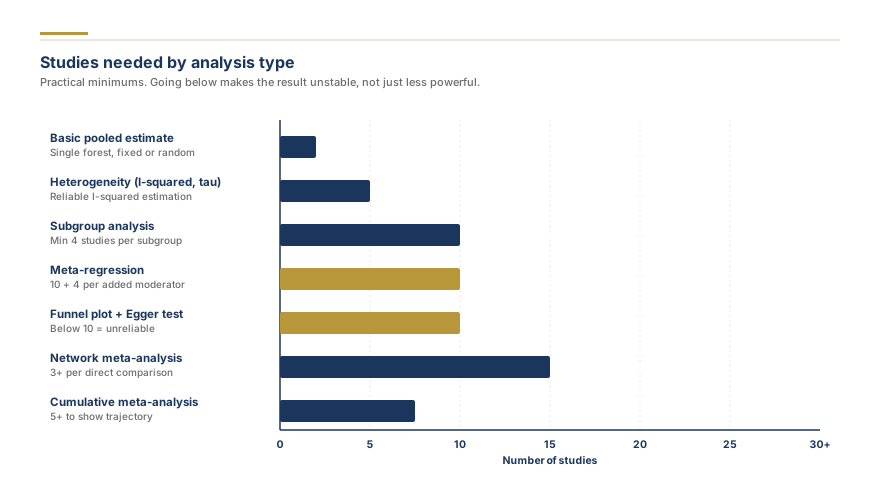
Practical Minimums by Analysis Type
Studies needed by analysis type
Analysis
Minimum Studies
Recommended
Rationale
Basic pooled estimate
2
5+
Stability of the combined effect
I-squared heterogeneity
3
10+
I-squared has low precision with few studies
Q-test for heterogeneity
3
10+
Very low statistical power below 10 studies
Subgroup analysis
2 per subgroup
5-10 per subgroup
Test for subgroup differences needs power
Meta-regression
10
20+
Rule of thumb: 10 studies per covariate
Funnel plot (visual)
5
10+
Patterns uninterpretable below 10
Egger's test (statistical)
10
20+
Very low power below 10 studies
Trim-and-fill
10
15+
Requires sufficient studies for imputation
Sensitivity analysis
3
5+
Leave-one-out needs enough studies to be informative
Need help with your meta-analysis?
Our PhD statisticians run complete meta-analyses: effect sizes, forest plots, heterogeneity testing, and publication-ready results sections.
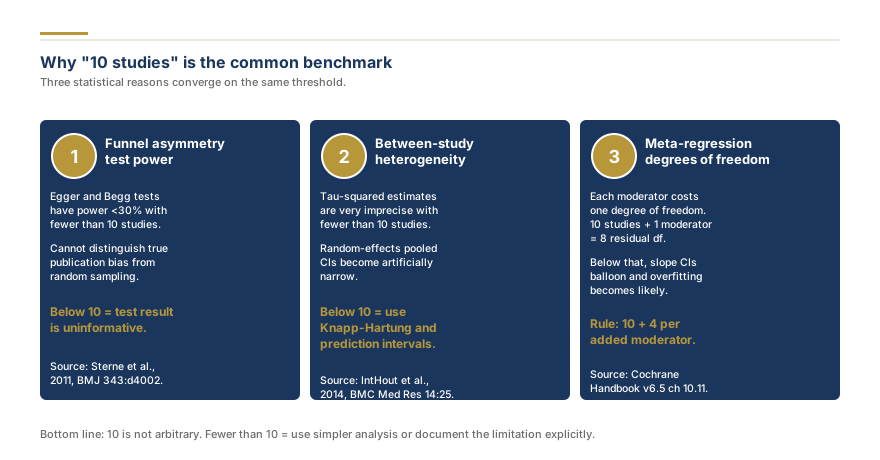
The number 10 appears frequently in meta-analysis methodology guidelines as a minimum threshold for several reasons:
Heterogeneity assessment. The I-squared statistic measures the percentage of variability across studies that is due to true differences rather than chance. With fewer than 10 studies, the confidence interval around I-squared is so wide that the estimate is essentially uninformative. A meta-analysis of 4 studies might report I-squared of 50%, but the 95% confidence interval could range from 0% to 90%, making the value meaningless for decision-making. See our heterogeneity guide for interpretation details.
Publication bias detection.explore funnel plots require at least 10 studies to show visually interpretable patterns of asymmetry. Egger's regression test has very low statistical power below 10 studies, meaning it frequently fails to detect real publication bias when it exists. The Cochrane Handbook recommends against using these methods with fewer than 10 studies.
Model selection. Choosing between random effects and fixed effects models becomes more consequential with fewer studies. Random effects models, which are usually preferred because they account for between-study variation, produce wider confidence intervals that may encompass clinical irrelevance when the number of studies is small. With very few studies, the between-study variance estimate (tau-squared) is imprecise, affecting the validity of the random effects model.
Quality Matters as Much as Quantity
A meta-analysis of 3 large, well-conducted randomized controlled trials can produce more reliable results than a meta-analysis of 15 small, low-quality studies. The number of studies is only one factor in determining the reliability of a meta-analysis.
Study size. Large studies contribute more information per study than small studies
Methodological rigor. Studies with low RoB 2 bias evaluation provide more trustworthy effect estimates
Precision. Studies with narrow confidence intervals contribute more weight to the pooled estimate
Directness. Studies that directly address your PICO question are more relevant than tangentially related studies
The GRADE framework provides a structured approach to rating the certainty of evidence from meta-analyses, considering not just the number of studies but also their quality, consistency, directness, and precision. Use our practical effect size calculator and heterogeneity calculator to analyze your data.
If you have fewer than 5 studies or your included studies are too heterogeneous for meaningful pooling, narrative synthesis is the appropriate alternative. Narrative synthesis is not a lesser form of evidence synthesis; it is the correct methodological choice when meta-analysis would produce misleading results.
Effective narrative synthesis for systematic reviews includes:
Tabulated results. Present individual study effect estimates, confidence intervals, and key characteristics in a structured table
Direction of effects. Describe whether studies consistently show benefit, harm, or no effect
Magnitude comparison. Compare the size of effects across studies
Vote counting with direction. Report how many studies found statistically significant effects in each direction (this is different from simple vote counting, which is discouraged)
Harvest plots. Visual displays that show the direction, magnitude, and quality of evidence across studies
Quality-stratified reporting. Describe findings separately for high-quality and low-quality studies
PRISMA 2020 provides specific guidance for reporting systematic reviews with narrative synthesis. The SWiM (Synthesis Without Meta-analysis) reporting guideline provides additional structure for narrative synthesis reporting.
What the Cochrane Handbook Recommends
The Cochrane Handbook for Systematic Reviews of Interventions addresses the question of minimum studies directly:
Meta-analysis can be performed with as few as 2 studies
Heterogeneity statistics should be interpreted cautiously when the number of studies is small
Publication bias assessment methods should not be used with fewer than 10 studies
The decision to conduct meta-analysis should be based on clinical and methodological similarity of studies, not a minimum number threshold
When in doubt, present individual study results and the pooled result, allowing readers to judge for themselves
The median number of studies in Cochrane meta-analyses is approximately 6, indicating that many published meta-analyses include relatively few studies. This is acceptable when the included studies are methodologically rigorous and clinically homogeneous.
Frequently Asked Questions
5
Technically yes, a meta-analysis can be performed with as few as 2 studies. However, a 2-study meta-analysis provides very limited information: you cannot assess heterogeneity reliably, cannot test for publication bias, and the pooled estimate is essentially a weighted average of just two data points. Most methodologists recommend reporting the individual study results alongside the pooled estimate and interpreting the result with substantial caution.
Funnel plots require a minimum of 10 studies to be visually interpretable, and statistical tests for funnel plot asymmetry like Egger's test have very low power with fewer than 10 studies. With fewer than 10 studies, asymmetry in a funnel plot is essentially uninterpretable, and formal publication bias testing should not be conducted.
Each subgroup should contain at least 2 studies for a pooled estimate, but 5 to 10 studies per subgroup are recommended for meaningful between-group comparisons. With fewer than 5 studies per subgroup, tests for subgroup differences have very low statistical power and findings should be considered exploratory rather than confirmatory.
A meta-analysis with 3 studies can be worthwhile if the studies are methodologically sound, reasonably homogeneous, and address a clinically important question. The pooled estimate provides a more precise answer than any individual study alone. However, heterogeneity assessment will be limited, and you should not attempt publication bias testing. Present individual study results alongside the pooled estimate for transparency.
When you have too few studies for meaningful meta-analysis, conduct a narrative synthesis instead. Present individual study results in a structured table, describe the direction and magnitude of effects across studies, discuss consistency or inconsistency of findings, and provide a qualitative assessment of the overall evidence. Narrative synthesis is a valid approach recognized by PRISMA and Cochrane for situations where meta-analysis is not appropriate.
Share
Found this useful? Share it with your colleagues.
Need help with your meta-analysis?
Our PhD statisticians run complete meta-analyses: effect sizes, forest plots, heterogeneity testing, and publication-ready results sections.
Reading About Meta-Analysis? Our PhD Team Runs Them Every Day.
From data extraction to forest plots, sensitivity analysis, and a journal-ready manuscript. We handle the full meta-analysis so you can focus on your research question.
Our promise: Free re-run of the pooled analysis if reviewers question the estimate or model.
4.9 / 5Quote within a few hoursmetafor R + Cochrane HandbookPhD methodologistConfidential by default
Dr. Sarah Mitchell holds a PhD in Biostatistics from Johns Hopkins Bloomberg School of Public Health and has over 15 years of experience in systematic review methodology and meta-analysis. She has authored or co-authored 40+ peer-reviewed publications in journals including the Journal of Clinical Epidemiology, BMC Medical Research Methodology, and Research Synthesis Methods. A former Cochrane Review Group statistician and current editorial board member of Systematic Reviews, Dr. Mitchell has supervised 200+ evidence synthesis projects across clinical medicine, public health, and social sciences.
Reading About Meta-Analysis? Our PhD Team Runs Them Every Day.
From data extraction to forest plots, sensitivity analysis, and a journal-ready manuscript. We handle the full meta-analysis so you can focus on your research question.
Krippendorff's alpha explained: what it measures, how it differs from Cohen's kappa, acceptable thresholds, and which agreement coefficient fits your coding design.
CHEERS 2022 checklist explained: all 28 items, what changed from CHEERS 2013, and how to report a cost-effectiveness analysis so payers and journals can use it.
SPIRIT 2025 checklist explained: all 34 items by section, what changed from SPIRIT 2013, and how the protocol lines up with CONSORT 2025 when you report the trial.