Learn when to use subgroup analysis vs meta-regression in your meta-analysis. Covers methodology, interpretation, pitfalls, and reporting requirements for both approaches.
Dr. Sarah Mitchell
March 2, 2026
Key Takeaways
Subgroup analysis divides studies into categories based on a study-level characteristic and compares pooled effects between groups, while meta-regression models the relationship between a continuous or categorical covariate and the effect size
Subgroup analyses should be prespecified in the protocol and limited to a small number of clinically meaningful comparisons to avoid false positive findings from multiple testing
Meta-regression requires at least 10 studies per covariate as a rule of thumb and has very low statistical power in most systematic reviews
The test for subgroup differences (interaction test) is more appropriate than comparing whether individual subgroup estimates are statistically significant
Both methods investigate between-study heterogeneity at the study level, not individual participant level, which limits their ability to detect true moderators
Cochrane recommends that subgroup analyses be considered exploratory unless prespecified and supported by biological plausibility
Subgroup analysis and meta-regression are the two primary methods for investigating why effect sizes vary across studies in a meta-analysis. When your I-squared value is high, indicating substantial explore heterogeneity beyond what chance alone would explain, these methods help identify which study-level characteristics are associated with larger or smaller effects. Understanding when and how to use each method is essential for producing informative, transparent meta-analyses that go beyond a single pooled estimate.
Both methods address the same fundamental question: do effect sizes differ depending on specific study characteristics? But they differ in how they model this relationship. Subgroup analysis is simpler, dividing studies into discrete groups and comparing pooled estimates. Meta-regression is more flexible, using weighted regression to model the relationship between covariates and effect sizes. The choice between them depends on the nature of your moderator variables, the number of included studies, and whether your investigation is prespecified or exploratory.
When to Investigate Heterogeneity
Before conducting subgroup analysis or meta-regression, confirm that meaningful heterogeneity exists. The Cochrane Handbook recommends investigating heterogeneity when:
I-squared exceeds 50 percent, suggesting moderate to substantial heterogeneity
The Q-test is statistically significant, indicating that between-study variation exceeds what would be expected by chance
Clinical or methodological diversity among included studies suggests that effect sizes may legitimately differ
The prediction interval around the pooled estimate is wide, indicating that the true effect in a new study could differ substantially from the average
If heterogeneity is low (I-squared below 30%) and studies are clinically similar, subgroup analysis and meta-regression add little value and may produce spurious findings through multiple testing.
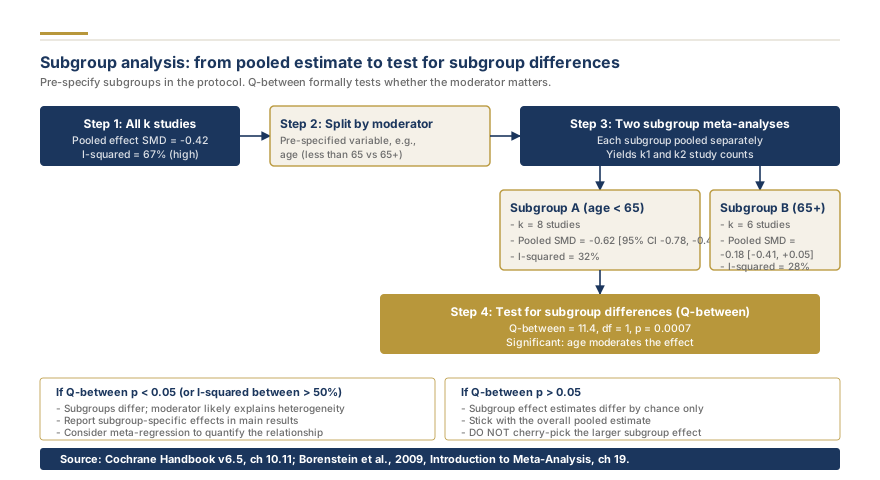
Subgroup analysis divides included studies into groups based on a categorical study-level characteristic and then calculates separate pooled effect estimates for each group. The key output is the test for subgroup differences (also called the interaction test or between-group Q-test), which evaluates whether the pooled estimates differ significantly between groups.
Example: A meta-analysis of exercise interventions for depression includes studies from high-income and low-income countries. Subgroup analysis pools the effect estimate separately for each country group and tests whether the pooled effects are statistically different.
Step-by-Step Process
Prespecify your subgroups in the protocol. Limit to 3-5 subgroups with strong clinical or theoretical rationale
Classify each study into the appropriate subgroup based on the moderator variable
Pool effect sizes within each subgroup using the same meta-analytical model as your main analysis
Conduct the test for subgroup differences to determine whether the between-group variation is statistically significant
Present results with separate explore forest plots or a single forest plot with subgroup sections
Interpret with caution, especially if the analysis was not prespecified
Interpreting the Test for Subgroup Differences
The correct way to evaluate subgroup differences is the interaction test, which directly compares the pooled estimates between groups. A common mistake is comparing whether individual subgroup estimates are statistically significant. This approach is flawed because a significant estimate in one subgroup and a non-significant estimate in another does not mean the effects are different; the confidence intervals may overlap substantially.
Need help with your meta-analysis?
Our PhD statisticians run complete meta-analyses: effect sizes, forest plots, heterogeneity testing, and publication-ready results sections.
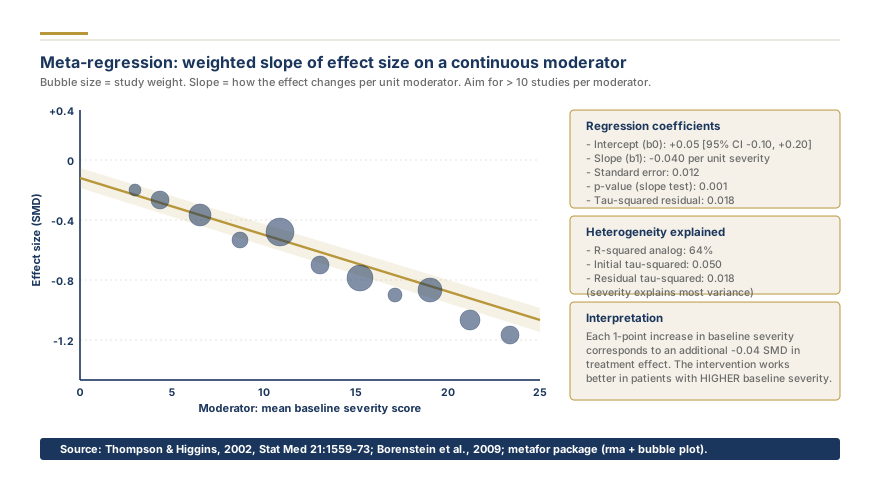
Meta-regression: weighted slope on continuous moderator. Source: Thompson & Higgins, 2002, Stat Med 21:1559-73.
How It Works
Meta-regression uses weighted least squares regression (or restricted maximum likelihood) to model the relationship between one or more study-level covariates and the effect size. Each study is a data point, with the effect size as the dependent variable and the study-level characteristic as the independent variable. Studies are weighted by their precision (inverse variance).
Example: A meta-analysis includes studies with intervention durations ranging from 4 to 52 weeks. Meta-regression models whether longer intervention duration is associated with larger effect sizes, treating duration as a continuous variable.
When Meta-Regression Is Better Than Subgroup Analysis
Continuous moderator variables. Subgroup analysis requires categorizing a continuous variable (e.g., splitting age into "young" and "old"), which loses information. Meta-regression can model the continuous relationship directly
Multiple covariates. Meta-regression can include multiple covariates simultaneously, allowing you to assess the independent association of each while controlling for others (although the number of studies rarely supports more than 2-3 covariates)
Dose-response relationships. Meta-regression can model whether effects increase linearly or non-linearly with dose, duration, or intensity
Minimum Studies Required
The rule of thumb is 10 studies per covariate in the meta-regression model. This means:
With fewer than 10 studies, meta-regression should not be attempted
Even with sufficient studies, meta-regression in systematic reviews has low statistical power because the number of data points (studies) is typically small compared to individual participant data analyses.
Testing many subgroups inflates the probability of finding at least one statistically significant difference by chance alone. If you test 10 subgroups at the 5% significance level, there is approximately a 40% chance of finding at least one "significant" result even when no true differences exist. Prespecify a limited number of subgroups and adjust your interpretation accordingly.
2. Ecological Bias (Ecological Fallacy)
Both subgroup analysis and meta-regression use study-level data, not individual participant data. An association observed at the study level may not reflect the true relationship at the individual level. For example, studies conducted in countries with older populations may show different effects, but this does not mean that older individuals within those studies respond differently.
3. Confounding
Study-level characteristics are often correlated. Studies from high-income countries may also be larger, more recent, and use different intervention protocols. Without controlling for these correlations (which requires meta-regression with multiple covariates and sufficient studies), an apparent subgroup difference may be explained by a confounding study characteristic.
4. Post-Hoc Subgroup Analysis
Subgroup analyses conducted after seeing the data (post-hoc) are inherently exploratory and should be labeled as such. Readers and peer reviewers are appropriately skeptical of post-hoc subgroup findings because they are susceptible to data-dredging and selective reporting.
5. Ignoring Within-Study Variation
Subgroup analysis categorizes entire studies, but many studies include diverse participants. A study categorized as "adults over 65" may include participants aged 65 to 95 with very different responses. Individual participant data meta-analysis is the gold standard for investigating participant-level moderators but requires access to raw data from each study.
When subgroup effects are the main question, individual patient data meta-analysis often outperforms aggregate-data meta-regression, and the IPD guide explains when the extra cost is justified.
Reporting Subgroup Analysis and Meta-Regression
introduction to prisma 2020 requires transparent reporting of all planned and conducted subgroup analyses and meta-regressions:
Prespecification: State which analyses were prespecified in the protocol and which were post-hoc
Rationale: Provide a clinical or theoretical rationale for each subgroup
Methods: Describe the statistical methods used (fixed or random effects, Q-test for interaction, meta-regression model)
Results: Report the test for subgroup differences (Q-statistic, degrees of freedom, p-value) for each comparison
Number per subgroup: Report the number of studies and total participants in each subgroup
Forest plots: Present forest plots showing subgroup results, which can be generated using our try the forest plot generator
Interpretation: Clearly distinguish between prespecified and exploratory findings
Subgroup analysis splits studies into discrete categories (for example, by continent, study design, or intervention dose category) and compares the pooled effect between groups. Meta-regression models the association between a study-level variable (which can be continuous, like mean participant age or intervention duration) and the effect size using weighted regression. Meta-regression is more flexible because it can handle continuous covariates and adjust for multiple covariates simultaneously.
Each subgroup should contain at least 2 studies for a pooled estimate, but 5-10 per subgroup are recommended for meaningful between-group comparisons. The test for subgroup differences has very low statistical power when subgroups contain fewer than 5 studies, so findings should be interpreted as exploratory rather than confirmatory.
The general rule of thumb is 10 studies per covariate included in the meta-regression model. With fewer than 10 studies total, meta-regression should not be attempted. With 10-20 studies, only one covariate should be examined. This rule exists because meta-regression with too few studies produces unstable estimates and inflated false positive rates.
Yes, subgroup analyses should be prespecified in the review protocol registered on PROSPERO. Prespecification prevents data-dredging, where researchers test multiple subgroups and selectively report statistically significant findings. Cochrane recommends that subgroup analyses be prespecified, limited in number, and supported by a biological or theoretical rationale.
No, subgroup analysis in meta-analysis cannot prove causation. It is an observational analysis at the study level that identifies associations between study characteristics and effect sizes. Confounding at the study level (ecological bias) means that an apparent subgroup difference may be caused by other factors that differ between groups of studies, not the subgroup variable itself.
Share
Found this useful? Share it with your colleagues.
Need help with your meta-analysis?
Our PhD statisticians run complete meta-analyses: effect sizes, forest plots, heterogeneity testing, and publication-ready results sections.
Reading About Meta-Analysis? Our PhD Team Runs Them Every Day.
From data extraction to forest plots, sensitivity analysis, and a journal-ready manuscript. We handle the full meta-analysis so you can focus on your research question.
Our promise: Free re-run of the pooled analysis if reviewers question the estimate or model.
4.9 / 5Quote within a few hoursmetafor R + Cochrane HandbookPhD methodologistConfidential by default
Dr. Sarah Mitchell holds a PhD in Biostatistics from Johns Hopkins Bloomberg School of Public Health and has over 15 years of experience in systematic review methodology and meta-analysis. She has authored or co-authored 40+ peer-reviewed publications in journals including the Journal of Clinical Epidemiology, BMC Medical Research Methodology, and Research Synthesis Methods. A former Cochrane Review Group statistician and current editorial board member of Systematic Reviews, Dr. Mitchell has supervised 200+ evidence synthesis projects across clinical medicine, public health, and social sciences.
Reading About Meta-Analysis? Our PhD Team Runs Them Every Day.
From data extraction to forest plots, sensitivity analysis, and a journal-ready manuscript. We handle the full meta-analysis so you can focus on your research question.
Krippendorff's alpha explained: what it measures, how it differs from Cohen's kappa, acceptable thresholds, and which agreement coefficient fits your coding design.
CHEERS 2022 checklist explained: all 28 items, what changed from CHEERS 2013, and how to report a cost-effectiveness analysis so payers and journals can use it.
SPIRIT 2025 checklist explained: all 34 items by section, what changed from SPIRIT 2013, and how the protocol lines up with CONSORT 2025 when you report the trial.