AMSTAR 2 Checklist: How to Assess Systematic Review Quality
AMSTAR 2 is the standard tool for critically appraising systematic reviews. Learn how to apply the 16-item checklist, interpret results, and rate overall confidence in review findings.
Dr. Sarah Mitchell
March 2, 2026
Key Takeaways
AMSTAR 2 contains 16 items evaluating the methodological quality of systematic reviews, with 7 designated as critical domains that can independently lower the overall confidence rating
The overall confidence rating is classified as high, moderate, low, or critically low based on the number and type of weaknesses identified across the 16 items
The 7 critical domains include protocol registration, comprehensive search, justification for excluding studies, risk of bias assessment, appropriate meta-analytical methods, consideration of risk of bias when interpreting results, and publication bias assessment
AMSTAR 2 replaced the original AMSTAR tool in 2017 and is now the standard instrument used in umbrella reviews and methodological overviews
A single critical flaw can reduce the overall confidence rating to low, and multiple critical flaws result in a critically low rating regardless of strengths in other domains
AMSTAR 2 is designed for systematic reviews of randomized and non-randomized interventions studies, not for qualitative or scoping reviews
AMSTAR 2 (A MeaSurement Tool to Assess systematic Reviews, version 2) is the standard critical appraisal instrument for evaluating the methodological quality of systematic reviews. Published in 2017 by Shea and colleagues, AMSTAR 2 contains 16 items organized into critical and non-critical domains that assess whether a systematic review was conducted with sufficient rigor to produce reliable results.
AMSTAR 2 is used in umbrella reviews to assess included systematic reviews, by clinical guideline development groups to evaluate evidence quality, by peer reviewers assessing manuscripts, and by researchers and clinicians who need to determine whether a systematic review's conclusions can be trusted. Understanding how to apply and interpret AMSTAR 2 is essential for anyone who reads, conducts, or commissions systematic reviews.
The 16 AMSTAR 2 Items
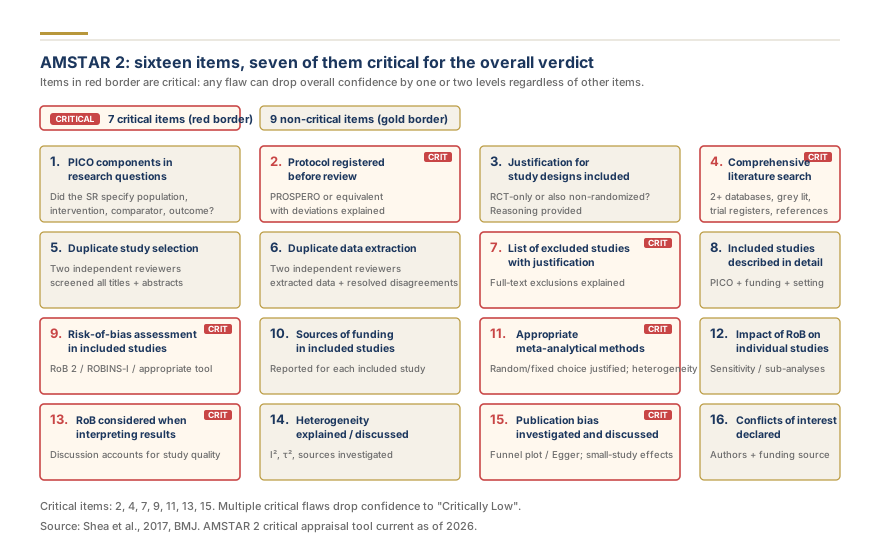
AMSTAR 2: sixteen items, seven of them critical for the overall verdict. Source: Shea et al., 2017, BMJ.
AMSTAR 2 evaluates systematic reviews across 16 methodological domains. Seven are designated as critical domains (marked with an asterisk below) that can independently lower the overall confidence rating.
#
Item
Critical?
1
Did the research questions and inclusion criteria include PICO components?
No
2
Was the review protocol registered before the review began, and were significant deviations reported?*
Yes
3
Did the review authors explain their selection of study designs for inclusion?
No
4
Did the review authors use a comprehensive literature search strategy?*
Yes
5
Was study selection performed in duplicate?
No
6
Was data extraction performed in duplicate?
No
7
Did the review authors provide a list of excluded studies and justify the exclusions?*
Yes
8
Did the review describe the included studies in adequate detail?
No
9
Did the review use a satisfactory technique to assess risk of bias in individual studies?*
Yes
10
Did the review report funding sources for included studies?
No
11
If meta-analysis was performed, did the review use appropriate methods for statistical combination?*
Yes
12
If meta-analysis was performed, did the review assess the potential impact of risk of bias on the results?*
Yes
13
Did the review account for risk of bias when interpreting and discussing results?*
Yes
14
Did the review provide a satisfactory explanation for any heterogeneity observed?
No
15
If quantitative synthesis was performed, did the review carry out adequate investigation of publication bias and discuss its likely impact?*
Yes
16
Did the review authors report any potential sources of conflict of interest, including funding?
No
Need expert quality assessment for your review?
Our methodologists conduct dual-reviewer risk of bias assessments, GRADE certainty ratings, and publication-ready summary tables.
The critical domains represent methodological elements whose absence or inadequacy is most likely to affect the validity of the review's conclusions.
Item 2: Protocol Registration
The review should have a registered protocol (on PROSPERO or equivalent) published before the review began. The protocol should follow PRISMA-P and any deviations from the protocol should be reported and justified. Protocol registration prevents selective reporting and post-hoc methodological changes.
Item 4: Comprehensive Search Strategy
The search should cover at least two relevant databases with a documented Boolean search strategy. The search should include reference list checking, expert consultation, and grey literature searching where appropriate. See our search strategy guide for what constitutes a comprehensive search.
Item 7: List of Excluded Studies With Justifications
The review should provide a list of studies excluded at the full-text screening stage with specific reasons for each exclusion, following the eligibility criteria defined in the protocol. This enables readers to assess whether relevant studies were inappropriately excluded.
Item 12: Impact of Risk of Bias on Meta-Analysis Results
The review should assess whether the risk of bias in included studies affects the meta-analysis results, typically through sensitivity analysis excluding high-risk-of-bias studies.
Item 13: Risk of Bias in Interpretation
The discussion and conclusions should account for the risk of bias findings. Reviews that identify high risk of bias in many included studies but still draw strong conclusions without caveat fail this item.
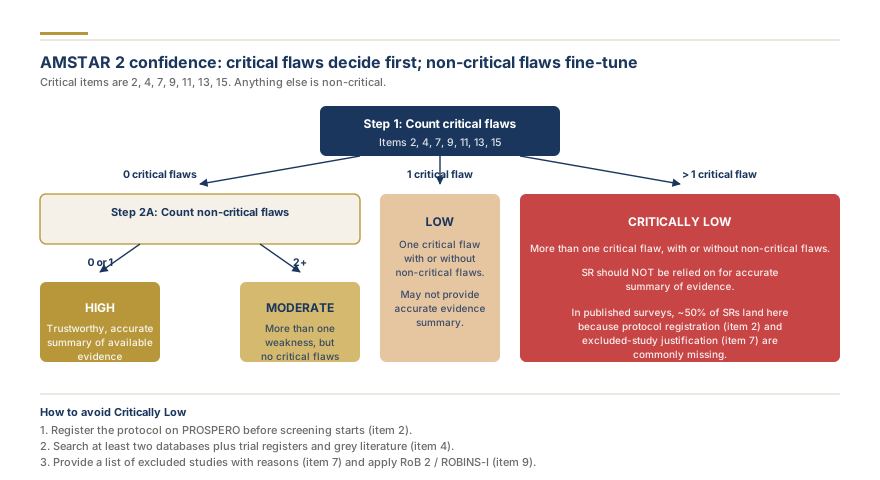
AMSTAR 2 does not produce a numerical score. Instead, the pattern of weaknesses across the 16 items determines an overall confidence rating:
Rating
Criteria
High
No critical flaws and no more than one non-critical weakness
Moderate
No critical flaws but more than one non-critical weakness
Low
One critical flaw with or without non-critical weaknesses
Critically Low
More than one critical flaw with or without non-critical weaknesses
This rating scheme means that a single critical flaw (such as no risk of bias assessment or no comprehensive search) can reduce confidence to "low" regardless of how well other aspects of the review were conducted. This reflects the reality that certain methodological shortcuts fundamentally compromise a review's reliability.
Need rigorous quality assessment for your systematic review or umbrella review? Our methodologists apply AMSTAR 2, RoB 2, ROBINS-I, and GRADE with dual-reviewer calibration and transparent reporting. Get a free quote, or explore our systematic review services.
Applying AMSTAR 2: Practical Tips
Calibrate Before Starting
If multiple assessors are evaluating systematic reviews, calibrate by independently assessing the same 2-3 reviews and comparing results. Discuss disagreements and establish decision rules for ambiguous items. This is the same calibration principle used in screening pilot testing.
Use the Detailed Guidance
Each AMSTAR 2 item includes detailed sub-questions and guidance in the original publication. The item descriptions above are summaries. For accurate application, consult the full item descriptions in Shea et al. (2017, BMJ) or the AMSTAR 2 website.
Document Your Assessments
Record your assessment for each item with a brief justification, not just a yes/no. This transparency allows readers of your umbrella review to evaluate your quality assessments and is expected by peer reviewers.
Present Results in Tables
Create a summary table showing the AMSTAR 2 rating for each item across all assessed reviews. Use color coding (green for yes, red for no, yellow for partial) for visual clarity. Include the overall confidence rating in the final column. Use our risk of bias chart tool for creating visual quality assessment summaries.
Limitations of AMSTAR 2
AMSTAR 2 has known limitations:
Designed for intervention reviews only. It is not appropriate for diagnostic test accuracy reviews, qualitative reviews, scoping reviews, or prognostic reviews
Binary critical flaw impact. A single critical flaw reduces confidence to "low" regardless of the flaw's actual impact on the review's conclusions
Does not assess reporting quality. AMSTAR 2 evaluates conduct, not reporting. A review may be well-conducted but poorly reported, or vice versa
Subjective judgment required. Several items require assessor judgment, which can vary between assessors despite calibration
Despite these limitations, AMSTAR 2 remains the most widely accepted and validated tool for assessing systematic review quality and is the standard used in published umbrella reviews.
Frequently Asked Questions
4
AMSTAR 2 replaced the original AMSTAR tool in 2017. Key differences include the addition of items for non-randomized studies, revised response options that go beyond simple yes/no, the introduction of critical versus non-critical domain classifications, and a structured approach to generating an overall confidence rating. AMSTAR 2 is not a revised scoring tool but rather a critical appraisal instrument that assesses the impact of methodological weaknesses on the reliability of results.
No, AMSTAR 2 was specifically designed for systematic reviews of intervention studies (both randomized and non-randomized). It is not appropriate for scoping reviews, qualitative systematic reviews, or diagnostic test accuracy reviews. For scoping reviews, the JBI critical appraisal checklist or the PRISMA-ScR checklist are more appropriate tools.
AMSTAR 2 does not produce a numerical score. Instead, it generates an overall confidence rating of high, moderate, low, or critically low based on the pattern of weaknesses identified. If no critical flaws and up to one non-critical weakness are found, confidence is rated high. One critical flaw drops the rating to low. Two or more critical flaws result in critically low confidence.
AMSTAR 2 is used by researchers conducting umbrella reviews to assess the quality of included systematic reviews, by guideline development groups to evaluate the reliability of systematic reviews informing clinical recommendations, by peer reviewers assessing submitted systematic review manuscripts, and by clinicians and policymakers evaluating whether a systematic review's findings are trustworthy enough to inform decisions.
Share
Found this useful? Share it with your colleagues.
Need expert quality assessment for your review?
Our methodologists conduct dual-reviewer risk of bias assessments, GRADE certainty ratings, and publication-ready summary tables.
Quality Assessment Takes Expertise. Our Team Does It Daily.
Rigorous risk of bias assessment, GRADE evaluations, and summary tables that satisfy peer reviewers. We handle the methodology so your review stands up to scrutiny.
Our promise: Free rework on synthesis or GRADE assessment if reviewers push back.
4.9 / 5Quote within a few hoursPRISMA 2020 + GRADE certaintyPhD methodologistConfidential by default
Dr. Sarah Mitchell holds a PhD in Biostatistics from Johns Hopkins Bloomberg School of Public Health and has over 15 years of experience in systematic review methodology and meta-analysis. She has authored or co-authored 40+ peer-reviewed publications in journals including the Journal of Clinical Epidemiology, BMC Medical Research Methodology, and Research Synthesis Methods. A former Cochrane Review Group statistician and current editorial board member of Systematic Reviews, Dr. Mitchell has supervised 200+ evidence synthesis projects across clinical medicine, public health, and social sciences.
Quality Assessment Takes Expertise. Our Team Does It Daily.
Rigorous risk of bias assessment, GRADE evaluations, and summary tables that satisfy peer reviewers. We handle the methodology so your review stands up to scrutiny.
CHEERS 2022 checklist explained: all 28 items, what changed from CHEERS 2013, and how to report a cost-effectiveness analysis so payers and journals can use it.
SPIRIT 2025 checklist explained: all 34 items by section, what changed from SPIRIT 2013, and how the protocol lines up with CONSORT 2025 when you report the trial.
ARRIVE 2.0 guidelines explained: the Essential 10 and the Recommended Set, what changed from ARRIVE 2010, and the items journals check in animal research reports.