An umbrella review synthesizes evidence from existing systematic reviews on a topic. Learn the methodology, when to conduct one, JBI guidance, and how it differs from other evidence synthesis types.
Dr. Sarah Mitchell
February 27, 2026
Key Takeaways
An umbrella review exclusively includes systematic reviews and meta-analyses as its unit of analysis, synthesizing the highest level of evidence on a topic
The JBI Manual for Evidence Synthesis Chapter 10 provides the primary methodological guidance for conducting umbrella reviews
AMSTAR 2 is the standard quality assessment tool for evaluating the methodological quality of included systematic reviews
Umbrella reviews are most useful when multiple systematic reviews exist on overlapping questions and a comprehensive overview is needed for clinical guidelines or policy
The Cochrane Handbook Chapter V on Overviews of Reviews provides additional guidance specifically for Cochrane umbrella reviews
Professional teams can complete an umbrella review in 6-10 weeks since the included evidence is already synthesized
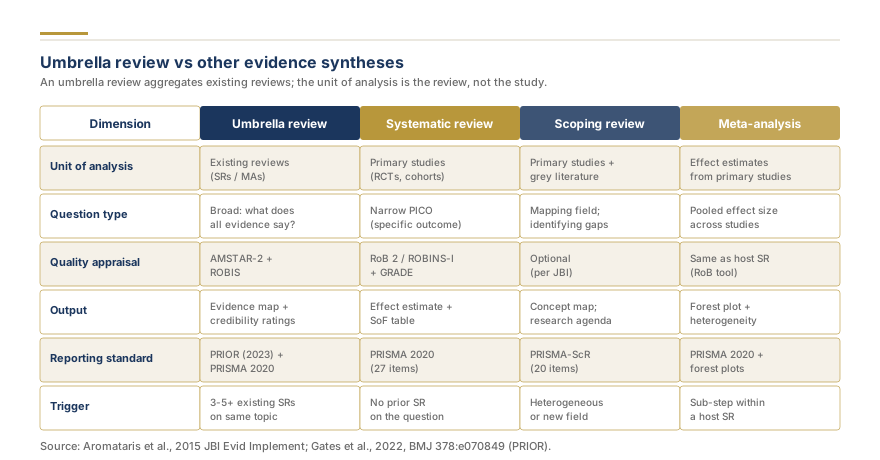
An umbrella review is a form of evidence synthesis that exclusively includes systematic reviews and meta-analyses as its unit of analysis. Instead of synthesizing individual primary studies, an umbrella review synthesizes the findings of existing systematic reviews to provide a comprehensive overview of all available synthesized evidence on a broad topic. This makes it the highest level of evidence synthesis in the research hierarchy.
Umbrella reviews are also called "overviews of reviews," "reviews of reviews," or "meta-reviews." They are particularly valuable when multiple systematic reviews exist on overlapping clinical questions and decision-makers need a single, comprehensive summary that compares findings, assesses quality, and identifies gaps in the evidence base. The Joanna Briggs Institute and the Cochrane Collaboration both provide formal methodology for conducting umbrella reviews.
When to Conduct an Umbrella Review
An umbrella review is appropriate when several conditions are met:
Multiple systematic reviews exist on related aspects of a broad topic. If only one or two systematic reviews exist, an umbrella review adds little value
A comprehensive overview is needed for clinical guideline development, health technology assessment, or policy decisions
Systematic reviews reach different conclusions and a structured comparison of their methods and findings is needed to understand why
The evidence landscape needs mapping to identify which aspects of a topic have been well-synthesized and where gaps remain
Examples of appropriate umbrella review topics:
All systematic reviews of interventions for fall prevention in older adults
All systematic reviews examining the association between screen time and child development outcomes
All systematic reviews of pharmacological treatments for chronic pain
If no systematic reviews exist on your topic, conduct a primary complete systematic review writing guide instead. If you need to compare a systematic review with a narrative review or other non-systematic synthesis, an umbrella review is not the right approach.
Our methodologists handle narrative synthesis, thematic analysis, umbrella reviews, and all forms of evidence synthesis, following established frameworks.
Frame your question broadly enough to encompass multiple systematic reviews. Use the deep dive into pico framework but with wider parameters than a primary systematic review.
Example: "What is the effectiveness of exercise interventions for managing type 2 diabetes, as reported in published systematic reviews and meta-analyses?"
Step 2: Develop a Protocol
Register your protocol on learn about prospero or the JBI Systematic Review Register. Follow the PRISMA-P checklist for protocol reporting. Your protocol should specify:
Search databases that index systematic reviews comprehensively. Essential databases include:
Cochrane Database of Systematic Reviews (CDSR)
MEDLINE (via PubMed, using the systematic review filter)
Embase (with systematic review study type filter)
JBI EBP Database
Epistemonikos (a database specifically designed for evidence synthesis)
Use Boolean search strategies that include methodology terms ("systematic review" OR "meta-analysis" OR "evidence synthesis") combined with your topic terms. Document your complete search strategy for PRISMA compliance.
Step 4: Screen and Select Reviews
Apply your explore eligibility criteria using dual-reviewer screening at the title-abstract and full-text stages. Include only:
Studies self-identified as systematic reviews or meta-analyses
Studies that report a systematic search of at least two databases
Studies with explicit inclusion/exclusion criteria
Exclude narrative reviews, scoping reviews, literature reviews, and evidence summaries that do not meet systematic review criteria. Document all exclusion reasons for your our prisma flow diagram.
Step 5: Assess Quality Using AMSTAR 2
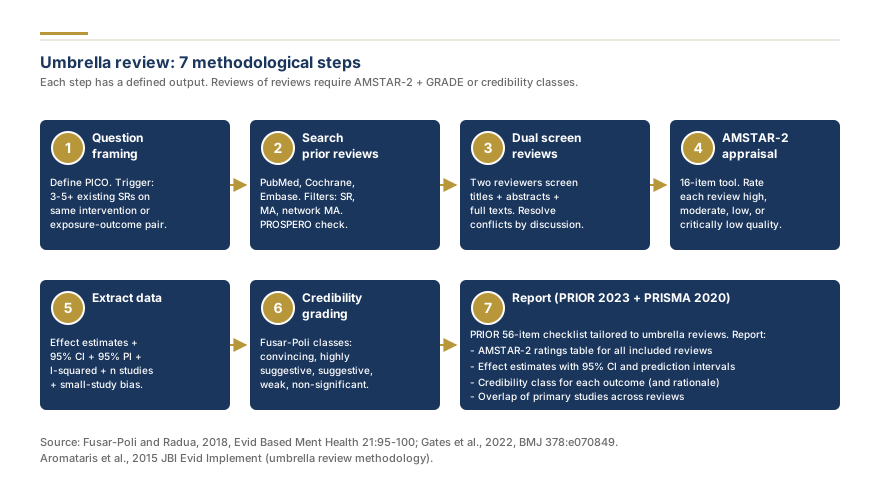
AMSTAR 2 (A MeaSurement Tool to Assess systematic Reviews, version 2) is the standard quality assessment instrument for umbrella reviews. It contains 16 items that evaluate critical methodological domains:
Was the protocol registered before the review began?
Was the literature search comprehensive?
Were inclusion criteria clearly defined?
Was risk of bias assessment performed?
Were appropriate meta-analytical methods used?
Was publication bias assessed?
AMSTAR 2 classifies overall confidence in each included systematic review as high, moderate, low, or critically low based on the number and type of critical and non-critical weaknesses identified. This quality grading helps readers understand the reliability of the evidence underpinning your umbrella review's conclusions.
Step 6: Extract Data
Extract key information from each included systematic review:
Review characteristics: Authors, year, databases searched, date range, number of included primary studies
Organize your synthesis by outcome, intervention, or population subgroup. For each outcome:
Summarize the number and quality of systematic reviews that address it
Compare effect estimates across reviews (do they agree or disagree?)
Assess the overlap of primary studies across reviews (many reviews may include the same studies, inflating the apparent evidence base)
Grade the certainty of evidence using GRADE applied at the umbrella review level
Identify gaps where systematic reviews are needed but do not exist
Overlap assessment is a unique and important step in umbrella reviews. Calculate the corrected covered area (CCA) to quantify how much the primary studies overlap across included reviews. High overlap means the reviews are largely synthesizing the same evidence, while low overlap suggests different reviews have captured different bodies of evidence.
Step 8: Report Using PRISMA
Report your umbrella review following prisma 2020 fundamentals guidelines. Include a flow diagram showing the number of systematic reviews identified, screened, assessed, and included. Present your AMSTAR 2 results in a summary table. Include a matrix showing the overlap of primary studies across included reviews.
When an umbrella review is just one option among several, the evidence synthesis service guide compares all the major synthesis formats so you can match scope to research question.
Common Challenges in Umbrella Reviews
Dealing With Overlapping Primary Studies
Multiple systematic reviews on the same topic frequently include many of the same primary studies. This creates a risk of double-counting evidence. Address this by:
Creating a matrix of primary studies included across reviews
Calculating the CCA (corrected covered area) metric
Presenting findings with awareness that apparent agreement across reviews may reflect shared evidence rather than independent confirmation
Handling Heterogeneous Review Methodologies
Included systematic reviews may use different search strategies, eligibility criteria, quality assessment tools, and synthesis methods. These methodological differences can explain conflicting findings. Explicitly compare the methods of included reviews and use AMSTAR 2 quality ratings to contextualize findings.
When Reviews Reach Different Conclusions
If included systematic reviews reach contradictory conclusions on the same question, your umbrella review should explore why. Common explanations include different explore eligibility criteria, different search dates, different quality assessment approaches, and different statistical methods for meta-analysis tutorial. Presenting these differences transparently is one of the key contributions of an umbrella review.
Umbrella reviews rely on the AMSTAR 2 checklist to appraise the methodological quality of the included systematic reviews; our dedicated AMSTAR 2 guide walks through each of its 16 items.
Frequently Asked Questions
5
A systematic review synthesizes primary studies (individual research studies), while an umbrella review synthesizes systematic reviews themselves. The umbrella review sits one level higher in the evidence hierarchy, providing a comprehensive overview of all synthesized evidence on a broad topic. Umbrella reviews include only systematic reviews and meta-analyses, never primary studies directly.
Conduct an umbrella review when multiple systematic reviews already exist on related aspects of a broad topic, and you need to compare their findings, assess their quality, or provide a comprehensive overview for clinical guidelines or policy decisions. If no or very few systematic reviews exist on your topic, a primary systematic review is more appropriate.
The standard tool for assessing the methodological quality of systematic reviews within an umbrella review is AMSTAR 2 (A MeaSurement Tool to Assess systematic Reviews). AMSTAR 2 has 16 items that evaluate critical methodological domains including protocol registration, search comprehensiveness, risk of bias assessment, and meta-analysis appropriateness.
An umbrella review typically takes 4 to 8 months for academic teams, which is shorter than a primary systematic review because the included evidence is already synthesized. The main time investment is in searching for and screening systematic reviews, applying AMSTAR 2 quality assessment, and synthesizing findings across reviews. Professional teams can complete umbrella reviews in 6 to 10 weeks.
Yes, umbrella reviews can include a re-analysis or summary of meta-analytic results from included systematic reviews. However, umbrella reviews typically do not conduct new meta-analyses of primary study data. Instead, they compare and contrast the pooled effect estimates reported across different systematic reviews on the same or similar questions.
Share
Found this useful? Share it with your colleagues.
Need help with your evidence synthesis?
Our methodologists handle narrative synthesis, thematic analysis, umbrella reviews, and all forms of evidence synthesis, following established frameworks.
Complex Synthesis? Our PhD Team Specializes in Every Type.
Systematic reviews, narrative synthesis, umbrella reviews, and rapid reviews. We match the right methodology to your research question and deliver a publication-ready manuscript.
Our promise: Free rework on synthesis or GRADE assessment if reviewers push back.
4.9 / 5Quote within a few hoursPRISMA 2020 + GRADE certaintyPhD methodologistConfidential by default
Dr. Sarah Mitchell holds a PhD in Biostatistics from Johns Hopkins Bloomberg School of Public Health and has over 15 years of experience in systematic review methodology and meta-analysis. She has authored or co-authored 40+ peer-reviewed publications in journals including the Journal of Clinical Epidemiology, BMC Medical Research Methodology, and Research Synthesis Methods. A former Cochrane Review Group statistician and current editorial board member of Systematic Reviews, Dr. Mitchell has supervised 200+ evidence synthesis projects across clinical medicine, public health, and social sciences.
Complex Synthesis? Our PhD Team Specializes in Every Type.
Systematic reviews, narrative synthesis, umbrella reviews, and rapid reviews. We match the right methodology to your research question and deliver a publication-ready manuscript.
CHEERS 2022 checklist explained: all 28 items, what changed from CHEERS 2013, and how to report a cost-effectiveness analysis so payers and journals can use it.
SPIRIT 2025 checklist explained: all 34 items by section, what changed from SPIRIT 2013, and how the protocol lines up with CONSORT 2025 when you report the trial.
ARRIVE 2.0 guidelines explained: the Essential 10 and the Recommended Set, what changed from ARRIVE 2010, and the items journals check in animal research reports.